- Friday, 22 May 2026

2082: A Year Of Great Political Upheaval
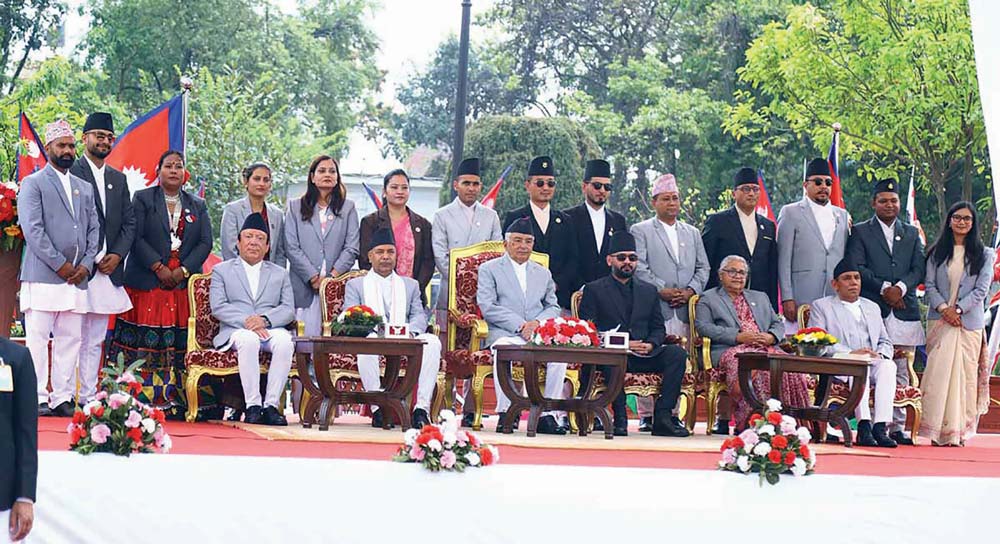
The caretaker government under Sushila Karki successfully conducted the elections to the House of Representatives (HoR) on March 5, 2026. The resounding victory of the Rastriya Swatantra Party (RSP) in the polls pushed the established political parties into a corner.
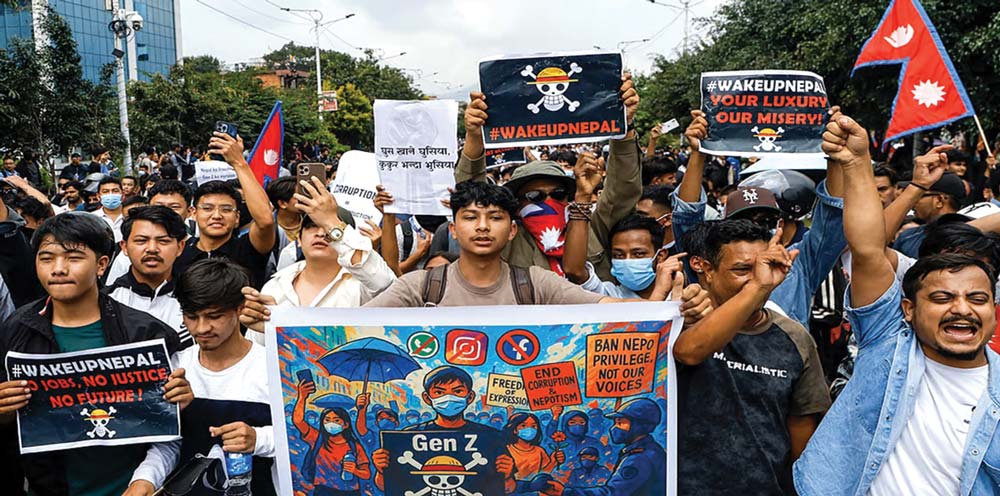
The 2082 B.S. will go down in Nepal's history as the year of sweeping political transformation. The country witnessed a roaring Gen Z uprising that overthrew the KP Sharma Oli-led coalition government of Nepali Congress and CPN-UML. Scores of youths were killed in police suppression, while public and private property worth billions of rupees was destroyed. The caretaker government under Sushila Kakri successfully conducted the elections to the House of Representatives (HoR) on March 5, 2026. The resounding victory of the Rastriya Swatantra Party (RSP) in the polls pushed the established political parties into a corner.
The most remarkable event is the rise of Balendra Shah in Nepali politics. Shah, a rapper-turned politician, mopped the floor with Oli in the latter's constituency in Jhapa in the historic elections. Shah, who now leads a government with a near two-thirds majority, has taken drastic steps in the direction of establishing good governance, ensuring justice to the Gen Z movement's victims and achieving rapid economic growth.
The article chronicles important political, economic, and diplomatic developments in detail.
On April 16, the government formed a task force comprising three senior secretaries to formulate a detailed roadmap for the implementation of the recommendations submitted by the High-Level Economic Reform Advisory Commission led by former Finance Secretary Rameshwore Khanal.
On April 19, former Prime Minister and CPN-UML Chairman KP Sharma Oli, former Nepali Congress President Sher Bahadur Deuba, and CPN (Maoist Centre) Chairman Pushpa Kamal Dahal ‘Prachanda’ held a meeting at the PM’s office in Baluwatar to create an environment for safeguarding the existing political system and the constitution of the federal democratic republic.
On April 21, inaugurating the 11th National Convention of the Nepal Progressive Professors’ Association in Kirtipur, Oli urged the agitating teachers to return to classrooms and engage in dialogue without any delay. On the same day, former Education, Science and Technology minister Bidhya Bhattarai resigned from her post, differing with the government on how to resolve the demands of demonstrating teachers.
The community school teachers were protesting in Kathmandu, demanding that the government promulgate the School Education Act soon. On April 29, the Lower House approved two key bills: the Bill to Amend and Integrate Customs-Related Law 2081 and the Bill to Amend Some Nepal Acts 2081.
On April 30, the Nepal Teachers’ Federation suspended the month-long street protest of the school teachers by inking a nine-point agreement with the government. On the same day, Kham Bahadur Garbuja was appointed as the Minister of State for Energy, Water Resources and Irrigation.
On May 2, President Ramchandra Paudel presented the government’s policies and programmes for the fiscal year (2025/26).
Both Houses of the Federal Parliament endorsed the government’s policy document for the fiscal year 2025/26 by a majority on May 11.
On May 16, the government organised Sagarmatha Sambad for the first time, kicking off with 350 participants from home and abroad and calling for global climate action. The Sambad concluded on May 18, issuing a 25-point Sagarmatha call for action. The government appointed Dr. Bishwo Nath (Bishwo) Poudel as the new governor of Nepal Rastra Bank. The Supreme Court, on May 23, rejected releasing Rastriya Swatantra Party (RSP) President Rabi Lamichhane from custody.
On Jestha 15 (May 30), the country marked Republic Day with fanfare. On the other hand, former Deputy Prime Minister and Minister for Finance Bishnu Prasad Paudel unveiled the budget of Rs. 1964.11 billion for the upcoming fiscal year 2025/26.
PM Oli, on June 1, virtually laid the foundation stone for 64 roads under the ‘One Constituency, One Road' project of the Madhes Provincial Government in Janakpur.
On June 2, Oli, Deuba, and Prachanda failed to end the House deadlock through talks. The Prachanda-led party and the RSP had been demanding the former home minister's resignation over the visit visa scandal. The Commission for the Investigation of Abuse of Authority (CIAA) filed a corruption charge sheet against former Prime Minister Madhav Kumar Nepal, Patanjali Yogpeeth, and Ayurveda Company Nepal, among others, on June 5.
On June 24, the Lower House approved the Appropriation Bill for the fiscal year 2025/26, along with key financial proposals. The government formed a high-level committee to study the visit visa scandal.
On June 30, the Lower House passed the Federal Civil Service Bill, 2080, fifteen months after its registration in the House.
At least nine people died and 19 others were missing as a massive flash flood hit Rasuwagadhi in Rasuwa district. The disaster caused severe damages to the Nepal-China border dry port and hydropower plants. The government formulated National Population Policy-2082 with an aim to balance fertility with population growth and integrate population concerns into all economic development aspects.
On July 23, the federal government declared Madhes Province a disaster-hit zone when prolonged drought in the region during monsoon depleted drinking water resources. Oli attended and addressed the inaugural session of the 3rd United Nations Conference on Landlocked Developing Countries in Awaza, Turkmenistan, on August 5.
On August 21, lawmakers in the Lower House strongly condemned the recent development between India and China to resume bilateral trade through the Lipulekh Pass, a territory claimed by Nepal. On August 22, the Lower House tabled the School Education Bill and Land Bill. On August 25, the government gave a seven-day ultimatum to the owners or operators of social media for registration and enlistment at the Information Ministry.
The delegation from the government visited China to participate in the 25th Summit of the Shanghai Cooperation Organisation Summit 2025 on August 29. They raised the issue of Lipulek during the bilateral meeting with Chinese President Xi Jinping in Beijing on August 30. On September 1, Oli addressed the Sanghai Cooperation Organisation Plus Meeting in Tianjin, China, calling for global cooperation and a reimagined multilateral order amid growing global crises.
The three-day statute convention of CPN-UML kicked off on September 5 and removed the 70-year age limit for leadership, allowing UML chairman Oli to run for a third term as party chairman.
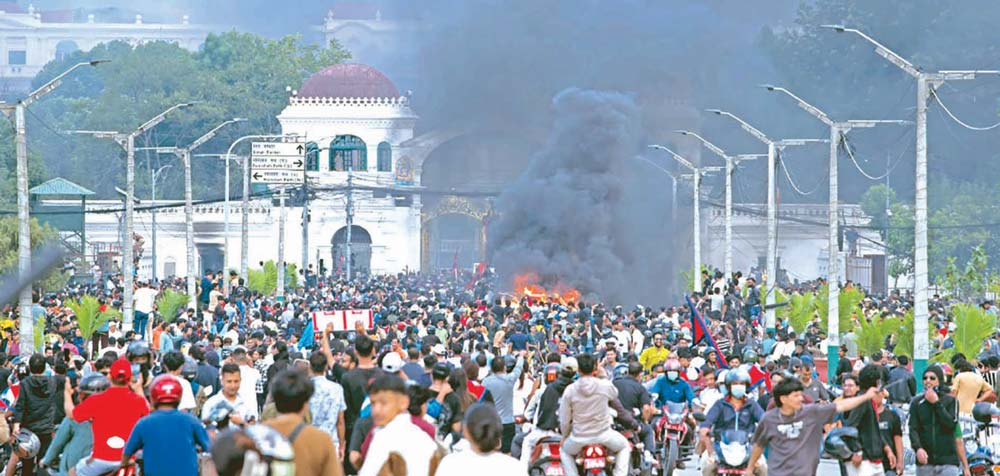
The youth-led protests, organised under the banner of GenZ Nepal, turned tragic, and 19 youths died and over 453 were injured in Kathmandu and Itahari on September 8. The next day, the government lifted the restriction on social media platforms which had been imposing restrictions since September 4.
On September 9, the entire nation descended into flames and turmoil as Gen-Z protests left state infrastructure in shambles, forcing Prime Minister Oli to resign amid urgent appeals from President Ramchandra Paudel and the Nepal Army.
The former Chief Justice Sushila Karki was appointed as the first woman interim prime minister of Nepal. She was chosen from a poll conducted on discord by the Gen-Z protesters because of her reputation as an impartial person with no involvement in corruption. Newly elected Prime Minister Sushila Karki took the oath of office and secrecy on September 12. President Paudel dissolved the Lower House as per the very first decision of the meeting held solely by newly appointed PM Karki. She was given the mandate to hold the election in the Lower House, slated for March 5.
Three new ministers, Om Prakash Aryal, Rameshwore Khanal and Kul Man Ghising, took the oath a day after PM Karki resumed her office on September 14. On September 17, the government observed a day of national mourning to honour those who lost their lives during the Gen-Z protests.
The country marked Constitution Day on September 19. Addressing a function organised at Sheetal Niwas on the occasion of Constitution Day, President Paudel stated that the new government was formed on the basis of consensus, as there was no way to constitute a Council of Ministers following the Gen-Z movement.
Four new ministers, Anil Kumar Sinha, Mahabir Pun, Dr. Madan Pariyar, and Jagdish Kharel, took the oath of office and secrecy at the President’s Office, Sheetal Niwas, on September 22. On September 24, President Paudel issued an ordinance amending the Voter Registration Act, 2073, paving the way for new voter enrolment ahead of the March 5 elections. The Election Commission announced the schedule for the March 5 elections on October 6. As per the schedule, the political parties intending to contest the elections had officially registered at the EC between November 17 and 26.
Torrential rainfall triggered floods and landslides across the country; heavy rains claimed around 50 lives in the first week of October. On October 9, the government declared Ilam a disaster emergency district for three months.
President Paudel urged political parties to focus their attention on the elections, addressing an all-party meeting attended by PM Karki and top party leaders at Sheetal Niwas on October 11. On October 17, Karki held discussions with foreign diplomats based in Kathmandu to brief them on the progress of election preparations, following the Election Commission's discussions with political parties.
President Paudel attended and addressed the 2nd World Summit for Social Development in Doha, Qatar, on November 4. On November 5, Prachanda led the formation of the Nepali Communist Party by merging 10 left parties. On November 16, the Home Ministry approved the Integrated Election Security Plan to ensure that the March 5 elections are held in a free, fair, and democratic manner.
On November 22, Nepali Congress decided to participate in the HoR polls scheduled for March 5. According to the EC, the nationwide voter registration campaign held from September 25 to November 21 added 837,094 new voters to the electoral roll. On November 27, President Paudel granted approval for the deployment of the Nepali Army targeting March 5 polls. The EC informed on November 29 that a total of 108 political parties officially registered with the election body to participate in the lower house elections.
The NC’s second special general convention, held in Kathmandu on January 11, elected a new central working committee under the leadership of Gagan Thapa. The EC recognised the Thapa-led NC leadership, while the Deuba-led NC faction filed a writ against the EC ruling.
Well over three thousand candidates filed nominations for the 165 first-past-the-post (FPTP) seats on January 20. After the nominations, the NC, the UML, and the RSP announced Gagan Thapa, KP Sharma Oli, and Balendra Shah as their PM candidates.
The NC and the UML emerged victorious in the National Assembly elections held on January 25, with the NC securing nine seats, the UML eight and the Loktantrik Samajbadi Party-Nepal one seat.
The historic election of the House of Representatives (HoR) members concluded peacefully across the country on March 5. The election has delivered a dramatic political upheaval, with the four-year-old Rastriya Swatantra Party securing almost a two-thirds majority.
Former Mayor of Kathmandu Metropolitan City, Balendra Shah, was chosen as the parliamentary party leader of the RSP after defeating former PM Oli in Jhapa-5. On March 27, President Paudel, in accordance with Article 76 (1) of the Nepal Constitution, appointed member of the House of Representatives, Balendra Shah, as the prime minister of Nepal. On the same day, Prime Minister Shah and his 15-member Cabinet were administered the oath of office and secrecy amid a ceremony at the President’s office in Sheetal Niwas.
Regardless of the number of ups and downs, it is clear that the nation is now headed towards stability, with increasing optimism about development in all sectors and a promise of imminent changes.
(The author is a journalist at The Rising Nepal.)