- Monday, 25 May 2026

Education System Demands Radical Reforms

Under previous governments, putting an end to student politics in schools, colleges, and universities seemed nearly impossible. Likewise, abolishing exams until the fifth grade or renaming institutions with foreign-sounding names was unthinkable. But all of this has changed under the leadership of Prime Minister Balen Shah’s new Nepal. The country now has a young prime minister — 35-year-old Balen Shah, a man of his word. Shortly after taking office, his government introduced a hundred-point reform agenda that has captured the attention of parents and students alike.
It is important to understand why student politics and student unions have been banned from Nepal’s educational institutions, why exams have been eliminated up to the fifth grade, and why the government has prohibited schools from using foreign names. Point 86 of the government’s 100-point agenda clearly states that all student political parties and groups must remove their offices and structures from schools and university campuses within seven days.
Political battlegrounds
Why was this step necessary? The reality is that many educational institutions had turned into political battlegrounds, where education was neglected and politics thrived. Student leaders often served as pawns for political parties, receiving donations and wielding immense power from behind the scenes. As a result, they engaged in hooliganism, intimidated professors, and frequently shut down universities through strikes.
Prime Minister Balen Shah’s logic is straightforward: educational institutions should be centers of learning—and not only students but also teachers must stay away from politics. Civil servants, too, are banned from joining any political party or trade union. However, this does not mean that student voices will be silenced. The government has announced that within 90 days, a non-political student council must be formed. Campus elections will be held, but without party flags or money. Students will vote purely on student-related issues, not political ones.
Another revolutionary decision in the 100-point agenda is the immediate elimination of all internal examinations up to the fifth standard. This move is designed to ease the overwhelming burden of homework on young children. The traditional education system forced children to cram, regurgitate information in exam halls, and earn marks based on rote memory. This approach has been ingrained in society for years, placing immense psychological pressure on children, leading to negativity and even personality disorders. Many young children develop a fear of going to school simply because they dread failing.
Looking at the world’s best education systems—such as Finland’s—there are no exams for young children. Nepal’s government now plans to introduce an alternative assessment system on similar lines. Teachers will assess children based on daily activities, behaviour, creativity, and learning skills. No longer will a child be judged by a one- or two-hour written exam once a year. This is a commendable step toward returning childhood to children.
Across South Asia—including India, Pakistan, Nepal, and Bangladesh—educational institutions suffer from chronic delays: late academic sessions, delayed results, and exams stretching for months. As a result, hundreds of thousands of young people, especially from poor families, become frustrated and go abroad for education.
Nepal’s new government has now mandated that universities must declare results on time according to the academic calendar. Another long-standing issue was that degrees were withheld without citizenship certificates, preventing young people from enrolling in higher education. The government has changed this rule: no bureaucratic document will hinder a child from pursuing higher education in the country.
It has become fashionable across Nepal to name schools after foreign institutions—Oxford School, Cambridge School, Lincoln School, The British College, and so on. These English names are found on nearly every lane and alley. Undoubtedly, such names reflect a form of mental slavery. Many people assume that if a school has an English name, the education must be superior. The new government has issued a strict directive: any educational institution with a foreign name must change it to a native Nepali name by the end of this year, based on Nepali identity.
National identity
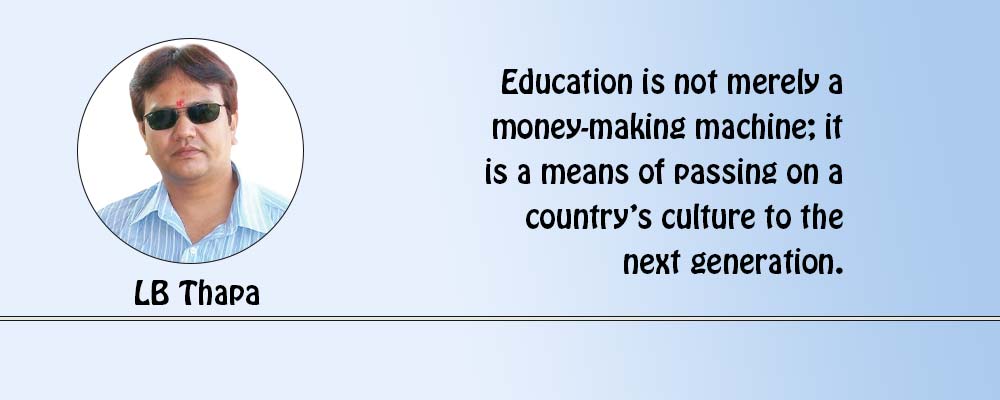
There are two main reasons behind this decision. First, the government wants to connect the new generation with national identity. Education is not merely a money-making machine; it is a means of passing on a country’s culture to the next generation. Second, the move aims to stop fraud. Many private schools charge exorbitant fees and exploit parents by overcharging for books and supplies. A great deal of exploitation takes place in the name of education. The obsession with English names, the government argues, reflects a desire for quick wealth.
The Balen government’s 100-point agenda is not just a manifesto—it is a blueprint for transforming the nation’s mindset. The government seeks to shake the old, rotten system by introducing a job-oriented education system. However, let us not forget that creating new policies and laws is one thing, but implementing them properly is entirely another.
(Thapa is a Pokhara-based writer and a regular contributor to The Rising Nepal. writerlbthapa@gmail.com.)
-original-thumb.jpg)