- Monday, 25 May 2026

Depoliticising Education And Bureaucracy

Prime Minister Balendra Shah’s April 20 directives to the university vice chancellors to debar political party-affiliated student unions from university premises and the recent decision of the Ministry of Federal Affairs and General Administration to disallow trade unions within the bureaucracy have been contested in the public sphere. Opposition parties CPN-UML, Nepali Congress and Maoist Centre (who have their respective unions functioning as sister organisations in education and civil service sectors) have termed these decisions as the manifestation of the authoritarian streak of the government. The government claims it is meant to clean up academia and bureaucracy. To get the big picture, one has to take a peek at the historicity of such unions.
After the restoration of democracy in 1990, nearly every sector of public life was politicised. There was a neat divide between communist and Congress supporters from top down to the grassroots. At the grassroots, those with Congress would be persecuted, alienated, and even boycotted by UML supporters and vice versa. In academia and bureaucracy, politically affiliated unions embodied this division. Up to this level, maybe it was fine. In a democracy, people have the right to pursue, advance and advocate for the political ideology of their choice.
Political activism
The problem started when political activism, or lack thereof, began to be used as a tool, a criterion, and even a weapon regarding who would run these institutions and how. If bureaucrat A, for example, was a member of a trade union affiliated to one party, even if he was an officer with proven competence, he would not be considered for promotion or reward if another party was at the helm. Or a situation would be created whereby he would either capitulate or seek transfer. Or bureaucrat A’s trade union would not cooperate with the government to implement even the best possible policies. In colleges and universities, appointment, promotion and rewards of a teacher depended more on his/her political affiliation than academic records and merits. In this scheme, the best minds could be sidelined while the mediocre could be elevated to the pedestal.
Party affiliated student unions, which were known for the contributions they made during the democratic movements in the past, lost their appeal after the union members started to extract financial gains through foul means. Their involvement in padlocking colleges and universities, disrupting learning, and in some cases even resorting to acts of riots, arson, vandalism and manhandling of professors earned them the moniker of goons. They made it difficult for teachers and professors of different political faiths to work in colleges and universities with student/teacher unions from opposing political parties.
This had two glaring malfeasant consequences in academia and bureaucracy. Political loyalty became a key criterion for becoming relevant in these two vital sectors. One could misuse one’s political affiliation and membership with a political organisation to shirk responsibility, and the political organisation, on its part, took advantage of this affiliation and membership to advance its partisan interests.
Together, this created a strong impression that unions and their members are a bunch of bad guys whose job is to create trouble instead of contributing to the smooth functioning of academia and civil service. The ignominy of partisan unions was so glaring that political leaders like Gagan Thapa started to call for disallowing students, teachers and professors the membership of Nepali Congress.
One reliable way to assess how exactly partisan politics impacts public institutions would be through credible empirical surveys and studies. Apparently, there are no such studies in Nepal, but a 2014 research paper entitled “How Do Teachers’ Unions Influence Education Policy? What We Know and What We Need to Learn” by Joshua Cowen and Katherine O Strunk on teachers’ unions in the United States may be instructive. This study shows unions often serve as rent seekers while contributing little or far less than commensurate to rent seeking in ensuring learning outcomes of the students.
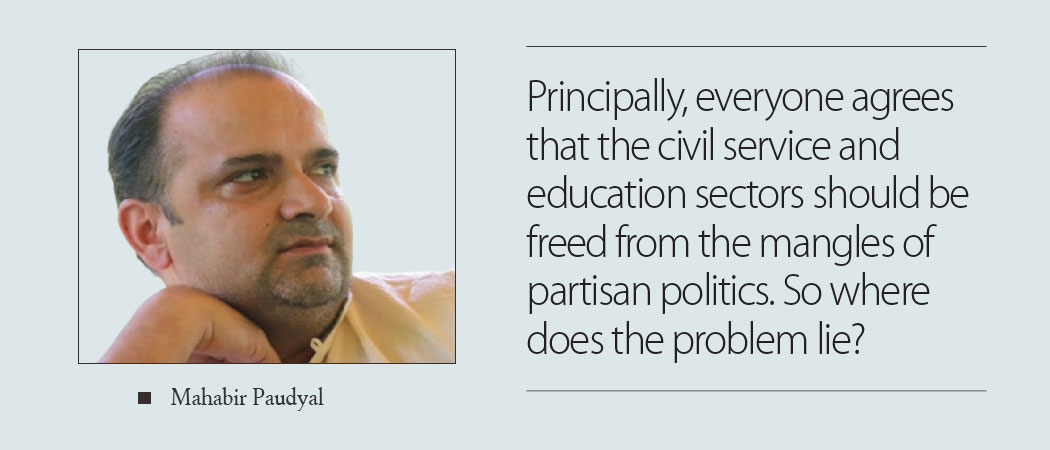
Principally, everyone agrees that public institutions should be freed from the mangles of partisan politics. Partisan politics in public educational institutions is one among many reasons that has pushed many students to pursue their higher studies abroad or in expensive private institutions in the country.
Lack of clarity
The problem appears to lie in a lack of clarity. What does the government’s bid to free education and bureaucracy from partisan politics entail? Is this about not allowing teachers and public servants to organise politically? Does it mean that the members of academia and bureaucracy are not allowed to keep their free political thoughts and exercise their political rights or they are debarred only from political activism? Or does it mean that student unions are free to function in their own way but they have to conduct themselves outside of campus and university premises? Does it mean that university students can no longer become the members of political parties? What will be the structure and mandate of the proposed ‘student council’ that is supposed to replace the ‘student union’? How will the members be selected in that council? Will there be a similar structure for the civil servants, too?
One statement by the concerned government ministry or the ruling party in this regard may help make things clear. No sane person will disagree that academia and bureaucracy should be kept away from the ills of partisan politics and they should become the places of learning and a vehicle of public service. A measure focused on removing partisan interference in academia and civil service will have wider legitimacy. The same measure, if intended to be used as a tool to suppress political rights and stifle dissent, can have unintended ramifications.
(The author is a Kathmandu-based educator and journalist.)