- Wednesday, 8 April 2026

Democracy In ‘Danger Zone’
Democracy should not be made a living lie. Under the stench of past misdeeds committed to blatant expediency, some countries have lost much of its moral fibre as far as its assertions on defining, interpreting and evaluating democracy for the entire world is concerned. Opportunism should not define any political narrative on democratic canvas. What is happening in various sectors is nothing new for someone who has been hammering frequently since more than a decade that the sands of global power centres of the dominant kind are shifting from the West to the East after five centuries.
Will the new shift invite disaster? If you can’t do something quick to deliver relief to the poverty-stricken millions of mouths across the world, you are no good-doer but self-centred entity with narrow agenda and parochial considerations. Hence, the task is one of attaining success measured in terms of what is contributed to the cause of humanity and environment. The “lesser” ones among nations should not be left deprived of their voice as against the lords of power, whose decisions the former are expected to comply with without question. For the times and the mood in the streets have changed.
Early signs
A recent survey, published by the Alliance of Democracies Foundation (based in Denmark) and the Latana (based in Germany), indicated that 49 per cent of Americans do not consider the United States to be a democracy. They consider public debates as nothing but an exercise in monopolising agendas by the elite. In contrast — and to the surprise of many in the West — the survey showed that 83 per cent of Chinese believe they live in a democracy. The survey universe can be gauged from the fact that nearly 53,000 respondents from 53 countries were involved.
It is not that an average individual has lost faith in democracy. The emphasis is on more democracy by way of functioning democracy. Nearly a third of the respondents felt they did not have free speech and only 31 per cent think elections in their country are fair. And 42 per cent do not believe the right to freedom exists in practice. To their credit, surveys in industrial democracies largely echo their common views. In the recent years, concerns are expressed over the issue of governance under one political system or the other.
In deference to various factors involved in the choice of a political system, national constitutions and systemic institutions vary in their functioning. Free and fair periodic elections, transparency in governance and accountability, together with the delivery of basic services, including guarantee of employment, are what keep a sound political system going.
Inequality in income and wealth is the most pressing issue that breeds injustice and discontent. Personal pocket affects everyone. It might take time for the chronic victims of inequality to organise themselves and express their dissatisfaction vigorously. Once the top blows off, the volcano thus erupted will have long-term spillover effects whose course and direction are uncertain.
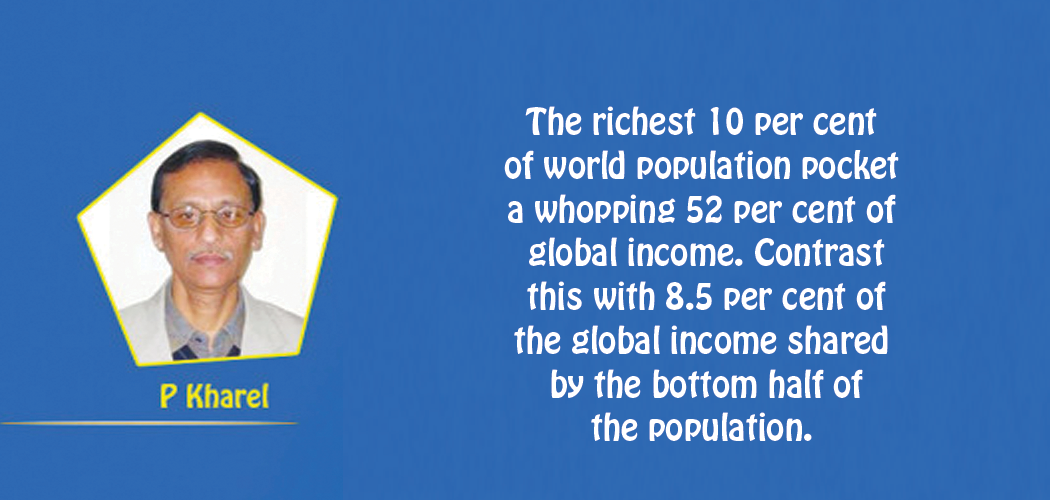
The richest 10 per cent of world population pocket a whopping 52 per cent of global income. Contrast this with 8.5 per cent of the global income shared by the bottom half of the population. Critics attribute such disparity in income between a minuscule few and a large majority as a breeding ground for trouble. The vast gap in inequality in the poorest countries is exacerbated by rampant corruption, cemented by political patronage. Misuse of high offices is transparently wide and deep to the extent of paying no more than lip service to good governance.
When the majority of a population is condemned to the victimhood of a few owning disproportionate volume of wealth, while most or majority earn drastically little, deep-seated resentment occurs, more often than not. At such juncture, other elements, bent on profiting from the resultant atmosphere and distrust, play mischief by inciting the disgruntled groups to take to the streets or even go for militancy.
Intra-country inequality draws focus also on inter-nation inequality. The richer states would want to ensure their economic prosperity to be consolidated and ever expanding, which means foreign trade and industrialisation. Hence the open thrust on free open market. Those who originated and forcefully floated this have gained at dazzling speed. Earlier, western colonists ruled most parts of the world basically for the supply of raw materials to their rapidly expanding industrial base followed by a ready market for their manufactured goods. Slave trade became a cruelly lucrative venture for those without qualms or humanitarian considerations, notwithstanding the lofty lines quoted from their thinkers.
Persistent gap
Not many, who tried emulating them out of persuasion, pressure or compulsion, have succeeded in making significant jumps in the economic rungs of the rich. They have sections complaining of the rich getting richer and the poor nowhere close to striding at a faster pace anytime in the foreseeable future. If no effective measures are adopted in alleviating the living standards of the billions of people across the world barely eking out a living under challenging conditions, the comments and prescriptions made by those with better off positions will sound hollow — their rhetoric rendered empty. They will be seen as no good-doer but a selfish lot with narrow agenda and parochial considerations — hidden or otherwise.
The situation will worsen if there were to be hardly any space for the less fortunate to air their views clearly and amply. Widely admired especially in the west, the economist Milton Friedman described profit making as the essence of democracy, which reduces any government or group that pushes for anti-market measures to being condemned as antidemocratic.
A halfway house between unfettered capitalism and maximum state control of all aspects of the economy, socialism is a term that hardly ever gets discussed in much of the core capitalist West, for instance. Social justice might just be a tolerable term but not so socialism. For that matter, some European countries are not as apprehensive of the term as Americans generally are.
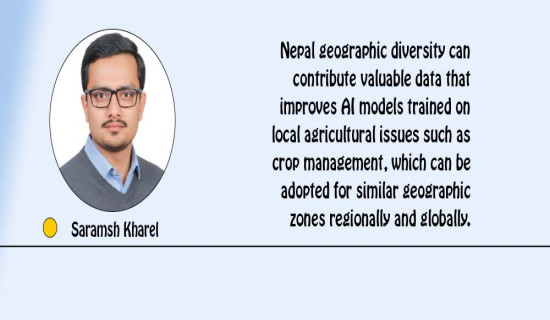
(Professor Kharel specialises in political communication.)
-original-thumb.jpg)