- Tuesday, 2 June 2026

Nepal Can Contribute To AI Growth
Using a basic feature phone, a Nepali-speaking farmer can consult a chatbot for advice on soil, seeds, and irrigation in his preferred language. In hospitals, doctors use AI tools to detect diseases faster. Meanwhile, a young engineer from a rural area trains language models to protect, document, and revive endangered local cultures. These cases are no longer science fiction. With the approval of the National AI Policy 2082, Nepal has taken a crucial step toward embracing AI for development. The potential is clear, but risks remain: a mistranslation can cause real harm. For AI to succeed, its answers must rest on verified sources.
However, the real impact lies not in downloads, but in whether Nepal can deliver safe and inclusive growth that benefits everyone. Nepal can offer solutions to agricultural productivity, disaster resilience, and access to health care. For the global AI ecosystem, Nepal brings unique talent, diverse data, and real-world problems, which make AI more inclusive. So, the relationship should be mutual: What AI means for Nepal and what Nepal means for AI forms an interdependent relationship that shapes the structural transformation of Nepal.
Policy
The National AI policy aims to promote AI for agricultural production forecasting, smart irrigation and e-markets. More than 60 per cent of people still rely upon agriculture. For instance, PlantSat Nepal helps farmers manage crops more effectively by using satellite data and is working on digitising crop and livestock insurance. The use of drones and satellites can forecast yields, optimise irrigation needs, and monitor progress. Reliable and quality healthcare is limited in rural Nepal. AI can facilitate telemedicine, early disease detection and forecast outbreaks like tuberculosis and malaria. For instance, NAAMI, a non-profit organisation, focuses on exploring ways to leverage AI to address significant challenges faced in remote regions.
In a disaster-prone region, AI can improve early warning systems for monsoons, landslides, floods, among other calamities by analysing weather patterns and satellite data. This can save lives and reduce potential economic losses. AI learning platforms can assist students in remote areas through learning activities. Such AI-driven offline tutors and customised learning platforms boost educational inclusivity. Likewise, universities are integrating AI robotics and data science into their curricula, and private institutions provide AI fellowships to prepare students for global markets as well.
AI helps to automate public services across various tiers of government. Integrating AI into existing e-governance platforms like Nagarik App will improve access. Another laudable example is that Lalitpur Metropolitan City has successfully deployed an AI-based intelligent traffic light system in the city to manage traffic efficiently. The AI policy aims to increase IT sector’s contribution to GDP by an additional 1 per cent and train AI professionals. For instance, F1Soft International has revolutionised digital payments, enabling people to shift towards online transactions. Such growth can directly impact global outsourcing, attracting foreign investment and promoting exports.
People tend to trust institutions more than algorithms. For widespread adoption, AI must carry the credibility of trusted institutions with credible sources. Nepal ranks 150th out of 193 nations in the Government AI Readiness Index, reflecting gaps in regulation, infrastructure, and digital literacy. The prevailing digital divide is worrying. Rural Nepal still suffers from poor internet, electricity, and low digital literacy, risking that AI benefits only urban and educated people while widening the inequality.
Skills shortage and brain drain further complicate the issue, as a talented population often seeks better opportunities abroad. Likewise, advanced systems demand a reliable energy source and infrastructure, which is still limited. Finally, regulatory and ethical risks, including data privacy, potential job displacement, and misuse, require careful governance. Even though the AI Regulation Council has been established, its implementation will be crucial. Nepal’s approach to AI should be focused on leveraging technology for socio-economic development, digital inclusion, and efficient public service delivery, as supported by the National AI Policy. So, Nepal is not only a consumer of AI technologies; it also offers valuable assets for the global economy.
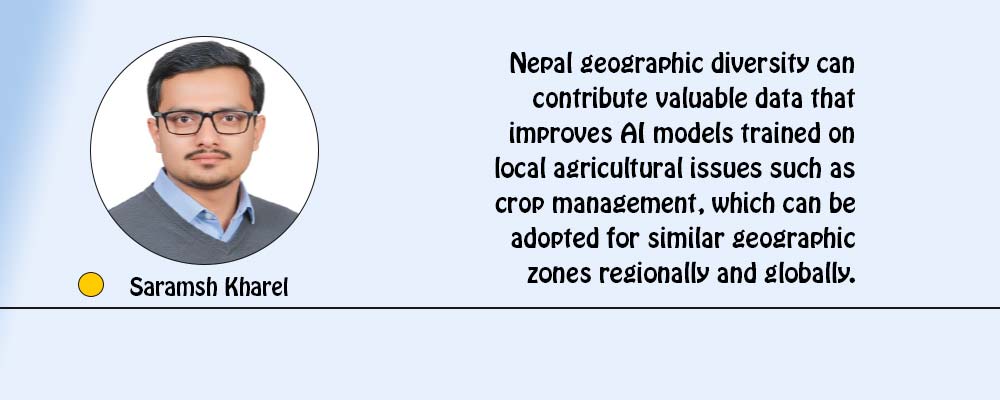
Nepali professionals are already contributing to global AI projects abroad. With initiatives like the Fusemachine fellowship and growing university courses, Nepal can definitely become one of the cost-effective and high-quality talent hubs. Nepal possesses vast hydropower potential. As AI data centres require huge energy and raise environmental concerns, Nepal can position itself as a green solution for the South Asian region. By investing in AI excellence centres, Nepal can move towards creator of global AI solutions. Nepal geographic diversity can contribute valuable data that improves AI models trained on local agricultural issues such as crop management, which can be adopted for similar geographic zones regionally and globally.
AI literacy
Effective implementation mechanisms should be adopted for the National AI Policy, with clear action plans, adequate resources, and monitoring. Priority should be given to AI literacy through targeted programmes focused on rural youth, women, and marginalised communities for skills development. Also crucial is building public-private partnerships to develop infrastructure and pilot projects in key sectors such as agriculture, health, and disaster resilience. Finally, focus on ethical AI governance must be ensured from the ground-level implementation.
Nepal could be one of the emerging markets for the world’s leading AI firms. The government should invite companies, academics, and innovators to test their systems in Nepal on a national scale. If done right, the adoption will not only improve public service but also enrich the science of AI through feedback from millions of users. The hardest place to make AI work is also the place where it matters the most.
(The author is an assistant manager at the Rastriya Banijya Bank.)


-square-thumb.jpg)