- Tuesday, 26 May 2026

Retain Youths To Foster Growth

If we hope for big but end up with small, we are bitterly frustrated. If we want more but have less, we are dissatisfied. That is exactly what is happening in our country. We have been unhappy since we began to see nothing in small, and we have been disillusioned since we ceased to be content with what we have. This restless state of mind is one of the chief reasons for our youths’ escape to foreign countries, not only in search of a job but also for permanent settlement. No one can deny that the villages of Nepal are being deserted.
Among other challenges for the newly elected government, one is how to retain youth in the country, if not to bring back those who have already left, with enthusiasm, to stay in the homeland and work for nation-building. It would be a big achievement, despite it looking small, if that really happened. Someone might think migration is a natural phenomenon in the age of globalisation, but it becomes a problem when the psyche of general citizenship is in that direction. If the drained brain comes back home, it will be a big gain, and we will have more, not less.
Ideology of patriotism
There may not be ready remedies for turning our restless psyche to a stable state of mind. Still, we may suggest some solutions to make the youths think for the nation, work for the nation, and build it for the true happiness of the general public. These remedies may be categorised into three groups: political, economic, and cultural. Under the political category, the biggest challenge is instilling the ideology of patriotism in the minds of youth. Many, though, may not believe in the truth that a citizen with a patriotic sentiment is ready to struggle in the homeland, even if they intensely suffer from the hardships of life. One might retort that no one chooses hardship, leaving aside comfort. Why else are people roaming around the world in pursuit of happiness?
What Thomas Jefferson (1776) meant in the Declaration of American Independence was not encouraging people to flee to other countries, but to stay and struggle in the homeland to bring happiness, which was curtailed by the then British monarchy. There can be no denying that Nepali youths are opting for foreign countries, not because they have nothing at home, but more because they want more, which they have not been able to gain. The obvious remedy is to create a conducive environment for patriotic sentiment. The slogan of nationality that is often proclaimed seems to be only a platitude without an illocutionary force to persuade the youth to work hard in the country amid numerous difficulties. Youths need to understand that even a small achievement is big, and even if we get less, it is already valued more.
But patriotism alone does not suffice. No one can choose a hollow sentiment, even at the cost of a moderate degree of physical comfort. No one chooses candlelight while there is a possibility of electric light, and no one is happy to ride a horse-drawn carriage in the midst of advanced automobiles. If someone does, they are called no more than "stupid" persons. One of several ordeals for the newly formed government is thus to create a conducive financial environment to sustain youth at home. Many times, erstwhile governments promised to increase the size of the economy, with a higher GDP and significantly higher per capita income, but they have recurrently failed to achieve their goals.
The new government must seriously ponder over what exactly could have caused this failure, or whether it was only an insignificant partial success. Is it because of the domestic constraint or because of the foreign intervention for their gain? Simply blaming the predecessors does not work. The government must show genuine cause and valid reasoning to support its point. It must convince the general public that even small things can have far-reaching positive impacts, yielding more rather than less. Only then can it find an unfailing remedy to rectify the apparently incorrigible situation.
Financial adequacy is not sufficient either. Our success depends on how responsibly we work while in decision-making positions. In many cases, we feel that the responsible persons appointed to important positions are not working in the public interest. Making decisions in personal interest of financial gain, nepotism, and favouritism are some examples of cultural degeneration. When we work in personal interest from responsible positions, we are culturally degenerate. For a few decades, we have been witnessing such irresponsible trends. We have cultivated the habit of double standards, denouncing others even if they have done right, while eulogising ourselves, even when we have done wrong.
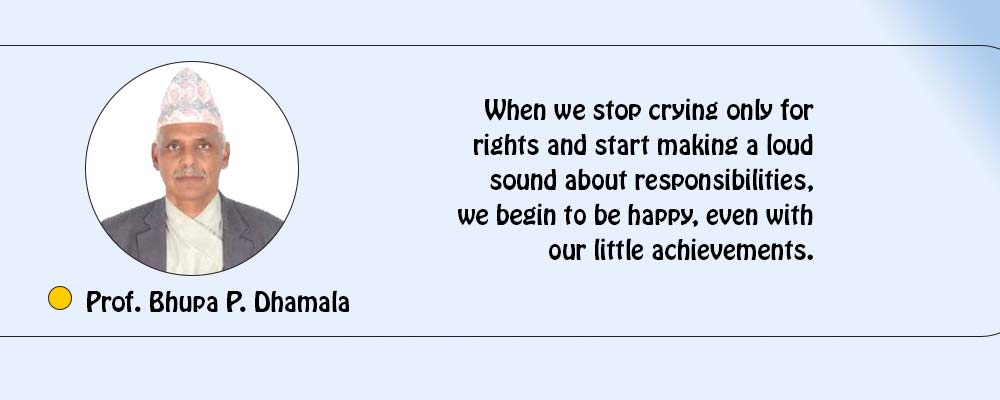
To establish something as right when done by a group and as wrong when done by another group in a similar context is a double standard. If we are ideologically loaded, we tend to tilt toward our ideological standpoint, forgetting our responsibility to be fair and impartial. We have also been demanding our rights while ignoring our sense of responsibility. It is essential to understand that rights and responsibilities are two sides of a coin and must go hand in hand. This can be called a culture of responsibility. When we stop crying only for rights and start making a loud sound about responsibilities, we begin to be happy, even with our little achievements.
Restlessness of minds
Most of our dissatisfaction has arisen from the restlessness of our minds rather than from the absence of physical comfort. Therefore, our problem is more psychological than physical. If we always think negatively and our attitudes and behaviours are consistent with that negativity, we can never be happy, even if we are physically prosperous. Physical prosperity and mental happiness may not be on the same index. Without being complacent, citizens of a nation cannot be happy themselves or work for the great task of nation-building, either.
If we are truly patriotic, if we do not pursue making more money for luxury rather than moderate comfort, and if we are responsible in our actions, then we can say we are headed in the right direction. All these conditions are crucial to a country's overall development and significant for our happiness, even when we find small rather than big, and get less rather than more.
(The author is the chairman of Molung Foundation. bhupadhamala@gmail.com)