- Saturday, 11 April 2026

After Frantic Flight, Familiar Face
Now that the turmoil kicked up by massive protest rallies against a failed administration in Sri Lanka is slowly settling down, the next course of action for addressing the most pressing issues of the island nation’s population of 22 million will be the focus of South Asian neighbours in particular and the rest of the international community in general.
The country’s parliament on Wednesday elected Prime Minister/Acting President Ranil Wickremesinghe as the crisis-hit country’s eighth president, tasked with steering the economy that has been in a shambles this year. Wickremesinghe has become the new executive head of state for the next two years on account of the Gotabaya Rajapaksa having fled to a foreign sanctuary resigned to leave the post vacant.
Several of the Rajapaksa family members held senior government posts and stood accused of widespread embezzlement of the state coffers and economic mismanagement that left the country without the vital foreign currency to import food, fuel and medicines, and pushed inflation to record levels. Amid a tension-filled atmosphere, the president fled the country and quit the presidency via an email sent from Singapore to authorities in Colombo.
The Rajapaksa family has had dazzling political ups and humiliating downs. In 2019, it returned to power in a grand style. Barely three years later, several of its members panted desperately for escaping the same voters who had so enthusiastically embraced and endorsed them to the seats of power earlier. The 2019 polls were fairly democratic, as the Rajapaksas were in the opposition.
Few friends
Like massive flashfloods, enraged people rallied in the streets and stormed into the presidential residence while Gotabaya fled the building in the nick of time. The country’s three major communities — Sinhala, Tamil and Muslims — came together to make common cause against the rulers. They torched Rajapaksa’s ancestral home and six-time Prime Minister Ranil Wickremesinghe’s private residence.
Rajapaksa, 73, his wife and two security guards had fled the country in the early hours of July 13 aboard a military aircraft to the Maldives before heading for Singapore. His escape move saw frantic efforts that proved unsuccessful for a day and a half. Embittered passengers and airport staff prevented turned back the embattled president at Colombo, as he was not allowed to utilise the VIP terminal.
Gotabaya Rajapaksa, who lived in the US, gave up his dual US citizenship in order to run for president. He made frantic attempts to escape to destinations for three days. The government of India refused to oblige his request for allowing a Sri Lankan military aircraft carrying him to land at an Indian airport, while the US embassy refused to issue him a visitor visa. Neither India nor the US wanted to be embroiled in controversies and face the wrath of irate crowds that could target the visa issuing sources for long-term enmity.
The president’s younger brother Basil Rajapaksa, 71, had resigned as finance minister in April and also quit his parliamentary seat in June in the wake of acute financial crisis, food and fuel shortages, and rapid hikes in the prices of essential commodities. Initially, the US passport holder was stopped from flying out of the country. Later on, he managed to leave for the US.
Meteoric rise in electoral politics is no guarantee when the very voters who install leaders in power might turn against the rulers who mismanage things and cause hardships to the general public. The Rajapaksa story in Sri Lanka is a stirring case in point. Electoral victory has been proactively defined as the task of delivering good governance and the pledges politicians make during poll campaigns.
After Gotabaya’s clandestine departure, a Sri Lankan official announced, Prime Minister Ranil Wickremesinghe was appointed acting president. Even as protesters breached the prime minister’s offices and took over the state-owned television broadcaster, Roopvahini, Wickremesinghe declared a state of emergency to give orders to the police and the military “to do what was necessary” for maintaining law and order.
Protesters were infuriated by the announcement that the six-time premier was appointed acting president. They accused of complicity with the Rajapaksa family. After taking over as acting president, Wickremesinge described the protesters occupying his office as “fascists” who wanted to “tear up the constitution”, and ordered the army to step in to do “whatever is necessary” for restoring order.
Recent events in Sri Lanka focused on an aspect of people power in action — spontaneous, massive and furiously determined, in a lesson to the corrupt and incompetent leaders who refuse to hear and see — not to speak of actually feel — the litany of problems faced by the common people struggling to eke out a living.
Daunting task
According to the UN, the island nation suffers a humanitarian crisis under the grip of its worst ever economic crisis, leaving millions struggling to buy food, medicine, fuel and other essentials. Anarchy stares at the island nation. Chaos, confusion and uncertainty envelope the state.
Last fortnight’s popular upsurge transcended political, ethnic and religious affiliations. Now, the mood is one of triumph and excited expectations: Deliver or face dangerously difficult decisions from people who flood the streets with protest rallies — by no means any easy task. Interestingly, Wickremesinghe is his party’s sole member in parliament. He will be obliged to the Rajapaksa’s party to survive.
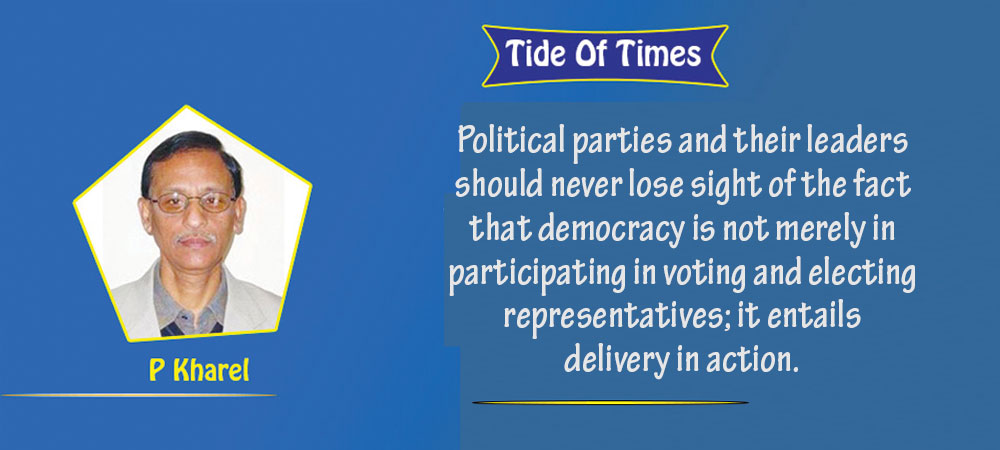
The Rajapaksa road to scintillating success and speedy flight to exile offers a valuable lesson. Political parties and their leaders should never lose sight of the fact that democracy is not merely in participating in voting and electing representatives; it entails delivery in action what political leaders routinely promise, more so during poll campaigns. Of great note of experience is that is hungry people get angry, and desperate people go on the rampage.
(Professor Kharel specialises in political communication.)