- Monday, 25 May 2026

Educational Psychology Optimises Learning
Educational psychology is a field of psychology that focuses on the study of learning and how psychological theories and techniques can be used to enhance learning among individuals, especially in the field of education. It presents its effectiveness in terms of theories of learning and methods of practical application to better understand and optimise the process of education. In the West, the field has been integrated into the school systems and has proved to be beneficial in student development and efficiency of teaching. Presently, most of the Nepali education system revolves around rote learning and repetition of course content. This has manifested itself in terms of end-of-the-term/year written exams that involve writing answers over multiple pages.
While there is a provision for practical examinations in almost all of the currently available courses in Nepal, in practice, those practical examinations have not been able to suffice for the need for practical education of students. In light of this, alternatives such as assigning large amounts of credit to practical examinations for subjects, like computer science or social work, that constitute more practical applications should be explored. Furthermore, putting more weight on internships or adding for-credit/non-credit courses as part of the degree can also be looked into.
Interpersonal skills
Alternatives such as this can allow students to be better prepared for the job market, as they would help them acquire essential interpersonal skills that are required to navigate complex workplace environments along with profession-related hard skills. From the perspective of educational psychology, constructivism provides an explanation of how the integration of practical methods of education and assessment can elevate a student's educational experience. Constructivism theory of learning posits that individuals learn based on the holistic experiences that they have regarding their life and society up to the present moment.
Essentially, individuals build atop their pre-existing knowledge and ideas and change and weave in new information accordingly. As learning is an active and ever-evolving process, exposing students to practical environments helps them to understand real-world experiences based on their theoretical knowledge. Likewise, the theory places importance on individuality, and as such, it becomes apparent that every student experiences the subject matter and their practical activities uniquely. However, a change in assessment systems should not mean making it easier for students to pass their exams but should be focused on addressing the core difficulties that students face during their education.
Assessment should be targeted at examining the key concept of any subject and should be designed in such a way that the assessment functions both as a method of testing the student’s capabilities and also as a method of providing constructive feedback to the student regarding the areas that they lack in. It is also essential to explore dynamic methods of assessment such as examining students based on their individual level of understanding. Here theories of educational psychology can offer a better perspective into how such change can be achieved.
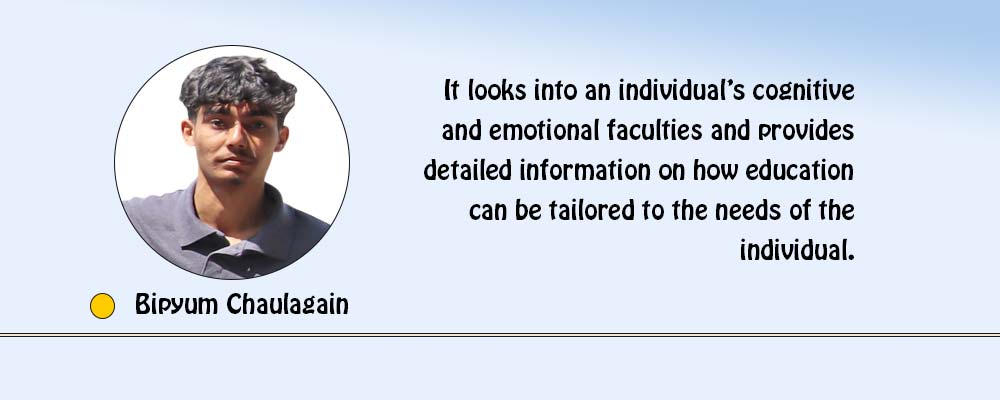
Another instructional model, discovery learning, places importance on the act of teachers creating an environment in which students can take part in learning of their own accord. In essence, adopting a research-based approach to setting an education system requires the development of research-based methods that prioritise students' well-being instead of traditional teaching methods and curricula. Educational assessments are another of such tools of educational psychology that help to identify the strengths and weaknesses of students related to learning. Specifically, it looks into an individual’s cognitive and emotional faculties and provides detailed information on how education can be tailored to the needs of the individual.
Learning disorders
Educational assessments can also identify a range of learning disorders, including ADHD, alongside executive functioning, memory, reasoning abilities, and mood disorders. Employing assessment on a large scale can help to identify groups of students with similar difficulties in learning. Then, group intervention methods can be used at scale if necessary, and learning strategies can be optimised across classrooms to match the styles of each group of students. If needed, individuals can also be recommended for therapeutic interventions, but the main focus can be on education-based intervention, as it remains the core focus of such assessments. Education-based interventions include motivational interviewing, behavioural and emotional coaching, resilience, and identity work, among others.
Similarly, the practice of conducting such assessments will create more employment opportunities for educational psychologists in the country and also improve the quality of education that institutions impart. An effort can be made by the government itself to mandate the presence of a psychologist in institutions that impart education to students up to the secondary level. It will also increase collaboration among teachers, guardians, and the institution so that all the concerned parties can work together for the well-being of the student.
(Chaulagain is a psychology student at St. Xavier's College, Maitighar.)







-original-thumb.jpg)