- Thursday, 11 June 2026

Rule-Based System Key To Democratic Polity
The democratic game is largely played under a system of rules set by the constitution. It promotes law-based freedom, not lawlessness. Such a rule deters both the tyranny of the minority and the domination of political processes by the majority. Nepal’s shift from a duty-based tradition to a rights-based political culture has elevated the rule of law over customs, social codes, and norms. Still, certain tacit texts of society, social norms, and moral sanctions play a role in controlling the deviant and capricious behaviour of people and leaders who drift into unknown territory. Rule-based order is the coordination of the conduct of all Nepalis, mutual trust, cooperation and social peace.
As a responsive rule, democracy protects and promotes individual rights and makes the rule consistent with shared welfare, the constitution and international duties. In no way does the rise of democracy amount to the decay of the positive functions of the Nepali state to control anarchic human nature and deliver public goods. The rule of law supposes due process, equality of law and autonomous administration of justice. These elements are central to the creation of an equal stake of people in the Nepali polity. Nepal’s tradition, culture and aspiration of people matter in evolving a political culture affirming democratic principles and practices, even if people’s empirical life is less equal, which only a virtuous state can ameliorate.
Reformist temptation
The reformist temptation of the current government is the right historical step to stop nihilists’ profane illumination of the strands of the nation's history and renewing its soul, where the writ of democracy exists and flourishes. The constitution does not matter if the rules of the political game fail to muster political consensus and parties are free to perform multipolar dances regardless of the public purpose of democratic rules. There is a causal relationship between the scale of human development indicators in the nation and democracy in achieving democratic stability.
The difficulty of building Nepal’s future springs from the divided mentality of leaders on the basis of parties’ lens, projection of conflicting aspirations and worries and putting democracy under tension by holding up the resolutions of multi-faceted crises clutching all aspects of national life. Mono-causal narration cannot grasp many of the nation's compound problems. Political will baked by interdisciplinary intelligence is vital to apply corrective measures to solve them one by one, from corruption, crime, human rights abuse, transitional justice, migration, public goods, to the management of geopolitics.
The historical amnesia of native knowledge and experience and lack of strong political will had tied many old leaders of established parties to perpetual clientalisation to regime change without taking the worthy initiatives they had promised. The new leaders under Prime Minister Balendra Shah have to restore the rule of law and alleviate the fear of opposition as to whether they can keep the democratic dynamic against counter-revolution. Nepali youths across party lines have articulated for responsive leaders and acquired a great electoral mandate for change and progress.
The receding of old parties showed a loss of partisan attachments and voters’ shifting modes of behavior to new parties, especially to the Rastriya Prajatantra Party in an almost surreal way. Does this new shift foster the value-orientation of people and leaders, which is essential to promote civic culture in the nation? Or remain within the constitutional constraints and fail to unveil the opportunities it has promised in the parliamentary election? Crafting civic culture in the nation is definitely a Herculean task. It is a phase of responsibilities for those who won stunning mandates and those who partially bloomed. It is a reflective phase for those who are lost and downsised.
Democratic rule promises a win-win and therefore offers parties and people many channels of political engagement, provides scope for opposition to articulate alternative policies, review failed strategies of economic management and spur common ground to plot the nation forward. Nepali leaders since 1991 shifted the mode of rule from a territorially bounded democracy to a de-territorialised governance, pluralised the state power and further weakened it by sharing the state power with political parties, business, civil society, NGOs and international regimes and with a horizontal series of non-state social movements to trigger anti-authority struggles.
The growing dominance of political parties, bureaucracy and the capital has provoked multiple resistances, setting a context for a high-intensity conflict boom. Nepali leaders should learn that the procedural rule of majority has been historically proven deceptive to adapt to the changing aspirations of people ignited by the spirit of the age and transformation of democracy from bourgeois and electoral pothole to a participatory one driven by information revolution, youth bulge and ecological imperatives. The digital platforms have politicised the everyday life of Nepalis and stirred political activism. It has thrilled society and turned it into an extrovert. Too many stirs, however, risk the drain of social capital accumulated by culture, spiritualism and affinity to native land.
New legitimacy to rule requires a scaffold of justice across generations, genders and classes and sound performance of the polity. Unfulfilled promises radicalise the population and subvert democratic processes beyond the writ of the Nepali state. Non-performance amounts to non-transformation of democracy to an egalitarian direction visualised by the Nepali constitution. Lingering patronage politics negates the rationality of modernity to de-tribalise the population and capture both policy and institutional space for people to deliberate, participate and make prudent decisions, not suffer from paranoia. None of the Nepali state institutions is manned by the leadership independent of party affiliation and able to perform impartially for the welfare of all Nepalis as promised by the nation.
Ironically, no political parties or top leaders seem to have built awareness about the condition of the state and reclaimed its role for the general welfare, as the current one claims. Since leaders have fought for democracy and freedom of political parties, they are overtly socialised and thus preoccupied with their own survival and primacy. Modern democracy, grounded in individual rights and the information revolution, has turned it into a participatory direction, not only to consumerism. Consumerism, according to Maurice Rouche, “tends to contribute to ecological problems and to undermine politics based on the legitimacy of notions of the public sphere and the public good.”
The latter two factors are vital aspects to make democracy robust, as the former educates Nepalis about leadership choice, informs them about key issues and brings social change through uncoercive means, while the latter helps to meet survival needs and moral progress. Human dignity requires means to promote fair conditions for social and political equality and the invigoration of a vibrant public sphere. The political life of Nepal can thrive on group solidarity and collective action based on shared values, institutions and interests, not the reckless neoliberalism of the past fostered by the convergence of radicals and conservatives. The process of globalisation has eroded the solidarity of space, economy and people in the national constellation and forced them to adjust to external imperatives rather than internal needs.
It is reconstituting the notion of national identity in a consumerist image, reducing the rule of law to a minimum and injecting the law of competition, efficiency and fighting ability, where the poor Nepalis do not have political agency for collective action other than to leave the nation to meet personal and family needs. The ability of new leadership to translate constitutional vision and the rights of people into reality requires fulfilling the promises of democracy to Nepalis. The excess of leaders’ power in the commanding heights of decision making, while complicity and temptation of opposition groups for cohabitation in power for long and division of civil society and business into compartmentalised roles, eroded the checks and integrity of the polity.
Grassroots Nepalis are, therefore, struggling to keep their ecological, economic and cultural survival. The policy challenge for new leadership is how to reclaim the state for the security, survival and progress of people and establish their right to national self-determination. Nepal is weak today, not because of its resource constraints but because of the incapacity of governance for long, where democracy is divorced from public morality and constitutional spirit, while development did not amount to self-reliance but dependency. As a result, there is no correspondence of the constitution to the constitutional behaviour of dominant actors, shadow agents, free riders and special interest groups. Information-driven awareness of people has liberated them from false consciousness and ideological indoctrination.
New leadership requires charting realistic paths for social mobility and a clear political direction for the nation’s political trajectory. Many unsatisfied distributional demands persist, inciting daily protests for justice, rights, equity and peace. Realisation of all constitutional rights in Nepal requires building a robust welfare state beyond market-based solutions, which are inappropriate to solve the problems of poverty, joblessness, inequality, alienation and anomie. An escape to the international job market can only be a short-term safety valve, not a long-term solution to build the nation’s stable future. The restoration of all import-substituting industries is vital.
To imagine democracy in the image of the market and people as an assembly of individual fragments ignores ecology, social practices, norms and memory of laws evolved for social order, statecraft and international relations. Certain political regulation of the national economy is desired for the promotion of public goods and to tie diverse societies together to walk along the constitutional path. It is an equally fatal strategy to engineer democracy in the seductive imagination of political doctrine or ideology unrelated to national reality. Adaptation to change in circumstances is as vital as learning from the humanitarian tradition but to fashion Nepal in the image of outsiders affronts the nation-building experience of heroes and builders.
Policy shift
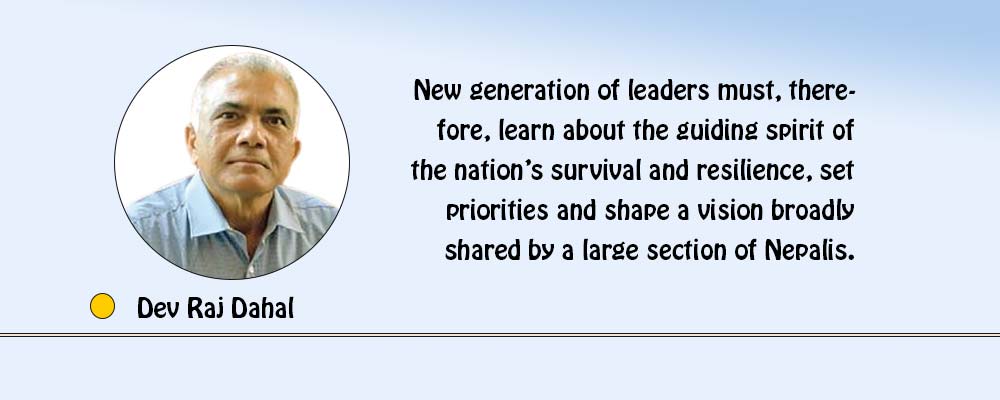
Nepal has kept its adaptability, culture and sovereignty, not totally conforming to what is occurring outside. New generation of leaders must, therefore, learn about the guiding spirit of the nation’s survival and resilience, set priorities and shape a vision broadly shared by a large section of Nepalis. A shift of policy from neo-liberalism to sustainable development is vital. Poor economic performance undermines the legitimacy and authority, while corruption drains the efficient allocation of resources, affects economic productivity, scares foreign direct investment and aids in complementing domestic resource deficits.
In a highly dependent economy, especially on aid, imports, remittances, and investments, external events and decisions deeply affect its development performance. Building indigenous capacity of the nation is vital for new leadership to set the right path for the nation to stabilise a rule-based polity. The new politics is seeking to shift from the old political culture of negation and revenge to new concerns for a livable future, a future that supposes the incommensurable conception of public goods cherished by all Nepalis.
(Former Reader at the Department of Political Science, TU, Dahal writes on political and social issues.)
-original-thumb.jpg)