- Tuesday, 26 May 2026

Nepal-China cultural ties are deep-rooted: Zhan


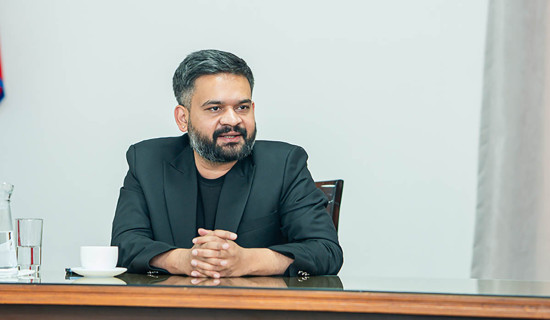
Zhan Xun is a Chinese professor. Recently, she was in Kathmandu to serve as a jury member at the Nepal International Film Festival (NIFF). The Head of the Department of Journalism and Communication at the University of Electronic Science and Technology of China, as well as a professor and media expert, Zhang is also associated with various think tanks in China. She has gained academic and research experience at the University of California, San Diego, and the College of William & Mary. She recently talked to Sukreet Nepal of Gorkhapatra. Excerpts:
What is the purpose of organising Chinese film festivals in Nepal?
The "Xizang Panorama" section at the Nepal International Film Festival (NIFF) is designed as a trans-Himalayan visual art dialogue and exchange that celebrates the enduring friendship and close neighbourly ties between the people of Nepal and China. Its main purpose is to use the power of cinema to bring the rich cultural heritage, stunning landscapes, and contemporary life of Xizang directly to Nepali audiences and international viewers. By showcasing a diverse selection of films, this panorama offers an authentic and multifaceted portrayal of Xizang—from its unique traditions and artistic expressions to its social and economic developments. Rather than relying on external narratives, the section encourages cross-cultural understanding and people-to-people connection through shared visual storytelling. It creates a platform for filmmakers, artists, and audiences from both sides of the Himalayas to engage in meaningful cultural exchange, fostering mutual respect and appreciation. Ultimately, "Xizang Panorama" serves as a cinematic bridge, strengthening the historical and cultural bonds that unite Nepal and China as friendly neighbours, while highlighting the power of art to transcend geographical and cultural boundaries.
How do Chinese film festivals promote cinema and culture?
For this edition of Xizang Panorama, we have selected a diverse range of themes. These include films like Snow Leopard, which explores the harmonious coexistence of humans and nature as well as ecological compensation in public policy, and Warrior King, an animated feature film adapted from the Tibetan epic The Legend of King Gesar. Additionally, the programme features a young man from Hong Kong who traveled deep into Xizang to launch a public service initiative called the “Mobile Photo Studio.”
The narrative follows his journey as he walks through streets, alleys, and villages, taking photos for local residents, presenting them with prints, and engaging in heartfelt conversations. Through authentic footage, the film captures the warm connections and emotional resonance between people. Completed in January 2026, Discovering Xizang 2026 is a documentary that explores contemporary Xizang through the perspectives of nine Gen Z participants from six countries across four continents — Nepal, the United States, Russia, Italy, Morocco, and Cambodia. Through their journeys, observations, and personal reflections, the film presents a vivid portrait of Xizang in a new era, highlighting its social stability, economic progress, ecological protection, technological advancement, cultural continuity, and growing international engagement.
What are the historical cultural connections between China and Nepal?
The historical and cultural ties between China and Nepal are deep-rooted in geography, art, and trans-Himalayan exchanges. The Nepali princess Bhrikuti married the Tibetan King Songtsen Gampo in the 7th century, helping to spread Buddhism to Tibet and later to central China. Chinese monks, including Faxian and Xuanzang, traveled through Nepal on their pilgrimages to India, documenting sacred sites. One of the most remarkable cultural bridges was the 13th-century Nepalese artist Araniko. Invited to the Yuan court by Kublai Khan, he introduced Nepalese and Tibetan Buddhist art to China, most famously designing the White Stupa of Beijing’s Miaoying Temple, a landmark of Sino-Nepalese craftsmanship. Centuries of trade and pilgrimage along the Himalayan routes fostered continuous exchanges of religious texts, icons, and architectural styles. Today, this shared Buddhist heritage remains a living bond, reflected in joint efforts to preserve cultural relics such as the Lumbini sacred garden, the birthplace of Buddha. These enduring connections illustrate how China and Nepal have long influenced each other’s spiritual and artistic traditions as friendly neighbours.
What makes Chinese film festivals more diverse than Nepali ones?
Film festivals in both Nepal and China feature excellent film screenings that are widely acclaimed. In addition to film screenings, Chinese film festivals also host numerous meet-and-greets with celebrities and project meetings for investors. Some films also schedule their premieres to coincide with the festival.
Also, China has a much larger population than Nepal, so the number of movie theatres is significantly higher in China than in Nepal. Nepali cinemas offer a warm, community-oriented atmosphere that many moviegoers appreciate. While Chinese cinema leads in technical sophistication and box office reach, Nepali cinema holds its own charm through sincere narratives and a close relationship with its viewers.











-original-thumb.jpg)