- Sunday, 12 April 2026

Views On Constitution Making
The constitution, no doubt, is a supreme document to manage a nation's life. Thus, it’s a public document, which provides equal space to talk about issues of citizens. The point here is: What kind of experience does Nepal hold on to it? What we find here is – that constitutional governance has always been a vision for the country. So, what Nepal’s experience tells is to say that ‘constitution’ alone is not enough; the true emphasis should be on democratic values to empower people. This is the objective, for which Nepali people made a long, strenuous struggle at the political level.
So, where does Nepal’s present Constitution stand in these qualitative features? Was it a sudden phenomenon or seeds of political thoughts about it long? So many questions related to Nepal’s present Republic Constitution can be there. But, the right answers to such curiosities can't be found if we forget the painful period of the constitution-making process for the republic of Nepal.
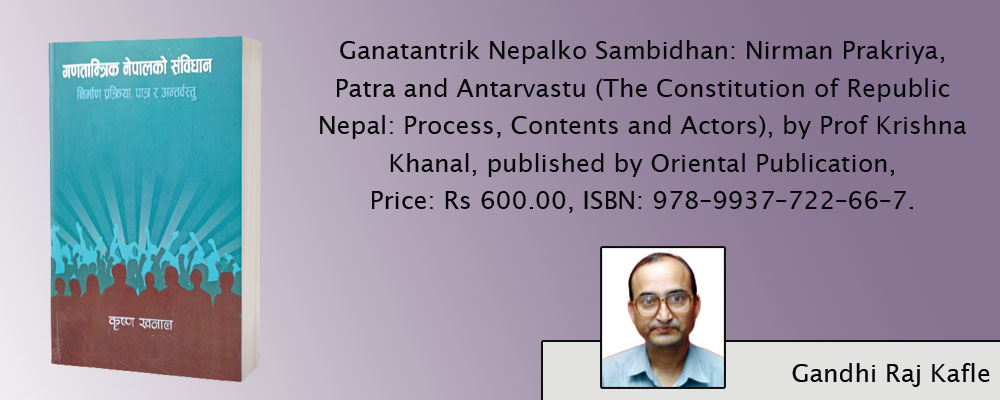
But, here what has come for us in this regard to read and remember the literature about a very important national document is the under review book entitled “The Constitution of Republic Nepal: Process, contents and actors” by Prof Krishna Khanal. Prof Khanal, as readers know, is a scholar who on his part had worked earnestly championing academic debates and discussions for the making of the Constitution of Nepal at that time. We need to remember that such discussions, which were held then at the civil society and academic levels, had played an instrumental role in helping the process to draft the statute for the Constituent Assembly.
It has only been half a decade since we got our constitution proclaimed and it is in the psyche of the nation that the people and civil society level exercises on the constitution making then were on boiling point. So, this is a good book because it has been written by Prof Khanal, a mature academician adept at discussing various aspects of the constitution writing process. Through this book, he displayed that he could discuss theoretical aspects and practical complications the nation dealt with through widespread participatory experiences of a tumultuous time of writing the republic constitution.
The title of the under-review book itself outlines the thematic border. No doubt, the republic identity is a new experiment for Nepal and making the constitution within this is a long cherished dream of the country. The author rightly quoted former Prime Minister late Girija Prasad Koirala, who had metaphorically said drafting the republic constitution is like the opening of ‘Pandora’s Box’ for the Constituent Assembly of Nepal. This 'Pandora's Box' is dealt with the main heading "The Constitution of Republic Nepal" in this book. The other three crucial themes in the book "Process, Contents and Actors", which are denoted in the subheadings of the book, too, are must-know subjects for readers.
Prof. Khanal's book, comprising 11 chapters, enters into discussion highlighting a very volatile time (first five-year term of the historic Constituent Assembly) of the Constitution written under the title "Half a Decade of Constitution". Is the idea of having a Constituent Assembly to write a constitution and political vision for the republic a new phenomenon? Not at all, the seeds of it have already been sown and the nation herself is witness to it.
Prof Khanal has quoted far past the context of 1951 AD from research work on Ganeshman Singh by Hari Gautam who wrote: 'King Tribhuvan himself while ending the Rana Regime with royal declaration had hesitantly introduced the agenda of the republic’. The agenda, however, later became dormant and the same dormant agenda came to the centre stage when Maoists aired their voices in favour of it.
Yet, the main theme of this book is to present the whole issues and processes of the making of the Republic Constitution of Nepal. The process was critical. The four meticulously discussed fifth to eighth chapters of the book entitled ‘Subject of State Restructuring: Principle, Structure and Process’, ‘Separation of Power between the Federal Government and States and Issues of Mutual Relations among Government Agencies’, ‘Community/Regional Political Forces and Politics of Identity and 'Challenges and Alternatives of Choosing the Form Of Governance' remained very critical during the whole process of the Constitution writing in Nepal.
Professor Khanal's book needs to be read not only to know about the biggest endeavour which the nation went through to proclaim the Constitution of Republic Nepal but also to update the comparative knowledge of many nations like ours which dreamt of freedom, democracy and Human Rights. The author has brought contexts of constitutions of the countries like India, the USA, England, France, Switzerland and South Africa to discuss the Constitution making processes of the Republic of Nepal.
In conclusion, there is the word ‘nascent’ which we often listen to in the context of democracy in our beloved nation. We, on the one hand, want full-fledged democracy and on the other, we also wish to strengthen it fully and this can be achieved if democracy is practised with care and prudence. Here we have a sentence from this book, which is a quote mentioned by learned politician Narahari Acharya in his preface to the book: ‘We require high mental ability and patience for use and practice of democracy.’ If the nation goes ahead this way, today’s nascent constitution of republic Nepal will grow further and gain maturity. In gist, this book offers insight to know about jolts and wounds of our constitution making which will also make us aware about our rights and duties at present in future.


-original-thumb.jpg)
-original-thumb.jpg)