- Saturday, 23 May 2026

Bancharedanda: Where ragpickers look for livelihood in piles of waste
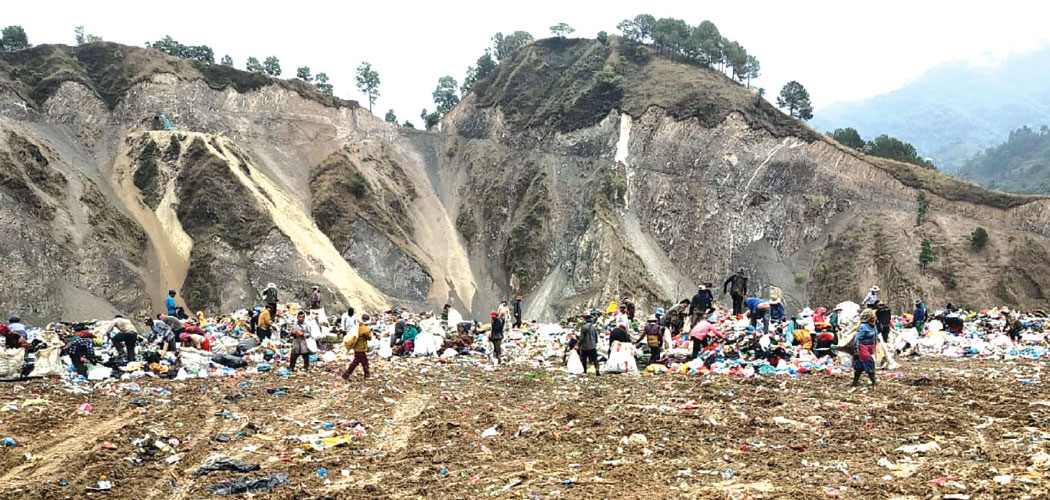
Kathmandu, May 3: People mostly prefer to stay away from waste. Urban residents feel so distressed if waste collection services are delayed even slightly. However, things are different at the Bancharedanda landfill site, where the garbage of Kathmandu Valley is disposed.
About 200 people living around Bancharedanda, some of whom are local residents whereas others are migrants, depend on garbage trucks for their livelihood. Every day waste loaded tippers arrive between 10 am to 2 pm, and these individuals begin sorting garbage on their own for survival needs.
Many of them have pig farms; they collect food waste for their pigs and recyclable garbage are sold for income. From the 'dirty' work, they are able to earn up to Rs. 2500 every day. Most of the waste workers belong to Janajati community (Tamang) from Rasuwa and Kavre who have migrated there for the purpose.
Rights and reality
The Constitution of Nepal guarantees every citizen's right to live in a clean and healthy environment; it sounds ridiculous in view of Bancharedanda residents. The situation has raised serious concerns about public health, environment safety, and the government's responsibility to uphold constitutional provisions. It is more shameful that residents of Nuwakot and Dhading are suffering more from the waste of Kathmandu Valley.
Ram Kumar Ghimire, Kathmandu Metropolitan City employee of the Bancharedanda Landfill site, said they tried to stop them from entering the landfill site sometime. But the office was obliged to allow them after the people protested and demanded to enter the site, as they have no alternate means of livelihood. The more dangerous fact is that the waste collectors bring their children together with them. Ghimire said, "We restrict children from going to the site, but because the site is in an open area, they use alternate paths to reach there."
During a field visit a couple of days ago, many workers were collecting the waste without masks and gloves. The whole area is heavily affected by strong stench, raising a serious question what drives people to be engaged in mountains of garbage every day.
Keshav Ghale, a resident of Bancharedanda who shifted from Rasuwa, said he and his family have been doing garbage collection jobs alongside pig farming. He said if the government provides alternatives for them, they don't have any interest in engaging themselves in such a risky occupation.
Health experts warn of severe consequences of this time and again. Sher Bahadur Pun, an infectious disease specialist, said people exposed to such hazardous garbage are at risk of allergies, coughs, sneezing, diarrhea and typhoid in short term and may suffer from heart, liver, kidney and even cancer-like diseases in the long term. Pun stated that the state's negligence regarding human health is a stance of state failure.
Sildol Health Post, established by Kathmandu Metropolitan City for landfill site residents, has been receiving similar types of patients. Raj Kumar Neupane, health post head, informed that currently around 20 service seekers visit the health post for general treatment. Many of them are suffering from allergies, cutting problems, gastric issues, coughs and sneezing. Besides that, some visit the health post with back pain problems as they are compelled to collect garbage.
According to Neupane, many patients infected with serious diseases directly visited Kathmandu hospitals, so they don't have a record of such patients. But at least 10 deaths were reported in the village last year from cancer. Villagers complain that the village health post doesn't even have basic medicines. Health post chief Neupane also accepts that they failed to provide sufficient medicines like tape for the wounded, as the KMC has not allocated budget for that.
Though the support is not sufficient, even this support is being given by Kathmandu Metropolitan City, though the landfill site has been used by all 18 local governments of the Kathmandu Valley. Currently, the KMC supports 56 teachers, health posts, compensation and infrastructure in the area.
Social stigma and isolation
Despite being garbage collectors, some locals have their own tipper; some are renting their houses. In spite of some opportunities, locals are dissatisfied because of the landfill site.
Along with health and environmental problems, people residing in Bancharedanda are facing social isolation. Many youths of the Bancharedanda don't get a partner for marriage, as people deny marrying in such a stinky place.
Badri Bahadur Ojha, a local of Bancharedanda, said his son-in-law, whose house is at Dhapasi, Kathmandu, never visits the place, blaming that the place is so stinky. Ojha said sadly that his daughter and grandchildren visited him sometimes without the son-in-law.
Government efforts and challenges
The Bancharedanda landfill site is better managed and far from the residential area in comparison to the Sildol landfill site. But it still operates as an open dumping site, with no segregation at source, and local residents visit daily for their survival, increasing health and environmental risks.
KMC has planned to establish a waste transfer centre in its own area with modern technology to promote segregation, reuse and recycling. However, it has been facing difficulty to acquire land and to bring new technology, as the local government alone doesn't have rights to do so, Sarita Rai, head of the Environment Division at KMC, said.
But Rai is hopeful of getting the support of the federal government this time, as the project was also a dream of Prime Minister Balendra Shah while he was leading the KMC as mayor.
Rai informed that they faced difficulty getting the land after locals refused to provide their area for the purpose.
According to the plan of the KMC, it will develop an advanced transfer centre with modern technology where 80 per cent of the waste will come in for reuse and recycling. But, for all these, the KMC needs the support of the federal government.
Mahesh Bahadur Singh, Senior Divisional Engineer of the Ministry of Urban Development, said the new Waste Management Act is in process to be submitted to the Cabinet, which emphasizes waste segregation from source, transfer station, and advanced transportation and other modern management of waste. According to him, after approval of the act, it will get a long-term solution for waste management. Singh claimed this government is about finding long-term solution once the law is approved.

<p>She is Journalist in The Rising Nepal .</p>