- Tuesday, 21 April 2026

Folk Stories Mirror Collective Social Reality

We grow up hearing folk stories as simple moral tales from our elders. They teach us kindness, honesty, and the value of community. But what if these stories carry something more—quiet truths about how our society understands gender, caste, and identity? We think of Nepali stories as childhood memories or moral tales; however, they are an inheritance that we have passed down to generations, and demonstrate our collective values and cultural customs.
While narratives are often seen as a source of entertainment and moral guidance, they also offer a window into understanding social structure and community interactions. Zhang Jian, a Chinese hermeneutic theorist, proposes an interpretive (i.e., hermeneutic) approach to narratives that offers no fixed or absolute (e.g., universal) meaning; meaning emerges through the interpretation of the reader in relation to the cultural context and the written story. In this way, stories act as living narratives. They lead us to examine not only what is explicitly stated in written stories, but also what is implied—especially in relation to power, identity, and inequality.
Imaginative society
Consequently, stories represent much more than a compilation of pain and emotion; they serve as fertile ground upon which to build an imaginative society, and may reveal their further meaning beyond their face value. In examining Nepali stories, there is a consistent theme of caste-based inequality throughout our texts. Many of our stories illustrate a society where one's birth (caste) is the defining factor in determining one's potential—rather than an individual's ability.
The story Latte Damai is an example of a character who is marginalised from society because of his caste and subsequently has limited non-violent options; however, he finds cunning ways to survive and overcome his oppression. He acts out of desperation because society has found ways to devalue him and his ability to perform, and therefore forces individuals to create their own possibilities of resistance to oppression.
According to Zhang Jiang's philosophy, the stories of others reflect our collective social reality, including how social hierarchies function and how struggles occur. The story of Latte Damai illustrates how socioeconomic status shape people decisions, as well as how resilience can be created when pressure exists; therefore, those portrayed as having lower social status in Nepali society may still achieve success despite their circumstance.
Another theme common to these folk tales is one of gender characteristics within the context of Nepali society. There are numerous folk tales which portray men as decision-makers and women as responsible for domestic activities; however, many of the same folk tales depict women as intelligent, capable, and resourceful.
An example can be found in a popular folk tale in which a clever daughter-in-law uses her wit and ingenuity to address the problems of men who do not know what to do. Even with the restrictions placed upon them by the societal structure, she is able to utilise her wisdom to solve problems and to question authority. As such, her actions demonstrate that women are not idle participants but rather are able to play an active role in negotiating and resisting the structures that surround them.
A second deeper level of interpretation reveals that the folk tales discussed above are not solely replicative of historical depictions of gender dynamics, but also provide subtle ways in which to challenge the historical depictions of gender roles. Furthermore, it indicates a disconnect between how society views individuals based on caste or gender and what individuals are capable of accomplishing. Therefore, the cumulative message of all of the folk tales presented above demonstrates an important truth. It is unwise to believe that people should be judged by their caste or gender, for it creates limitations to both the person being judged and also the society that judges them.
Marginalised communities
Throughout all of these tales, characters representing traditionally marginalised communities demonstrate wit, strength, and morality. Therefore, these characters challenge, on a continual basis, the same structures that seek to define their being. While many of the issues of violence against women, discrimination based on caste, and social exclusion based on status may have changed since the end of the civil war in Nepal, many of these attitudes still exist today. Despite substantial social and political change in Nepal, society continues to demonstrate both subtle and overt caste discrimination, gender discrimination, and social exclusion on a daily basis.
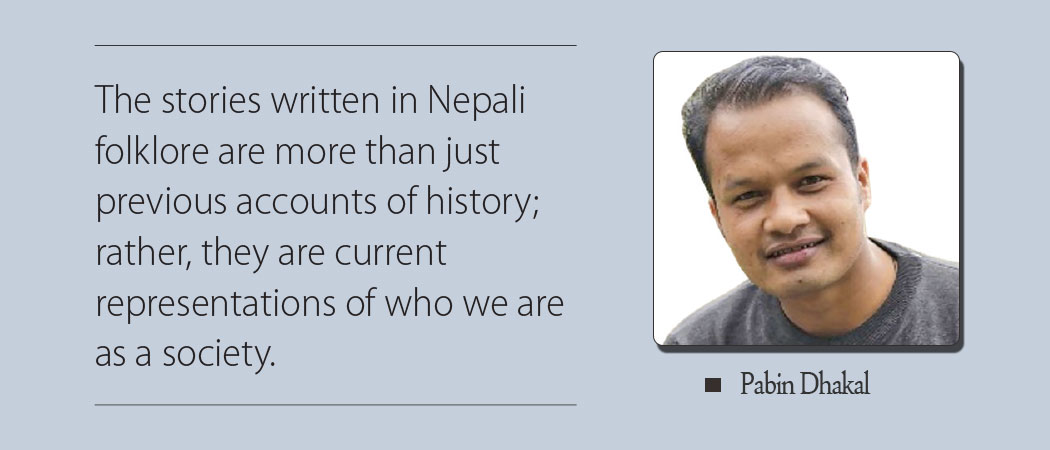
Ultimately, Zhang Jiang's philosophy illustrates that critical interpretation of past experiences can also provide insight into the present. Furthermore, the stories written in Nepali folklore are more than just previous accounts of history; rather, they are current representations of who we are as a society. When we listen carefully to their meanings, we will have better understanding not only of our past but also of the type of future we would like to create as a people defined by dignity, equality, and respect for all people.
(Dhakal is a PhD researcher at the School of Global Education and Development, University of the Chinese Academy of Social Sciences (UCASS).