- Tuesday, 21 April 2026

Inheritance Of Opinion
Swaansh Mahat

Most people have opinions about everything. Politics, relationships, careers, success. Ask a question and the answer comes quickly, confidently, almost automatically. It sounds certain, like it has been properly thought through. But if you push a little further, something starts to show. A lot of these opinions are not really theirs.
They come from somewhere else. From family, from social media, from whatever voice has been repeated the most. Over time, repetition starts to feel like belief. You hear something often enough, you start saying it yourself, and eventually you stop questioning where it came from in the first place. It is subtle, which is why it is easy to miss.
You grow up hearing what a “good life” looks like. A stable job, certain degrees, certain timelines. You are told what is acceptable, what is not, what is respected, and what is looked down on. At first, it feels like guidance. Later, it becomes a script. Most people follow it without realising they ever had a choice.
It takes time, discomfort, and a willingness to stand alone sometimes. It means questioning things that have always been treated as obvious. It means admitting that what you believed might not actually hold up. So instead, it is easier to adopt what is already there.
You repeat what sounds reasonable. You agree with what feels familiar. You align with what is widely accepted. It keeps things simple and smooth, but it also keeps things shallow. An opinion you have never challenged is not really an opinion. It is an inheritance.
When your thinking is borrowed, your decisions start to follow the same pattern. You choose paths that make sense to others but feel distant to you. You follow timelines that look right but do not feel right. From the outside, everything seems stable. From the inside, something feels slightly off, but not enough to disrupt anything.
There is a quiet kind of discomfort that comes with realising this. It is not dramatic. It shows up in small moments, like when you hesitate before answering a simple question about what you actually want. Not what sounds right. Not what is expected but what you want. And there is no immediate answer. That pause says more than anything else.
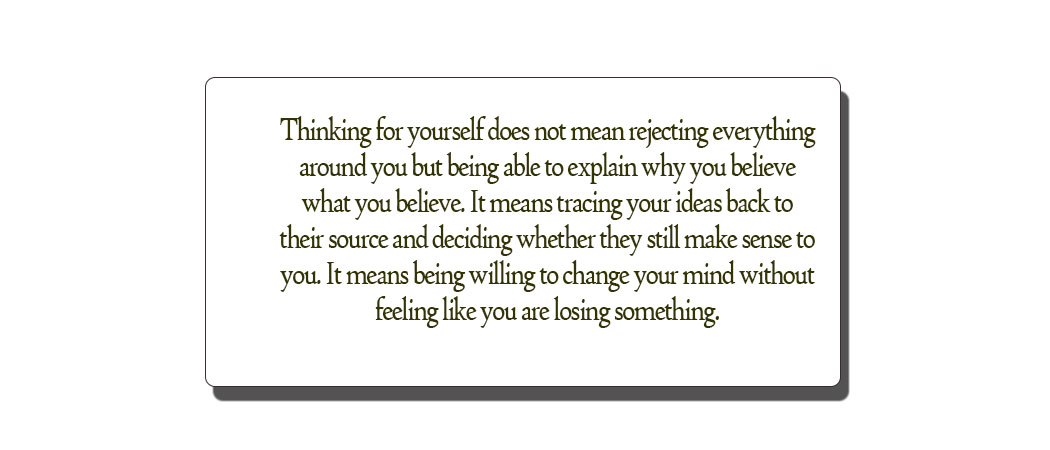
Thinking for yourself does not mean rejecting everything around you but being able to explain why you believe what you believe. It means tracing your ideas back to their source and deciding whether they still make sense to you. It means being willing to change your mind without feeling like you are losing something.
Most people avoid this because it creates friction. It makes things uncertain. But without it, there is a different kind of cost. You can spend years building a life that looks right and still feel disconnected from it. You can be certain about everything and still not feel like any of it is yours.
At some point, that catches up. Because a life built on borrowed opinions will always feel slightly borrowed too.