- Saturday, 30 May 2026

Service delivery at doorstep: Vital departure in public service
By Hemant Joshi, Kathmandu, April 16: In a significant departure in the existing mode of public service delivery, the citizens in different districts began receiving service at their doorsteps.
Materializing the recent announcement of revamp in governance reform, essential documents like passport and driving license, are dropped to service seekers' residences. It has relieved the service seekers from the compulsion of standing in line, and running from one chamber to another of government offices.
Importantly, it has ended the entrenched practice of resorting to 'bichauliya' (broker) to access public service.
Director General at Department of Postal Services, Manamaya Bhattarai, said that such service had already been launched as test scheme in Makawanpur, Myagdi, Dadeldhura districts. Sankhuwasabha, Nawalparasi Purba and other districts are also making final preparation for similar service.
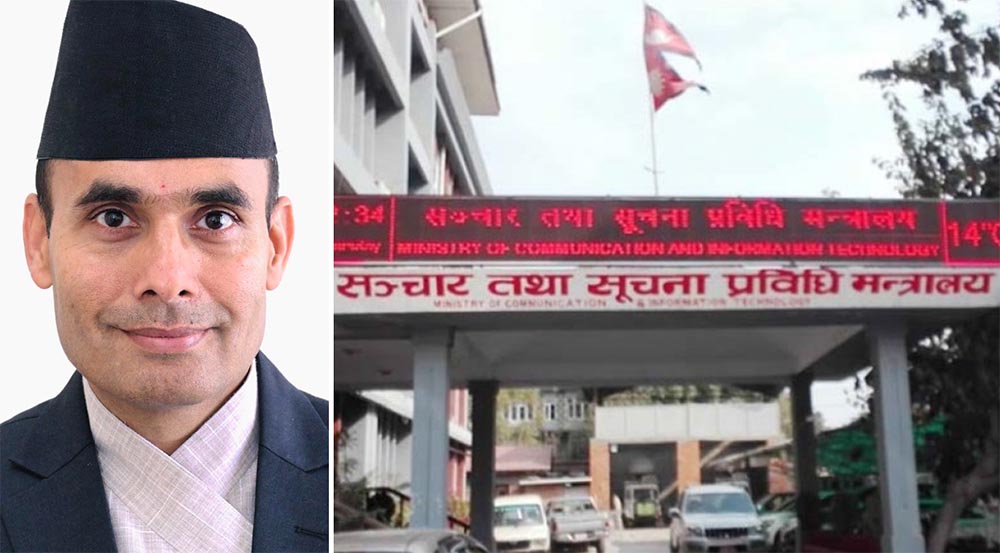
Minister for Communications and Information Technology, Dr Bikram Timilsina, has been forwarding the scheme with special focus. He has directed all subordinates to advance present campaign in a collaborative manner.
As per the March 27 announcement of governance reform, the government is gradually enforcing the delivery of public service at citizens' doorsteps like providing passport, citizenship certificate, license and other essential government documents. It is the plan to be materialized within 100 days of government formation in line with the reform agenda.
Chief District Officer of Myagdi, Rabindra Acharya, handed over passport to respective individuals, reaching Beni municipality-2 and 6 on Wednesday.
He told RSS that they have also sent passports in some places of the district today. "Positive feedbacks have been received from the citizens who have received the services at their doorsteps in the initial phase," Acharya underlined.
The government has adopted a strategy to make the Department of Postal Services, which has remained largely inactive for the past few years, more active. A plan has been implemented to restructure postal office into a government 'courier service'.
Priority has been given to coordination among the Department of Passport, the Department of Transport Management, the District Administration Office and the Postal Office for this purpose.
Chief District Officer of Sankhuwasabha, Srijana Thapaliya, opined that it is not as easy to expand this service as we have no systematic house number and postal code system.
Thapaliya mentioned, "Although the government has adopted a policy to deliver passports at service buyers' doorsteps, it is very difficult to deliver even up to local levels in some places. It is necessary to pay attention on geographical complexities as well as human resources management."
Similarly, it is necessary to develop 'postal tracking system, information dissemination through SMS, as well as resolve problems of human resources crisis, lack of availability of vehicles services in remote areas, he argued, adding additional resources and infrastructure are needed to expand postal service in the districts with large areas.
The Department of Postal Services has stated that it is planning to impart training to its employees and to mobilize new workforce if necessary. It appears that it will still take time to effectively implement this programme nationwide.
The district administration office is currently responsible for collecting and distributing passport-related details. The passports printed by the Department of Passport are sent to the district administration by post, and for distribution, the district administration has to instruct the postal service again.
In this way, the Ministry of Communications and Information Technology and the Ministry of Home Affairs are working in coordination to eliminate double expenses and time consumption. If the Department of Passport can deliver directly through the post, this problem seems to be solvable.
However, the fees for delivering documents to citizens' homes through postal service have not been determined.
According to Bhattarai, the Director General of the Postal Service Department, clients have been instructed to send documents via post by paying a fee of up to Rs 55. The determination of this fee and standards is yet to be uniform nationwide.
Similarly, the postal service is doing its homework on how to arrange services that can be accessed from any district administration office and make the entire service process traceable and time-bound.
Once this system is fully implemented, service users will be able to receive information on whether documents such as passports and licences have been prepared, their status, and when they will arrive at their home, all on their mobile.
Until services are expanded nationwide, not all citizens have equal access to benefits. Citizens in remote districts, in particular, still rely on the old system. There, lack of infrastructure and manpower may make it difficult to implement the new system.
Experts on public service delivery have stated that long-term planning, adequate investment and continuous monitoring are necessary for the effective implementation of the programme.(RSS)
-original-thumb.jpg)
-square-thumb.jpg)
-original-thumb.jpg)

-original-thumb.jpg)