- Monday, 8 June 2026

There is no reason to panic: FM Wagle
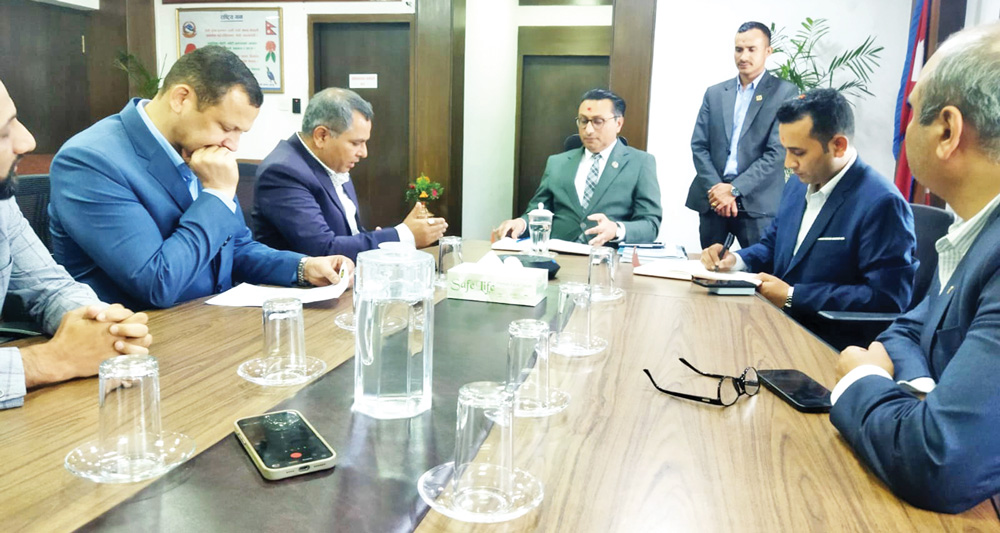
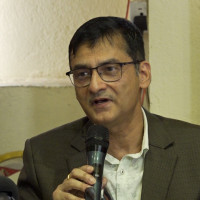
Finance Minister Dr. Swarnim Wagle in a meet with a delegation from Stock Brokers Association of Nepal, led by its General Secretary Bhakti Ram Ghimire, held at the ministry on Monday morning.Photo: TRN
By A Staff Reporter
Kathmandu, Apr. 7: Finance Minister Dr. Swarnim Wagle has emphasised the importance of making the stock market more accessible to institutional investors while also ensuring stronger protection for individual investors.
He made these remarks during a meeting with a delegation from the Stock Brokers Association of Nepal, led by its General Secretary Bhakti Ram Ghimire, held at the ministry on Monday morning.
Finance Minister Dr. Wagle said that the capital market is inherently a transparent and professional sector, and there is no reason for stakeholders to panic.
He also highlighted the crucial role of the private sector, noting that it provides employment to nearly nine out of 10 people, and affirmed that the government has no intention of discouraging it.
According to the minister, the government is committed to broadening the scope of private sector participation.
He noted that some ongoing investigations are long-standing cases that have now reached their final stages.
He clarified that while no one involved in wrongdoing will be granted immunity, there will be no selective or retaliatory actions.
“Justice will be fair and impartial,” he said.Reiterating the government’s stance, Dr. Wagle stressed that it is supportive of the private sector.
“Even my first decision reflects that. Neither the government nor the Rastriya Swatantra Party (RSP) is against the private sector,” he added.
Highlighting economic priorities, he said the government is working towards transforming the economy and promised that the upcoming budget will be the most transformative and historic since 2048 BS.
“A golden era for Nepal’s economy is approaching,” he remarked.
Addressing concerns in the stock market, Wagle stated that his party holds one of the most liberal positions on the share market, as clearly outlined in its manifesto.
He urged stakeholders not to be misled by rumours and misinformation currently circulating in the market.
He emphasised strengthening the role of the Securities Board of Nepal to ensure fair practices in the capital market.
The finance minister reiterated that the government’s policy framework has prioritised capital market development.
He described the capital market as a model sector and suggested that other sectors could adopt similar standards of transparency and professionalism.
During the meeting, representatives of the Stock Brokers' Association of Nepal expressed concern over declining confidence among small investors.
General Secretary Ghimire emphasised that the spread of false information in the market has contributed significantly to declining confidence, particularly among retail investors.
He urged stakeholders and regulators to take steps to curb misinformation and restore trust.
They also highlighted the need to introduce measures that make the market more accessible and favourable for institutional investors, which they believe would help stabilise the market.
Regarding ongoing investigations into the private sector, they acknowledged that such actions are justified.
However, they criticised the lack of confidentiality, stating that sensitive investigations should have been conducted discreetly to avoid negative impact on market perception.
Removing Nepal from FATF grey list top priority
Meanwhile, representatives of the Society of Economic Journalists–Nepal (SEJON) and Finance Minister Dr. Swarnim Wagle discussed a wide range of economic issues.
During the discussion, Minister Wagle clarified that rumours of government action targeting investors are misleading. “There is no intention to take action against small investors,” he said, adding that unnecessary fear has been created in the market.
The minister said that removing Nepal from the Financial Action Task Force (FATF) grey list is the government’s top priority.
He noted that Nepal’s inclusion in the grey list has harmed the country’s international reputation and negatively affected the investment climate, creating challenges in attracting foreign investment and maintaining investor confidence.
FM Dr. Wagle acknowledged that past efforts to exit the grey list were largely limited to paperwork and commitments without effective implementation.
However, he emphasised that the government has now entered the execution phase, focusing on enforcing necessary reforms.


-original-thumb.jpg)