- Thursday, 30 April 2026

Dhankuta farmers attracted to banana cultivation
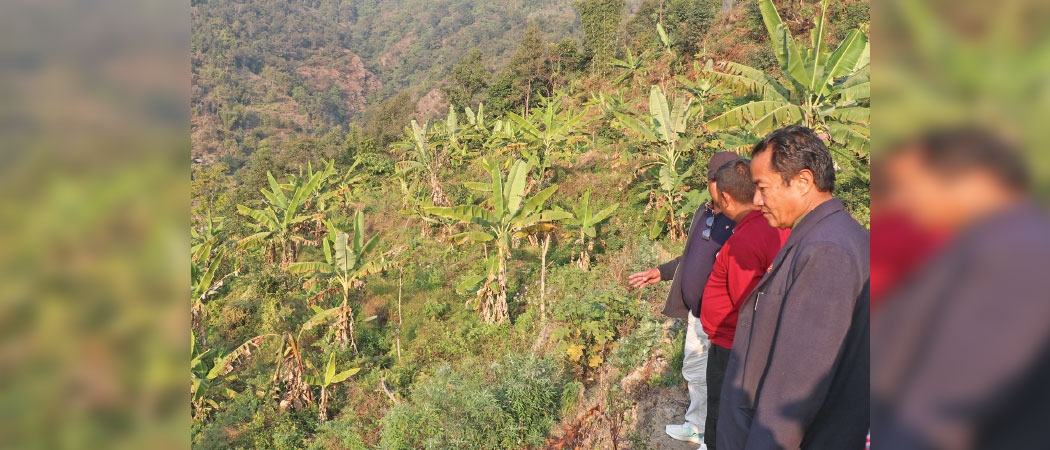
Photo: TRN Banana farming field of Shukraraj Rai in Pakhribas Municipality-9, Dhankuta.

BY KABIRAJ GHIMIRE,Hile, Mar. 25: Shukraraj Rai, a farmer from Pakhribas Municipality-9 in Dhankuta, has started banana farming on approximately 40 ropanis of land. He turned to banana cultivation after facing a shortage of labour for paddy and other crops. The banana farming he began three years ago has now become a good source of income for him.
According to Rai, banana farming is easier than other types of cultivation and requires less labour and effort, which is why he chose this crop. “It requires less hard work, provides quicker returns, and there is no problem with the market. That’s why I opted for banana farming. It is now generating good income,” he said.
In Dhankuta, it is quite difficult to find farmers engaged in commercial banana farming like Rai. However, inspired by him, his neighbours have also started showing interest in banana farming. This type of farming, which has been practised traditionally in rural areas, is now gradually expanding. Additionally, banana farming has long been practised in the lower regions of Shahidbhumi Rural Municipality, Sangurigadhi Rural Municipality, and Pakhribas Municipality.
According to the Agriculture Knowledge Centre, Dhankuta, currently, banana cultivation is carried out on 43 hectares of land in the district, producing about 400 metric tonnes annually.
Banana farming can be done on both flat and sloped land. A temperature range of 15 to 35 degrees Celsius and well-drained but moist soil are considered suitable for cultivation. Compared to other crops, banana farming is relatively easy, requires less effort, and provides returns in a short time. Experts said that the future and market for banana farming are very promising.
According to agricultural technician Karna Bhujel, different varieties of bananas can be cultivated commercially across the district depending on altitude. “If appropriate varieties are selected based on altitude, banana farming can be done throughout Dhankuta, but such practices are not yet widespread,” he said.
Although a banana plant produces fruit only once, it generates multiple suckers that grow into new plants. With proper care, including weeding, fertilisation, and irrigation, farmers can continue to earn income for many years.
According to Nagendra Rana, head of the Agriculture Knowledge Centre, a new plant can bear fruit within a year. He added that varieties such as Jahaji, Malbhog, Chiniya Champa, and Asame are commonly grown in Dhankuta. He encourages farmers to adopt banana farming, as it requires less labour, yields income quickly, and needs fewer workers compared to other crops.
The market for bananas is also very strong. As a nutritious fruit, it is in high demand. However, local production in the district is not sufficient to meet even the district’s own demand. There is also high demand in the Tarai for local varieties grown in hilly regions.




-original-thumb.jpg)