- Saturday, 9 May 2026

Shun Utopian, Dystopian Discourses

After more than 10 million people voted for 68 different political parties, allowing only six of them to be constitutionally recognised as national parties, the fever of the March 5 election is over now. As many had anticipated, the new political party emerged as the largest, with a landslide majority, leaving the old forces far behind. No wonder the Nepali people are eagerly awaiting the sweeping reforms after the formation of a new government. Since the 1950s, we have been experiencing the utopian/dystopian political discourses. Each political group creates its utopia and shows the government's actions as dystopia when in opposition. But the moment they gain power, they soon forget their dystopian portrayal in their actions. This is not simply a double standard of the political parties, but something that confuses the people in one way or another.
Utopia is a beautiful picture of the world that exists in the dreamer's mind. The dreamer creates this imaginary dreamland, an earthly paradise, and makes it look more beautiful than it really is. Then the dreamer constructs an ideology of a beautiful world that the general public takes for granted. It is very likely that an uncritical thinker is easily goaded by a persuasive speaker. Dystopia, on the contrary, is a social condition in which the speaker makes the world look worse than it actually is. The dystopian world is fraught with a gloomy atmosphere, where people are dismayed by the lack of ways to improve it.
However, utopia and dystopia are not simply fantasies, as many people might suppose. This practice exists in many parts of the world. Utopian discourses have been made by thinkers from Plato in ancient times to democratic thinkers and Marxist philosophers in modern times. But as we know, they have never been realised as the dreamers envisioned. Although they are somewhat unreal conditions, they can be useful too if handled properly. The problem is that both conditions are shown exaggeratedly in our country. Let this never happen again.
Unreal conditions
Both utopia and dystopia, however, are unreal conditions. No previous regime was utterly dystopian, and no current government is likely to make this nation a paradise. Despite the utopia of the present, another possibility lurks on the horizon. If utopia plays in imagination, dystopia is encountered in surface reality. There is always conflict between these two social conditions. If one is dominant at one time, another emerges as dominant at another time. In a sense, they are present side by side, encountering each other.
This time, the newly emerged political party made the previous regime look worse than it really was. They presented it as an ugly world full of corruption and filth. They made the general public believe what they said was absolutely true, even though it was only relatively true. This enabled them to gain more votes in the election. To a large extent, the new political party has won the hearts of the people and convinced them to vote for it. As a consequence, it has garnered almost 50 per cent of the vote, thereby gaining a near two-thirds majority of seats in parliament.
In the context of the formation of a single-party government, we are hopeful that this government will bring about significant reforms to the governance system and pave the way for the nation's overall development. Nevertheless, this government faces some barriers that must be overcome. Some global factors, such as political, economic, and cultural ones, are not as easily solved as many people might think.
There are significant differences between the previous dreams of epoch-making revolution promised by democratic and republican forces and the current alternative political party's reformist dream for the governance system. As the former has promised to make Nepal a paradise where the nation would be prosperous, and people would be happy (it was a utopia), the latter has now promised to almost every ear of aspirants to make this country a land of zero tolerance to corruption and the state mechanism run entirely by merit (another utopia). The new government must consider the following constraints to really improve the situation. Let us hope this really happens this time.
Constraints
Political factors: Politics is both ideological and practice-based. In the context of the present complex geopolitics, our government should be able to balance the ideologically distinct countries, namely our closest neighbours, one of which is a communist country and the other a democratic one. Our government should develop a balanced foreign policy to maintain diplomatic relations. This is perhaps the most difficult task for the new government, but it is not impossible if handled carefully.
Economic factors: The economy is the most pressing issue. To meet their daily livelihood needs, the most energetic youth are compelled to seek labour jobs in the Arab world and Southeast Asian countries, including India. As a consequence, our fertile land has been left uncultivated, with many plots of land still barren. Our productivity has decreased, and we import food from other countries. Per capita income is low, but we are overpowered by the global phenomenon of consumerism. This trend is another factor that encounters to the new government.
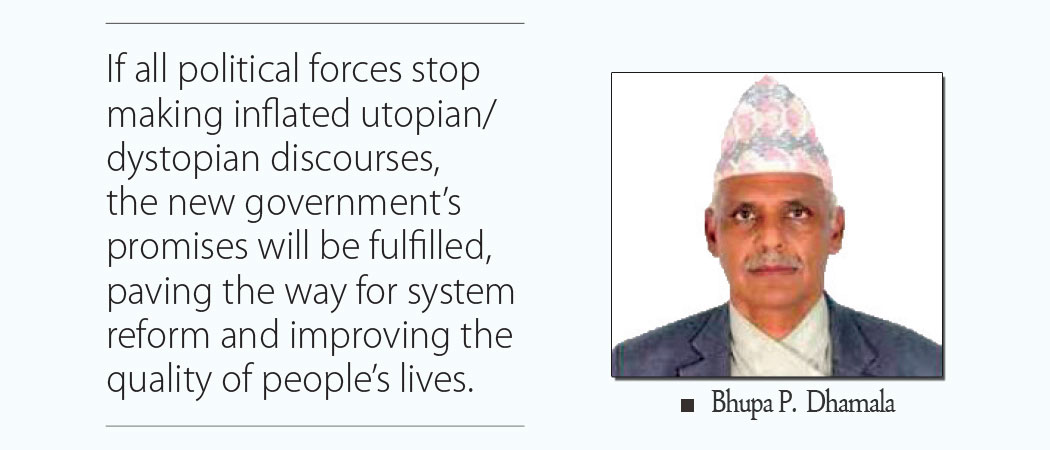
In the last few decades, Nepali culture has been degenerating. We have lost the work ethic. We want to earn easy money, although we do not work hard. This leads us to simply consumer culture where we like to spend more than we earn without realising that being extravagant without income is a stupid practice. Moreover, we have been merely critical of others, and we have been uncritical thinkers. If these constraints are successfully overcome, and if all political forces stop making inflated utopian/dystopian discourses, the new government’s promises will be fulfilled, paving the way for system reform and improving the quality of people’s lives.
(The author is the chairman of Molung Foundation. bhupadhamala@gmail.com)
-square-thumb.jpg)
-square-thumb.jpg)