- Saturday, 6 June 2026

Linguistic Diversity Across South Asia
 Rajendra Prasad Baral
Rajendra Prasad Baral
Rajendra Prasad Baral
Late February in Kokrajhar, Assam, India, was not just a time and space but a seven-day amalgam of languages, cultures, memories, and shared responsibilities. It was an assembly of scholars, teachers, researchers, and students with a common concern: how we can protect our languages and traditional knowledge systems locally and globally in the modern technological era of globalisation, liberalisation, and digitalisation.
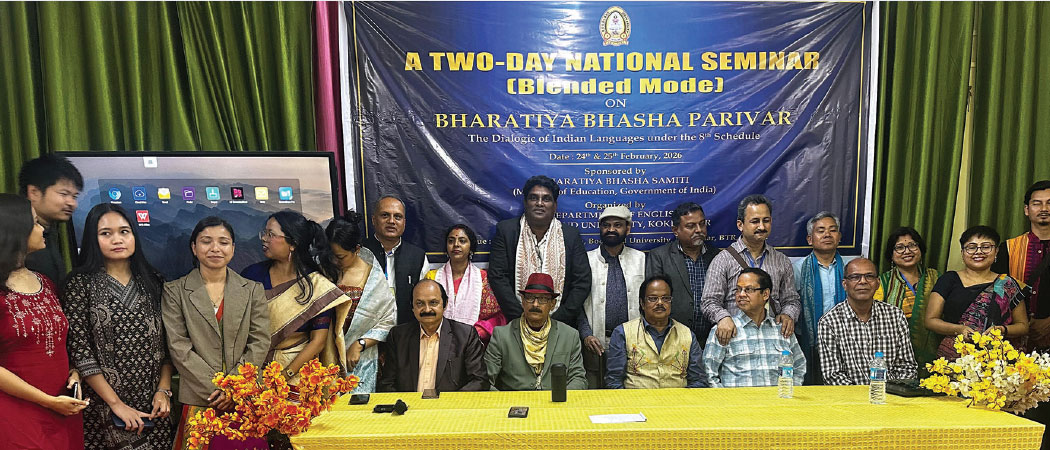
The Department of English at Bodoland University organised a blended four-day national seminar on "Language Preservation and Traditional Knowledge Systems" from February 24 to 27, 2026. The first two days were hosted by the Department of English at Bodoland University, while the concluding sessions on February 26th and 27th were organised by the Department of Humanities and Social Sciences at the Central Institute of Technology (CIT), Kokrajhar. The theme, “One Language, Many Languages, and Culture", captured the spirit of the entire event: language and culture, the shared human heritages, should not die but be sustained for the future with intergenerational transmission.
More than fifteen distinguished retired and working professors of English language and literature from universities across India and South Asia, including Nepal, participated in the seminar. It was an attempt to create a sense of togetherness by exploring the diverse and often unforeseen challenges that languages on the Indian subcontinent face in contemporary contexts.
This seminar was not about rehearsing cultural and literary theories, grand narratives or glorifying the past. The vice chancellor of Bodoland University, Prof. B. L. Ahuja, in his inaugural address, reminded the audience that language is more than grammar and vocabulary – it carries a community’s history, wisdom and worldview. When a language disappears, culture and tradition also begin to fade. Throughout the sessions, speakers emphasised that preservation should not mean romanticising, harbouring nostalgia for the past, or freezing it in time. Instead, it means ensuring that it continues to be spoken at home, taught in schools, adapted to technology and passed lovingly from one generation to the next for sustainability.
The discussions revolved around Bharatiya Bhasha Parivar – the great family of Indian languages. Scholars examined how languages in the Indian subcontinent have evolved through centuries of cohabitation, migration, and cultural exchange. They also acknowledged the growing challenges: urban migration, market-driven education systems, and the dominance of global languages like English as a lingua franca that often push smaller tongues through the process of dilution and marginalisation.
Experienced voices
The seminar brought together eminent scholars with their keynote speech, plenary talk and paper presentation. The reflection was true to what Isaac Newton says: "What we know is a drop; what we don't know is an ocean." Their presentations ranged from linguistic research on endangered languages of Northeast India to policy discussions on multilingual education. Each paper/speech added a different thread to the larger tapestry of concerns about inclusive language policies by the government and private sectors; active community-led revival programmes; community-centred research and translation practices for documentation and sustainability; and safeguarding both Nepal's and India's linguistic diversity and traditional knowledge systems. India is one of the world's most linguistically diverse countries, with 22 major languages recognised in the eighth schedule of its constitution.
Based on the number of speakers, the Nepali language is among the top sixty languages of the world. Nepali is an Indo-Aryan language of the Indo-European family. But it is also widely spoken in Sikkim, West Bengal, Assam, and other northeastern states, as well as in Bhutan and Myanmar, across India. International participation from Dr. Olga Glukhova of Rostov University of English, Russia, widened the conversation by comparing preservation efforts in other multilingual societies. Dr. Khagen Sharma of Gauhati University, Dr. R. Vasanthan from the Kohima Campus and Associate Professor Rajendra Baral from a university in Ilam, Nepal, offered region-specific insights into documentation and research on language and culture, focusing on the fact that Nepali is the national language. The Nepali language dominates education and social media, largely marginalising other minority languages.
Language and future
One of the strengths echoed through all sessions was the importance of education on mother tongue language and culture preservation for the peaceful coexistence of both majority and minority languages. Many speakers pointed out that children learn best in the language they first hear at home. When education disconnects them from that linguistic foundation, it often weakens both confidence and cultural continuity. Language is not merely a tool of communication; it is a key feature of individual identity and the socio-cultural ethos of collective life. Documentation and digital archiving were also discussed as urgent tasks. Oral traditions – folk songs, myths, proverbs, ecological knowledge, and moral values – are rich but fragile in India. Once elders pass away without recording their stories, entire chapters of cultural history may disappear. Participants discussed how universities can collaborate with local communities to document these traditions ethically and respectfully.
Importantly, the seminar stressed that preservation efforts must involve indigenous communities themselves. Language cannot be saved from outside; it must be sustained from within. The role of scholars, therefore, is to support, document, and create enabling structures—not to appropriate or control them but to mutually respect, promote, and sustain them. The other vibrant reflection was true to NR Parker's remark, "One language makes a wall; two languages make a gate." Among the presenters, Nepal's presentation focused on the dialogue between language preservation and traditional knowledge initiatives in the Nepalese context, where over 120 living languages exist. Nepali is a national language and language of education and media, and hence, mother tongue is not treated as a discipline, and children understand but cannot speak and write their ancestral languages confidently. The presentation focused on Eastern Nepal, particularly the districts of Ilam and Jhapa, which have the same multilingual and multicultural landscapes as India. In Ilam’s hill communities, the indigenous languages of Rais, Limbus, Magars, and Tamangs continue to thrive in ritual and community-based value systems, despite urban migration and rapid language shifts. In Jhapa’s Terai plains, linguistic diversity is vibrant but often marked by uneven power relations between dominant and minority languages.
Among the communities are Rajbansi, Meche, Santhal, and Dhimals, as well as Khasi in Meghalaya, Mizo in Mizoram, Nagamese in Nagaland, and Bodo in Bodoland. The focus was on preservation efforts such as mother tongue-based primary education, government- and community-driven documentation projects, and the digital archiving of oral literature in the region. Preservation must become a policy, practice, and daily habit. During the seminar, Bodoland, Assam, carried a reflection that the recognition of the Bodo community in the Indian constitution was the image of political identity and respect for the indigenous Bodo language and culture. When languages co-exist for a long time, there are mutual influences, and borrowing or loaning is one of them. But extensive borrowing has a high risk of language loss. However, the audience responded warmly, appreciating the balance between scholarly analysis and grounded experience and focusing on how multilingualism and literature can bring diverse people and societies together and develop empathy and cultural sensitivity.
Professional collaboration
The smoothly organised seminar reflected strong academic insight, a cultural tour, institutional collaboration, and professional networking. At Bodoland University, the programme was coordinated by Prof. Pradip Kumar Patra, Head of the Department of English, while at CIT Kokrajhar, the sessions were coordinated by Dr. Tanushree Nayak from the Department of HSS. The presenters and participants played an active role, engaging in discussions and raising critical questions about ethics, policies, and the future of linguistic and cultural research.
The languages of the Indian subcontinent reflect their speakers' lives and culture, as well as their interactions. Knowing one's own language and that of others is a sign of love for oneself as well as respect for oneness, which a man of culture can adhere to in the sociocultural fabric of society.
Preservation, they noted, can/should not remain confined to seminar halls. Participants left the venue with a renewed commitment to ensure that their research, teaching, and community engagement contributed meaningfully to language sustainability and identity formation.
The four days in Kokrajhar reminded everyone that languages are living bridges between generations. They carry rituals, social values, and oral traditions from grandparents; farming knowledge and lifestyles shaped by local ecology; and stories that define identity. Preserving language and culture means respect for social harmony in diversity.
The seminar’s message was clear: strength and beauty lie in linguistic diversity and cultural plurality beyond classrooms, communities, and geography, along with tolerance and acceptance, revitalisation, and mutual respect for years to come. No people can be monolingual today. Many languages coexist and influence each other despite their different systems, sharing features like social beliefs, local ecology, rituals, folklore, cultural practices, and shared emotions. Therefore, we should be nonjudgemental or unconditional in language and cultural varieties. Languages do not emerge spontaneously. The power of intersection or dialogic of language, culture and the self always works in every community, and hence language preservation and maintenance and traditional knowledge systems matter both locally and globally.
The author is an Associate Professor at Mahendra Ratna Multiple Campus in Ilam.