- Wednesday, 20 May 2026

EC submits poll report to President
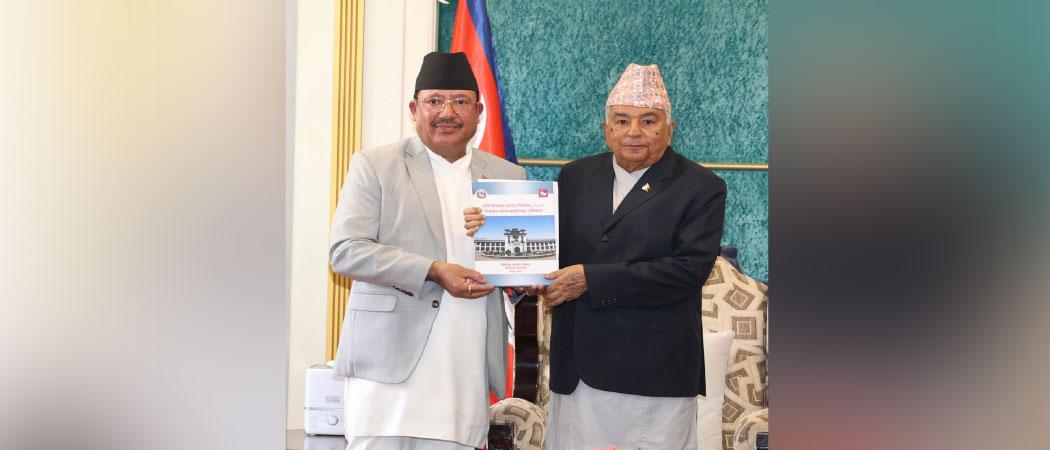

By A Staff Reporter,Kathmandu, Mar. 20: The Election Commission has submitted the report of the House of Representatives election results to President Ramchandra Paudel.
In accordance with Section 62 of the Election of Members of the House of Representatives Act, 2018, the Acting Chief Election Commissioner, Ram Prasad Bhandari, submitted the report at a special programme organised at the Office of the President, Sheetal Niwas, on Thursday.
The election held on March 5 elected all 275 members of the House of Representatives, which was dissolved following the Gen-Z movement in September last year.
Receiving the report, President Paudel expressed satisfaction over the successful completion of the election, noting that it had been carried out through dedicated efforts in difficult and complex circumstances. He thanked all stakeholders, including the Election Commission and civil servants, for their role in ensuring the smooth conduct of the polls.
“The Commission has successfully fulfilled its responsibility by conducting the House of Representatives election on March 5 in a free, fair and fearless environment. This has increased public confidence in the Election Commission and the electoral system, and has further strengthened democracy,” President Paudel said.
While submitting the report, Acting Chief Election Commissioner Bhandari presented a summary of election management activities and the results.
According to the results, a total of 165 candidates were elected under the First-Past-The-Post (FPTP) electoral system, including 164 from six political parties and one independent candidate. Similarly, 110 candidates from six political parties were elected under the proportional representation system.
Of the total 275 members elected to the House of Representatives, 179 are men and 96 are women. In terms of inclusion, 21.09 per cent of members are from indigenous nationalities, 49.09 per cent from the Khas Arya group, 3.27 per cent from the Tharu community, 6.18 per cent from the Dalit community, 16.73 per cent from the Madhesi community, and 3.64 per cent from the Muslim community.
For the purpose of joint participation under a common election symbol, a total of 114 political parties were registered under 107 election symbols. Of these, 12 parties shared five symbols, while 102 parties used their own symbols. Among the registered parties, 65 participated in the FPTP system under 61 symbols, while 63 parties contested under the PR system using 57 symbols.
A total of 3,406 candidates were finalised for the FPTP sy stem, including 388 women, 3,017 men and one from other categories. For the PR system, a closed list of 3,135 candidates was finalised, comprising 1,772 women and 1,363 men.
A total of 18,903,689 voters were registered, including 9,240,131 women, 9,663,358 men and 200 others. Additionally, 186,142 voters were included in the provisional electoral roll prepared in accordance with Section 30 of the Electoral Roll Act, 2073, and were allowed to vote under the proportional representation system.
Of the votes cast under the FPTP system, 94.55 per cent were valid, while 5.45 per cent were invalid. Similarly, under the PR system, 96.05 per cent of votes were valid, and 3.95 per cent were invalid. The average rate of invalid votes across both systems stood at 4.7 per cent.
To ensure cost efficiency, the Commission adopted a policy of reusing previously procured materials and entered into agreements with government-owned organisations for additional supplies.
Of the 50 types of election materials, 37 were procured through provincial and district election offices, while 13 were centrally procured and distributed to districts. Of the Rs 7.81 billion requested for the election, Rs 6.77 billion was approved by the Ministry of Finance. Of this amount, Rs 5.37 billion has been spent so far, with some payments still pending.
The election was observed by both domestic and international observers. A total of 164 representatives from 22 diplomatic missions and three international non-governmental organisations conducted international observation, while 35 organisations carried out domestic observation.
Organising a press meet on Thursday evening, the Commission expressed its gratitude to all voters for participating in this exercise of representative democracy under special circumstances and for contributing to the process of electing representatives through the use of their voting rights. The Commission also thanked the Government of Nepal, provincial and local governments, Chief Electoral Officers and Returning Officers, security agencies, election officials, political parties, candidates, observers, the international community, and the media for their roles in successfully conducting the election.
-original-thumb.jpg)


-original-thumb.jpg)