- Saturday, 30 May 2026

South Asian Youths Seek Safer Future

Several South Asian countries have been facing unstable political regimes, hampering their development. However, in recent days, Sri Lanka, Bangladesh, and now Nepal have shown that youth power is important in bringing countries and their political leaders back on track to focus on development rather than personal and party politics. In all three countries, governments have changed. However, the road to development is rarely covered with a bed of roses. This is especially true at a time when conflicts are flaring in different parts of the world, demonstrating a politics of power focused on weapons, oil, and the psychology of supremacy.
While youth across the world are expressing the need for a cleaner environment and a safer future in which they can move ahead with confidence, wars raging in different regions stand in stark contrast to this sentiment. These wars are eroding not only Mother Earth but also the psyche of people who are affected through no fault of their own. Those killed in the Ukraine war, the Gaza conflict, or now the Iran crisis are largely individuals who neither desired nor ordered these wars. They are either sent to fight on command or are civilians caught in the wrong place at the wrong time.
Stranded Nepalis
Then there are migrant workers, including many Nepalis currently stranded in the Middle East. They had gone with dreams of earning for their families and contributing to their country, often by taking loans. Now, many find themselves stranded, their dreams shattered, and trapped in cycles of debt as their sources of income have abruptly ceased without warning. Remittances to countries like Nepal from the hard labour of such migrant workers are also affected. This, in turn, affects the economy and finance of some of the poorest countries on earth.
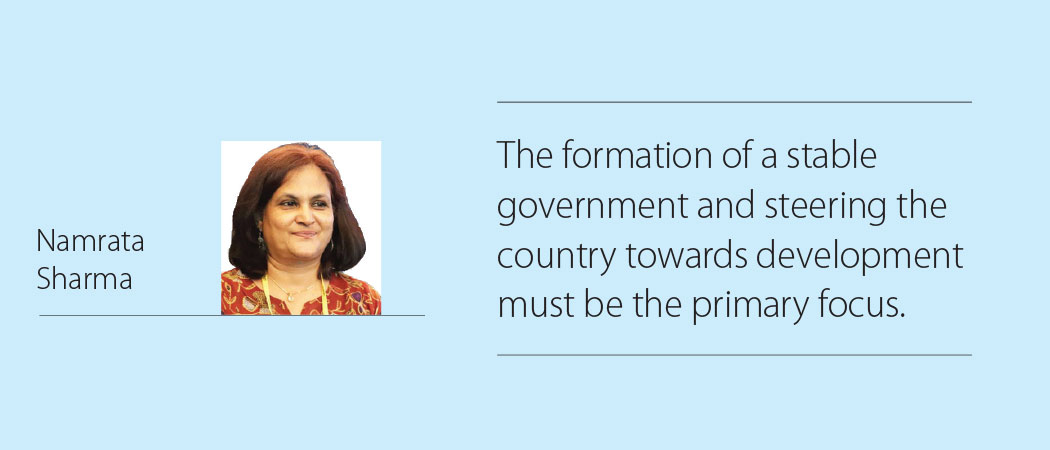
At such a time, as Nepal heads towards a new political era, several pressing issues demand immediate attention. The formation of a stable government and steering the country towards development must be the primary focus. However, the incoming government must first address a number of critical concerns before fully concentrating on development agendas. These include long-standing allegations of corruption against politicians, delivering justice to the 77 people killed during the Gen Z protests by taking action against those identified in the report submitted by the commission formed under former chairman of Special Court Gauri Bahadur Karki and addressing the urgent need to repatriate Nepali migrant workers from Gulf countries.
Additionally, the government must deal with shortages of daily commodities and the skyrocketing prices speculated to result from the recent attacks on Iran by the USA and Israel. Moreover, a majority of parliamentarians from the Rastriya Swatantra Party (RSP) are young and relatively inexperienced. While this offers a refreshing start with new perspectives, it may also pose challenges in governance due to a lack of experience. Although many had predicted that elections would not be held on 5 March 2026, they were conducted, and the results were unexpected.
Balendra Shah and the newly strengthened RSP, led by Rabi Lamichhane, have secured a remarkable victory in Nepal’s elections for the House of Representatives (HoR). With the party’s blue flags and election symbol “bell” now visible across the country, the voice of the youth calling for an end to corruption and a fresh beginning is clearly resonating. However, there is a need for the entire population to play a positive role in turning this aspiration into reality. The voices of the youth will shape the future of the country. Rather than suppressing these voices, it would be far more beneficial to support them in achieving their goals while guiding them when necessary.
It is now crucial to form a government at the earliest and provide clear indications of how the country will be steered forward. With the proportional representation results completed and all 275 parliamentarians now known, the next step must be to move ahead with government formation. While doing this, there is a need to limit the number of ministries to fewer than 15 in the centre and seven in the provinces. This will reduce government costs and help in moving ahead by complementing the work of different departments rather than spreading the resources to too many ministries and departments.
Nepal’s geopolitical position and its landlocked status have often placed it at a disadvantage, creating difficulties for its people. The Balen-led RSP government must now work towards a foreign policy that enables Nepal to benefit from friendly relations, particularly within South Asia. Strengthening ties not only for Nepal’s development but also for regional cooperation will be key. Nepal must adopt more effective strategies in its relations with India and China, ensuring that it engages with both nations on equal footing despite its geographical constraints.
Meaningful development
For meaningful development to take place, global peace is essential. Peace, in turn, requires mutual respect among nations. Countries must respect each other’s identities and explore ways to grow together. South Asia, in particular, shares deep commonalities and interconnected resources that influence the region’s climate and ecosystems. With shared borders, water systems, and wildlife, cooperation is not just beneficial but necessary. Rather than fostering enmity, political leaders in the region must begin formulating policies that allow for greater trust and freer movement, enabling collective regional development.
The youth of South Asia must now come together to push for such a vision, and they must be supported in doing so. The policies adopted by new governments will be crucial in addressing these challenges. This will not only help develop Nepal but also strengthen the region as a whole.
(Sharma is a senior journalist and women’s rights advocate. namrata1964@yahoo.com or on X @NamrataSharmaP.)

-original-thumb.jpg)
-square-thumb.jpg)