- Thursday, 4 June 2026

Integrated Election Security teams deployed across country
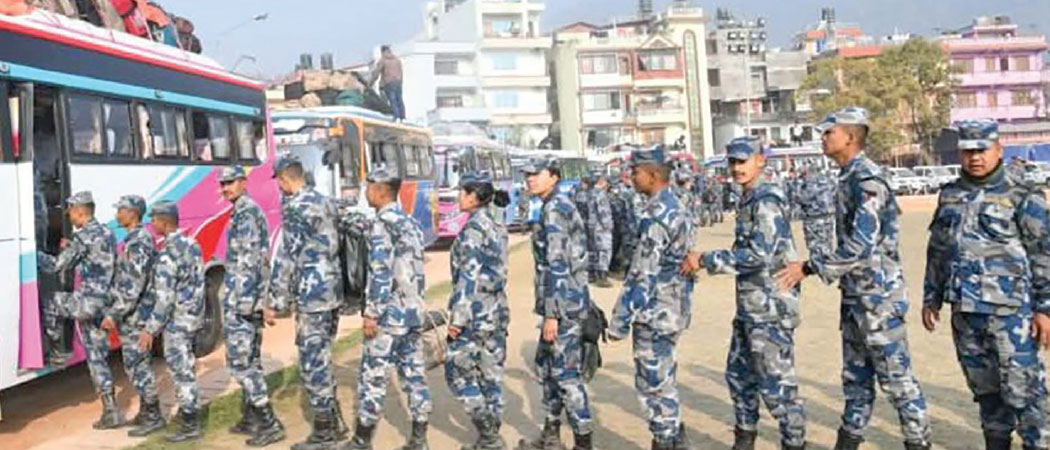

By A Staff Reporter,Kathmandu, Feb. 20: Ahead of the House of Representatives elections scheduled for March 5, Integrated Election Security teams comprising the Nepali Army, Nepal Police, Armed Police Force Nepal, and the National Investigation Department have been deployed across 165 constituencies.
Around 150,000 election police personnel have also been assigned to their respective areas to ensure a free, fair, and secure voting environment.
According to the Ministry of Home Affairs (MoHA) integrated security plan, all four security agencies are operating in coordination, with preparations completed to safeguard every polling station.
Spokesperson and Deputy Inspector General of Nepal Police Headquarters Abi Narayan Kafle said that integrated election cells formed at central, provincial, and district levels have already begun patrolling, conducting spot checks, and monitoring security arrangements.
To oversee and support police deployment at 10,976 polling centres nationwide, the Police Headquarters has deployed additional inspector general (AIG) teams across all seven provinces. Cybersecurity police units have also been mobilised to monitor, alert, and remove misleading or deliberately false information from social media that could influence voters.
The Election Commission has established a dedicated digital unit to monitor such activities, while security teams with vehicles, weapons, and necessary arrangements are already in position. With election day approaching, special attention is being given to the security of candidates and political activities of competing parties.
The Ministry has also formed an integrated mechanism to coordinate election management down to the ward level.
Across the country’s 6,743 wards, a joint framework comprising political parties, civil society, media, private sector, and community leaders has been established. Representatives from political parties, local officials, and ward-level party structures are included in this coordination.
District security committees will maintain continuous contact and coordination with this framework to ensure ownership, accountability, and responsibility in the electoral process, according to the Ministry’s spokesperson and Joint Secretary Ananda Kafle.
District security committees will also oversee peace and security, manage personnel deployment, enforce election-related laws, and take necessary action to ensure the infrastructure, security, and code of conduct at polling stations are properly implemented, added Kafle.