- Thursday, 4 June 2026

Nepal Police Go Through Political Changes
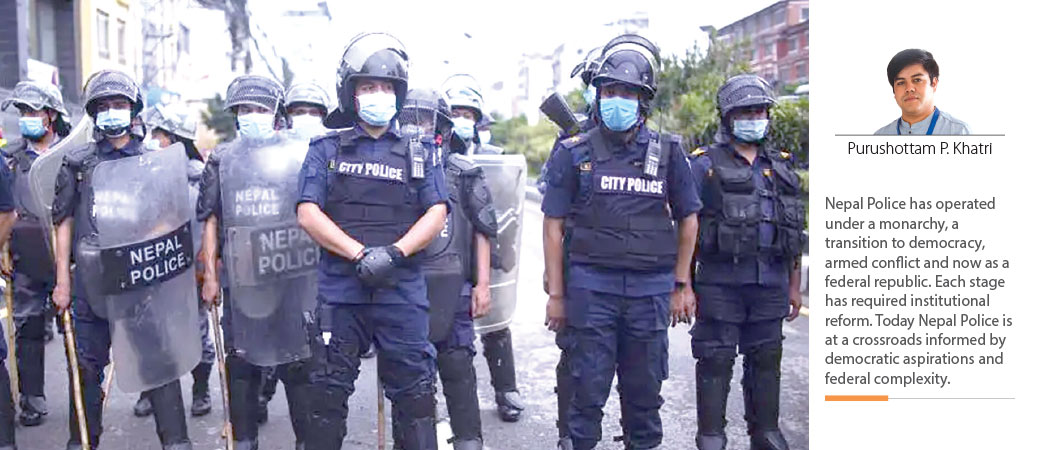

The history of Nepal Police is closely intertwined with the nation’s political evolution. Ever since the abolition of the Rana oligarchy in 1951 and its establishment as the Federal Democratic Republic through the 2015 Constitution, the institution has been subjected to the shifting systems of rule.
Its trajectory points to the nation’s transition from despotic rule to constitutional monarchy, the three decades of monarchy-led authoritarianism through conflict and unrest to federal democracy. The government had no modern police force before 1951, only 'poorly functioning', parochial and militarised institutions that represented the interests of the ruling classes and privileged institutions, rather than the rights of citizens.
In the wake of democracy being granted to Nepal, the new state needed a civilian force to enforce the law within the bounds of the constitution. This led to the development of new legislation, institution-building and police reforms. Implementation of the Police Act in 1955 and the Police Regulations in 1959, the setting up of a centrally headed police force in Kathmandu, reinstitutionalisation of a competitive selection system and formalised training system signalled the decade-long shift to professional police service.
After the dissolution of the parliament and the imposition of the party-less Panchayat system by King Mahendra in 1960, the Nepal Police existed within a monarchical singularity characterised by a lack of democratic accountability, a focus on order and stability, central control over institutions, suppression of political opposition and control of the police by the state.
In 1990, the transformation from an autocratic system to a democratically elected polity brought with it renewed democratic expectations of transparency and accountability and human rights, which the police had to adapt to. Reforms pushed for professionalisation, institution building and techniques for modernisation. However, democratisation was short-lived, as Nepali society descended into a decade-long Maoist insurgency (1996–2006).
During the crisis period, the police faced a multitude of challenges in its internal security role. It became the primary force fighting the Maoist insurgency, with its posts within the rural periphery attacked, its personnel assassinated and its resources decimated. During the initial stage, in the absence of the Nepal Army, which later took on primary responsibility for internal security, the police suffered numerous human rights violations coupled with excessive force as it endeavoured to fight the war. The decade-long conflict would strain institutional capacity, moral standards and professional discipline more than ever before. As accusations of human rights abuse and harsh police behaviours grew in frequency, the institution was put under extreme pressure in the context of the anti-insurgency campaign.
This raised questions on the equilibrium of security development and democratic accountability. The signing of the Comprehensive Peace Agreement in 2006 ended the decade-long war and launched a new political beginning. The king was terminated from the nation’s institutions, with the country becoming a republic through the abolition of the throne in 2008. The 2015 Constitution now declared Nepal a federal democratic republic, redefining its governing mechanisms, including the police.
Federalism and police restructuring
Federalism brought decentralisation, which was lacking in the traditionally overly centralised system of policing. The Nepal Police and Province Police (Coordination) Act, 2020, seeks to define the jurisdiction and areas of cooperation between federal and provincial forces.
However, the lack of a comprehensive Federal Police Act and reliance on the 1955 system pose challenges in the agreement and implementation of command, administrative oversight and resource sharing. Discussions are still underway on several issues. The core functions of Nepal Police continue to be related to its essential services of ensuring law and order, safeguarding persons and property, upholding constitutional rights and providing an impartial and independent service of enforcing the law. In a nascent democracy, policing encapsulates more than crime prevention; securing the citizen and the state is a continuum.
Democratic policing
Since 1950, Nepal Police has been representative in safeguarding elections and facilitating transitional security. The provision of services during the catastrophic 2015 earthquake also demonstrated Nepal Police’s capacity to soldier on and navigate national crises. Services have diversified to encompass scientific expertise in cybercrime, forensics and anti-trafficking efforts. International deployment of Nepal Police systems has earned them recognition as participants in multiple UN peacekeeping deployments.
This has enabled their professionalism abroad and positively contributed to the country’s reputation on the global stage. However, ongoing problems include political interference in some transfers, promotions and appointments which are seen to be based on political favouritism rather than merit and will diminish public confidence in the legitimacy of an impartial service. Regular references to human rights abuses in public and private security states call for careful management and proportional use of force.
Additional resources are essential to address modern challenges that are narrower, deeper and more technologically advanced. Democratic security has a federal face. The articulation of a federal Police Act and the establishment of clear divisions of authority are each nonetheless critical to ensuring smooth command and control. Solid collaborative mechanisms are vital for a seamless national security system while respecting provincial functionality. Public engagement and participation remain the mainstay of federal policing. Building trust and partnership in some communities can be difficult, but an active, engaged and committed police service must acknowledge evolving security concerns and other societal issues.
Reform and professionalisation
Looking forward, institutional independence and competent leadership will be vital. An ongoing focus on training, accountability mechanisms and professional development will be needed to adapt to the changing security environment. Investment in resources and expertise must be balanced with structural reform. And a service-minded approach in which officers consider themselves as representatives of the people rather than as enforcers of state power will shape the institutional culture. The trajectory of Nepal Police in many ways parallels that of the state itself.
Nepal Police has operated under a monarchy, a transition to democracy, armed conflict and now as a federal republic. Each stage has required institutional reform. Today Nepal Police is at a crossroads informed by democratic aspirations and federal complexity. Its mandates go far beyond simple crime prevention and investigation to include election security, disaster management, the fight against terrorism, cybercrime resolution and deep engagement with communities.
It must balance the use of authority with adherence to the rule of law and effective national direction with local decision-making. In the end, the foundation of Nepal’s democracy is its law enforcement institutions. They are not just agencies of protection. They are public institutions built to safeguard the Constitution and freedoms of citizens. As Nepal advances in consolidating the federal democratic system, the development of the Nepal Police will be central to stability, development and confidence.
(Khatri is a journalist at The Rising Nepal.)