- Saturday, 2 May 2026

Madhyamiki Parikrama pilgrims arrive in Matihani
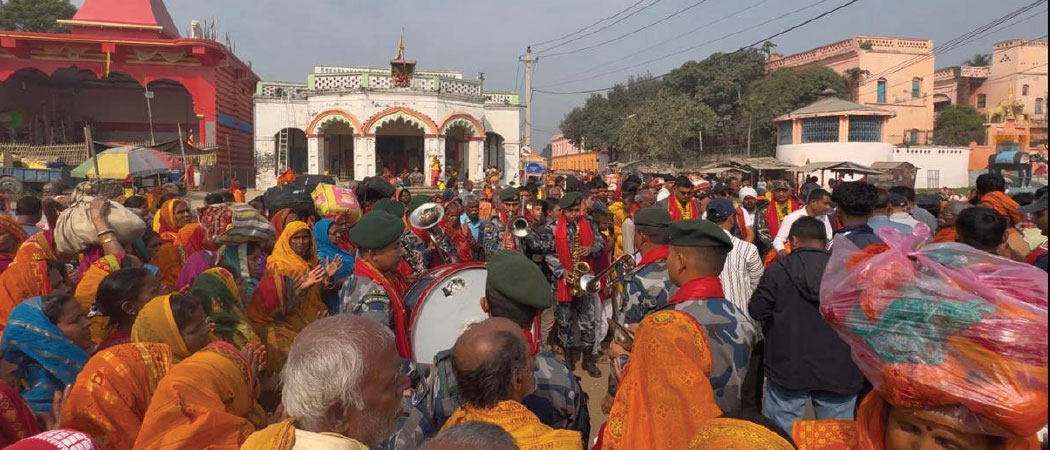
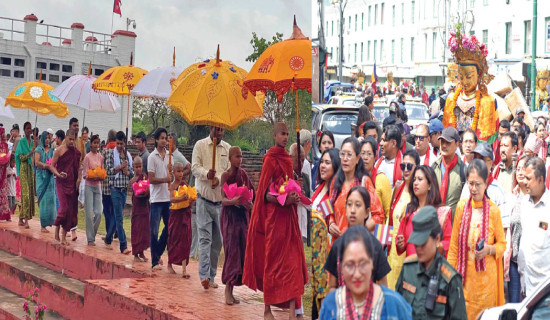
Photo: Mahesh Kumar Das Pilgrims arriving in Matihani, Mahottari, are being welcomed.

By Mahesh Kumar Das,Jaleshwor, Feb. 20: Hundreds of pilgrims participating in the mythical and historical 15-day Madhyamiki Parikrama arrived in Matihani, Mahottari, on Thursday morning.
The pilgrims, led by the Mithila Bihari palanquin, which started from the Mithila Bihari Matha in Kachuri, Dhanusha, reached Matihani in Mahottari on Thursday morning via Kalna and Phulhar in India. Matihani is the gateway to Mahottari for the Parikrama journey. Matihani Municipality declared a public holiday on Thursday to welcome the Parikrama Yatra pilgrims.
When Mithila Bihari and the palanquin of Kishori arrived in Matihani early Thursday morning, they were given a grand welcome by local residents, including Mayor Hari Prasad Mandal.
Mayor Mandal stated that the Madhyamiki Parikrama is a living symbol of Mithila civilization and social unity and said that all necessary arrangements have been made for the convenience of the devotees.
“The Madhyamiki Parikrama is not just a religious journey; it is a priceless heritage linked to the history, culture, and identity of Mithila,” Mayor Mandal said. “This journey, which unites saints and householders as one, sends a message of mutual harmony and social unity.” According to Mayor Mandal, preparations have been made keeping in mind the convenience of the pilgrims, with high priority given to health services, drinking water, sanitation, electricity, toilets, and security arrangements.
Stating that Matihani, a land associated with the marriage rituals of Ram and Sita, is one of the historical centres of the Madhyamiki Parikrama, Mayor Mandal said that the people of Matihani have been fortunate to welcome the Parikrama since its beginning, which is a matter of pride for them.
Mayor Mandal said that the Madhyamiki Parikrama, a long procession of monks, saints, and householders, is one of the longest religious pilgrimages, with a history of about 150 to 170 years.
The Parikrama Yatra, which has become a symbol of religious culture and mutual harmony between Nepal and India, has 15 rest stops, 13 in Nepal and two in India.
According to the Mithila Mahatmya, it has been observed as a pilgrimage since the eighteenth century, and pilgrims spend 15 days singing hymns and performing kirtan at night.
The long religious pilgrimage of the Parikrama takes travelers through Kalna and Phulhar in India; Matihani in Mahottari; Jaleshwor; Madai; Dhrubakunda; Kanchanban; the Dhanusha mountain range; Dhanushdham; Satoshar; and Aurahi, resting one night at each place before arriving in Janakpur on the eve of Purnima.
On the morning of Purnima, they complete the 15-day journey by celebrating Holi and circumambulating the inner sanctum of Janakpur.
It is believed that by undertaking this pilgrimage, devotees attain happiness, prosperity, mental peace, and the spiritual merit equivalent to visiting the four Dhams. During this religious journey, pilgrims walk 133 kilometres, including 107 kilometres in Nepal and 26 kilometres in India. It is believed that this Parikrama journey began with the Kalyaneshwor, Jaleshwor, Kshireshwor, and Sapteshwor Shiva temples built at the four corners of Janakpur, the capital of ancient Mithila.
The Armed Police Force and Nepal Police have been extensively mobilized to ensure the safety of the Madhyamiki Parikrama pilgrims.