- Saturday, 2 May 2026

Bangladesh Emerges From Chaos

The chaotic political transition in Bangladesh set off by the Zen Z revolt in July 2024 has finally come to an end, with the results of the national election giving a mandate to the Bangladesh Nationalist Party (BNP) to rule for five years. The BNP, which was out of power for the last 15 years, has swept the polls by winning 212 out of 299 seats contested. This election is being viewed as a historical watershed marking the end of three decades long dynastic rule by Begum Khalida Zia and Sheikh Hasina Wazed. Tarique Rehman, under whose leadership the BNP had gone to the election, is the son of Begum Khalida Zia but he is not being viewed as a dynastic successor but a catalyst for restoring democracy, peace and order in Bangladesh.
The peaceful and orderly way in which the election was held indicates how deeply Bangladeshi people cherish the democratic process, peace and stability. This election has succeeded in bringing the constitutional process derailed after the Zen Z revolt back on track but the challenges remain; the most prominent of them being the exclusion of the Awami League from the electoral process, compelling it to question its legitimacy. Against the general assumption in Bangladesh that the National Citizen Party (NCP) would come victorious, it won only 6 seats despite its alliance with Jamaat –e-Islami and nine other smaller parties.
Lack of visionary youth leader
In view of the fervor of youth power that imbued the consciousness of Bangladeshi society in the wake of the overthrow of Sheikh Hasina Wazed in August 2024, this result was unexpected. Some of the reasons for this might be the absence of a strong ideological underpinning and organisational networks of the Gen-Z movement. The youths also lacked a strong, visionary and charismatic national leader. Youth activists like Nahid Islam, Akhtar Hossen and Hasnat Abdullah remained public icons among the smartphone-wielding youths but the message of change hardly resonated with the millions of impoverished, poorly educated and rural working people occupied in earning two meals a day for their family.
Yet another drawback for the Bangladeshi Zen Zers could be their decision to ally with Zamaat- e- Islami which is considered a fundamentalist Islamic party that wants to rule the country with Islamic law. It is considered a force that stands against women's rights, a fact which is proved by its failure to field even one woman candidate to contest in the newly concluded election. In an interview given to Al Jazeera journalist Srineevasan Jain a week before the election, its leader, Dr. Shafiqur Rehman, had said that his party would never have a woman chief as it would be against the will of Allah.
The Jamaat-e-Islami also stands against the secular fabric of Bangladesh society and advocates an Islamic way of life under a thinly veiled policy of minority religious freedom. Jamaat-e-Islami did not have good relations with India till recently, which considered it a pro-Pakistani force. In recent years, however, India has had limited diplomatic engagement with this party but with skepticism. In addition to the above, the Jamaat-e-Islami also carries a 'negative historical baggage' of colluding with Pakistan and being complicit in the killing of '3 million people and raping 300,000 women during the liberation war of 1971, a charge which this party vehemently denies.
Because of these reasons, the NCP's electoral alliance with this party did not resonate well with the vast non-Muslim youths who had participated in the July uprising. This party has now become second largest party in the parliament by winning 77 seats but the Bangladeshi Zen Zs hardly see their face in their victory. BNP and Awami League have been major power players throughout post independence history of Bangladesh. With the short interregnum of Muhammad Yunus' interim government, the BNP has returned to power and it will be premature to say that stars may not shine again for the Awami League also. In view of the unfair treatment it received in the past from the Awami League, BNP has its wounds to lick but has little room for engaging in revenge politics against its former adversary.
Tight rope
Similarly, the BNP will have to perform a tight rope walk in accommodating Jamaat-e-Islami's competing aspirations and do justice to Zen Z crusade against corruption, nepotism and bad governance. The election of Bangladesh was held not only to have an elected government in place of transitional authority headed by Yunus, it was also meant to be a referendum for introducing constitutional reforms such as expanding representation, controlling corruption, setting the number for prime ministerial tenures, promoting women's right and protecting judicial independence. The BNP government will have to work for implementing these reforms while ensuring stability, dispensing justice to the victims of the revolt, providing employment to the jobless and enforcing law and order in the streets.
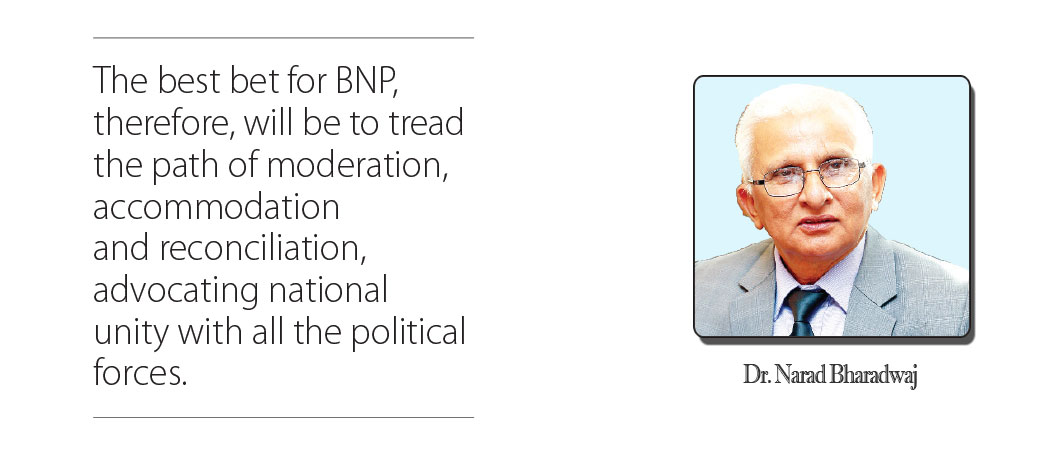
During its earlier tenure in power, spanning from 2001 to 2006 as a coalition partner of Jamaat-e-Islami, BNP had come under criticism for repressive use of power and conniving at covert political killings. Now it is facing the same party as the main opposition in the parliament, with its former nemesis, Awami League, silently plotting long games from outside to stage a comeback. Even the rapidly shifting geopolitical alignments caution the BNP government against using the majority to monopolise power. The best bet for BNP, therefore, will be to tread the path of moderation, accommodation and reconciliation, advocating national unity with all the political forces.
(Dr. Bharadwaj is a former ambassador and former chairperson of Gorkhapatra Corporation. bharadwajnarad@gmail.com.)
-square-thumb.jpg)