- Saturday, 6 June 2026

Are We Enjoying Democracy?

Abraham Lincoln, the 16th president of the United States, said that democracy is the government of the people, by the people, and for the people. If we explore the origin of the word 'democracy', we find that it has been derived from the Greek word 'demokratia' where 'demos' stands for 'the people' and 'kratia' for 'power' or 'rule'.
So, in very simple terms, democracy can be defined as a system of government that is decided by the people via election. They vote for representatives and send them to parliament, which is a country's legislative or law-making body. The parliament develops different systems to run the country smoothly. If we see the history of democracy, it goes back to the fifth century BC. During that time, it was first introduced in Athens by Cleisthenes of Athens, who is considered the father of democracy.
History
Since then, there has been the practice of democracy in the world in different forms. Nepal has its own history of democracy. For the first time, with the help of political leaders, such as B. P. Koirala, Ganesh Man Singh, Krishna Prasad Bhattarai, and many others, the late king Tribhuvan Bir Bikram Shah took an initiative to establish democracy in Nepal on the 7th of Falgun, 2007 BS or 1951 AD. This step was taken to topple the 104-year-long autocracy of the Rana regime. So, this year, we, the Nepali people, are celebrating the 75th democracy day.
During these years, Nepal has gone through different democratic movements, and people have experienced a lot of ups and downs. The Nepali Congress-led government ruled the country for about a decade. Unfortunately, this government was removed by the late King Mahendra Bir Bikram Shah in 1960 AD to introduce the Panchayati system, which he claimed was a suitable system for the nation. But people started to feel that this system of monarchism pushed democracy back.
There are different indicators of democracy. Some of them include sovereignty, fundamental human rights, equality, and individual freedom, open access to information, freedom of speech, free press, people's participation in politics, multi-party system, free election, independent judiciary, transparent government, decentralisation, and others. Since the Nepali people were deprived of all these facilities, they were not happy with the Panchayati system.
As a result of their dissatisfaction, there was a joint civil resistance in 1990 AD. It was led by the United Left Front, which turned out to be the CPN UML and Nepali Congress. After a long struggle, eventually they were successful in overthrowing the Panchayati system and establishing a constitutional monarchy, which seemed to be a form of democracy.
Although the government system was changed and people got limited access to democracy through a multi-party system, they were not fully satisfied. This was reflected in the Maoist rebellion in 1996 AD, and led to an armed civil war. Once again, democracy was at stake in Nepal. The people's war lasted for a decade, and it resulted in thousands of deaths and widespread destabilisation, particularly in the countryside.
In the meantime, the Royal Palace Massacre occurred, in which King Birendra and much of the royal family were killed. Following this tragedy, King Gyanendra ascended to the throne. He dissolved the government and assumed absolute power in 2005, which invited much public criticism and opposition from political parties. This led to yet another movement in 2006 AD. It forced the king to step down. Subsequently, Parliament was reinstated, and the signing of the Comprehensive Peace Accord with the Maoists formally ended the decade-long civil war.
Although democracy was restored this way, it had not been implemented as people had expected it to be. Three major parties emerged - Nepali Congress, CPN UML, and Maoist - to rule the nation. They took charge of the country turn by turn. Gradually, corruption, nepotism, anarchism, inequality, unemployment, brain-drain, and whatnot started to foster. When all this reached a climax, the Gen Z revolution occurred in 2025. We all know the rest.
This snapshot of the political history of Nepal shows that more than seventy years have been employed and spent on democracy. It seems like the movement started against the autocracy of the Rana dynasty has not fully achieved its goals yet. Dr. Tara Nath Ghimire had conducted a research study on 'Democratic movements and challenges in Nepal' and found several reasons for the failure of democracy in Nepal. First of all, the political parties were unable to teach people that the country is bigger than the party.
Greed for position and power
The Nepali citizens could not be emotionally organised due to the leaders' greed for position and power. Secondly, the political leaders have lost respect for morality. The rights and duties of citizens are not delineated. The general people are also prone to immorality due to the unethical actions of political leaders. Another reason Mr. Ghimire points out is that the media also has an important role in shaping democracy, but unfortunately, most of them are run by political parties, and this leads to bias.
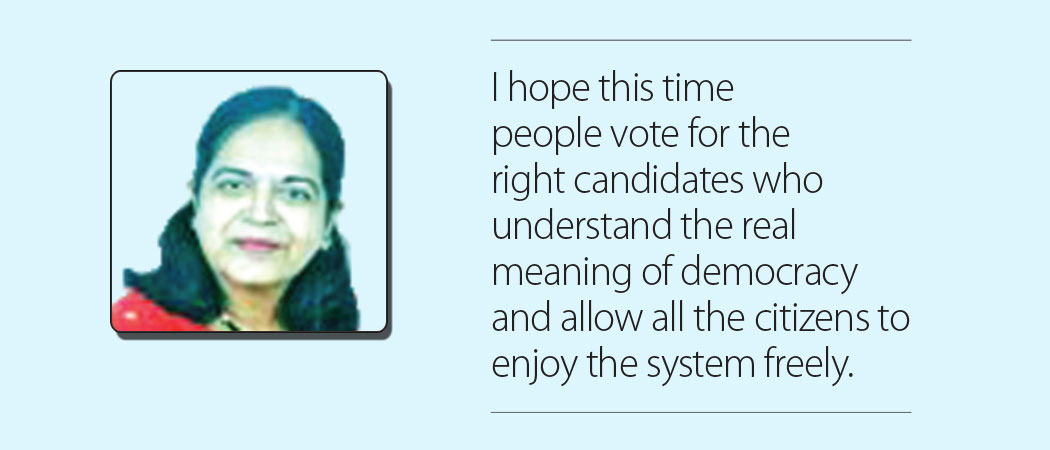
Once again, Nepali people are at a threshold of general elections to elect the members of the House of Representatives. I hope this time people vote for the right candidates who understand the real meaning of democracy and allow all the citizens to enjoy the system freely. The elected political leaders should keep in mind that democracy is the government of the people, by the people, and for the people. It, in fact, protects people's power, not the political leaders'. Happy Democracy Day to all who are in Nepal and abroad.
(The author is the director of Vidya Shilpa Academy, Damak, Jhapa.)