- Monday, 8 June 2026

Struggles Within Democratic Progress

Nepal observes Democracy Day every year on Falgun 7 to mark the end of the Rana regime in 2007 BS (1951 AD), a moment that changed the political trajectory of the country. The fall of the 104-year-old regime opened the opportunity for citizens to claim fundamental rights and imagine a political structure accountable to its people. Seventy-five years down the line, the day serves as a remembrance of historic victory as well as how far the democracy has prevailed in Nepal, but also where it struggles to continue smoothly.
From the sacrifices of the martyrs, political prisoners and parties that challenged the system, modern democracy has evolved for many Nepalis into what it is today. The overthrow of the Rana regime was a backbone of the establishment of democracy, which has been a story of freedom of rights for the people, even though the struggle lies in its proper implementation.
Nepal’s democratic journey has been a rollercoaster of progress and reversal. After the fall of the Rana regime, political instability and power sharing brought upon the party the less Panchyat system that lasted for three decades. The people movements in 1990 and 2006 took place to revive people’s rights, leading to multiparty democracy and the abolishment of monarchy to establish a federal democratic republic. The promulgation of the Constitution in 2015 represented another milestone, promising inclusion, rights, and decentralised governance.
Despite these achievements, the path has rarely been smooth. Each phase has revealed the challenges of translating democratic ideals into durable institutions.
Former Minister of Law and Attorney General Agni Kharel reflects on the early movement as a conscious effort to replace an exclusionary system with one rooted in public participation. According to him, the political actors of the time, though still developing organisationally, shared a clear objective, which was to ensure that citizens could elect their leaders and hold them accountable.
Kharel notes that democracy inherently involves complexity. Decisions are easier to make under an autocratic system, because there is no questioning there, but in a democracy, the process ensures that voices of the citizens are heard. In his view, this participatory nature is the greatest strength of democracy, even though the process takes time. Political analyst Chandra D. Bhatta says that the constitution of Nepal, electoral processes, and representative bodies are essential institutional frameworks required for democratic governance, which Nepal already possesses. However, he describes the country as still being in a phase of consolidation.
The continuous political instability and shifting coalitions have made long-term policymaking difficult. Bhatta points out that public hope of economic progress and personal rights has been tarnished due to the pace of delivery. This gap between aspiration and outcome, he argues, contributes to growing frustration among citizens.
Bhatta stresses strengthening political stability, ensuring effective implementation of constitutional provisions, creating economic opportunities, and addressing concerns of a large and increasingly vocal youth population. Without progress in these areas, he warns, democratic institutions risk losing public confidence.
For constitutional expert Bipin Adhikari, political leadership and governance culture are the two challenges that are halting the progress of democracy and constitutional framework. He says that the democracy in Nepal is continuously struggling with issues of accountability, inconsistent rule of law and the persistence of corruption.
Adhikari believes that internal political division and short-term calculations are two main reasons the government fails to sustain their mandates. He acknowledges that Nepal has made good progress in preserving its democracy, but it will not be beneficial until there is good governance and insurance of the effective functioning of public institutions.
In his assessment, democracy cannot be judged solely by its existence but by how well it serves citizens.
Former Constituent Assembly member Khim Lal Devkota notes that Nepal’s political system and democracy have evolved through multiple phases, from the Rana regime to Panchayat governance, constitutional monarchy and finally republicanism. This broader historical and structural context has left multiple institutional legacies.
Devkota combines current democracy with geopolitical pressures, administrative capacity, citizens' behaviour and the cost of elections. He warns that all these mechanisms risk encouraging corruption and narrowing political participation. Such trends, he suggests, could undermine the inclusiveness that democracy seeks to promote.
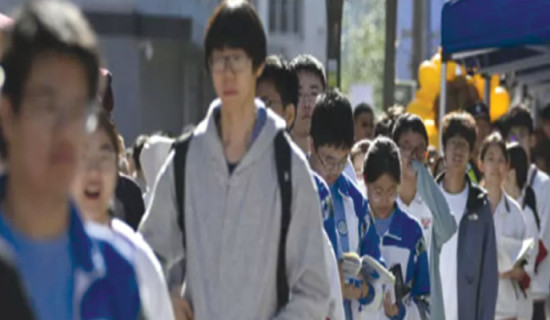
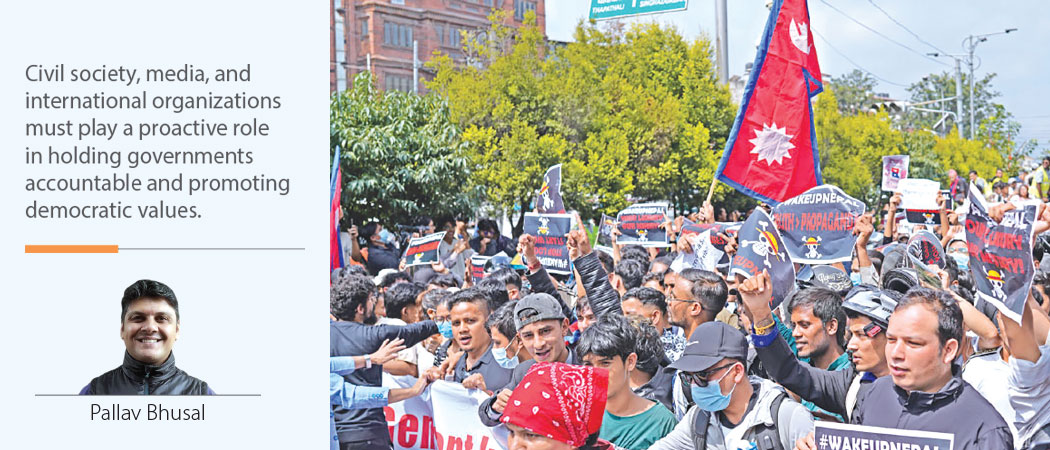
Younger Nepalis, who have not witnessed any people movement and only read about it in books or on the internet, are interpreting democracy through a different lens. They recently held their own revolution, given the name Gen Z movement, to uphold their basic democratic rights of good governance, anti-corruption and freedom of rights. The backdrop of it arises not from historic milestones, but more of it derives from everyday realities, including employment prospects, public services, and opportunities at home.
Gen Z activist Rakshya Bam describes democracy as a system that guarantees fundamental freedoms, including the right to speak openly, organise, and question authority. She acknowledges these as important gains compared with earlier periods when dissent was suppressed.
At the same time, she notes a growing emphasis among young people on improving living conditions. Contemporary civic movements, she suggests, reflect a shift from fighting for political rights to demanding effective governance and tangible results. This perspective highlights an evolving expectation, which is that democracy must deliver not only freedom but also opportunity.
From neighbourhood gatherings to social media conversations, democracy is the most talked about topic in the world. Freedom of expression is a basic human right that is applicable in every democratic society. Within these rights, citizens debate about economic challenges, governance performance and the pace of development. These platforms become an active, engaging arena with political processes.
Democracy has gifted Nepal an expanding representation for women, marginalised communities and historically excluded groups. All citizens from every background are involved in political and public institutions. Public debate has become more open, and criticism of leaders is widely expressed, which are the indicators of a functioning democratic culture.
However, democracy has still not overcome political polarisation and the influence of money in politics and policymaking. Experts caution that for democracy to flourish, there needs to be assurance of free and fair political competition.
Democracy Day should be celebrated as an honour to remember who fought for the people’s right to be free. At the same time, Democracy Day also reminds us that reforms are still needed.
It should not only be about speeches and celebrations. It should also prompt honest questions. Are our democratic institutions truly responsive to the people? Are leaders accountable for their actions? Are ordinary citizens genuinely benefiting from the system they helped to build?
Building a stable and inclusive political system takes time, and democracy is the backbone that helps in building those systems. The country has witnessed many forms of democracy, from the end of the Rana regime to the demand of rights from Generation Z.
Experts believe that for the democracy to prevail, the years ahead will require stronger governance, better economic delivery and more ethical leadership. But democracy cannot function without active citizens and their participation. Democracy gives them the right to ask questions and contribute to public life.
(Bhusal is a TRN journalist.)