- Tuesday, 2 June 2026

Idle Wisdom Must Serve Villages

The Kathmandu Valley has become a garrison for a vast army—not one preparing for the next operation, but one living in a state of comfortable post-war peace. This is an army not of weapons but of wisdom. It is comprised of retired civil servants, military and police officers, professors, technocrats, consultants, lawyers and the parents of those employed abroad.
They meet at marriage parties and bratabandha ceremonies in lavish banquet halls and party palaces flourishing along the Ring Road. High dignitaries from the government, non-governmental organisations (NGOs) and international non-governmental organisations (INGOs), as well as businesspersons who share a common origin, ferry many of them there. In the corners of these halls, they engage in panel-like discussions, striving to devise practical solutions for the country’s ongoing problems. Their arguments are often provocative, sparking the interest of bystanders. The opinions that surface reveal sharp ideas in critical thinking, problem-solving and decision-making.
They discuss the migration of youth from villages to cities and then to foreign lands. The fault, they say, lies in our education curriculum, the heavy cost of healthcare, water scarcity, unemployment and air pollution. These arguments are “handy” for these grey-haired elites, who critique the actions and inactions of responsibility holders—from local communities to the highest echelons of power. Outside social events, one can find them at the annual general meetings of banks and financial institutions, serving as advisers, coordinators or partners. At times, these discussions turn into long debates or rivalries, with participants blaming one another while defending themselves. This cycle of meeting and discussing has become the annual ritual of our capital.
Yet most of these senior and elite groups have either left their ancestral homes or forgotten them—a defining condition of present-day Nepal. These are the same people who began their lives in local schools and who still carry memories of the misty village mornings, the scent of kitchen smoke, the damp earth of the khet, and the sound of the school bell ringing across the hills. For the new generation, those ancestral village homes once served as the source code of success while living in the crowded suburbs of Kathmandu or the high-rises of Tokyo, Texas, Sweden or Sydney.
An ocean of experience and wisdom—from high-ranking officers to thinkers who climbed the ladders of opportunity—now sits unused and unharnessed, idling inside glittering villas and towering flats behind iron gates.
Silent responsibility
The daily ritual for many seniors is to scan the morning headlines and watch the news. The general tendency is to watch—and sometimes bellow at the screen—rather than ask, “Why?” and “How?” We see reports of donations and support from foreign governments, UN agencies, INGOs and benevolent individuals far from our soil. The collected savings of foreign schoolchildren, taken from their snack money, have become a primary source of midday meals for our children in schools across the country.
At present, the World Food Programme (WFP) is the main donor to our national school nutrition programme, fortifying rice with iron and zinc to fight the stunting that threatens our youth. The United States provides the lentils and fortified oil that keep classrooms full. Finland is developing green kitchens, replacing traditional chulos with clean induction stoves in remote schools in Karnali. South Korea is implementing the Zero Hunger Communities programme, which aims to eradicate hunger and improve nutrition, while Japan’s International Cooperation Agency (JICA) supports school gardens to provide fresh greens for the next generation. While we thank these governments and agencies for supporting our future leaders during this painful formative period, where are we?
Organisations such as Teach for Nepal are actively striving to close this gap. It is a movement of outstanding university graduates and young professionals who commit two years to teaching in public schools. They focus on ending educational inequity, ensuring that a child’s path in life is not determined by their birthplace, and they work to provide essential resources and support systems that enhance opportunities for underprivileged students. Beyond academics, they provide mentorship and have become a frontline force in transforming the very schools our elites once attended.
There are hundreds of individuals on the forefront providing clothing, books and computers, or establishing scholarship funds. Some mothers’ groups are joining hands to prepare midday meals. Local governments have also started contributing, with a national budget of about Rs 10 billion annually.
But the majority of us are busy elsewhere. Our culture often directs our donations toward the religious sector. While that has its place, those contributing solely to religious causes need to review their strategy. Could we consider delving deeper into the news to fully grasp the seriousness of the situation? Why have we abandoned the most essential duty of a society—to provide the bare minimum of food to our children—and instead relied on the kindness of friends from far away?
We have kept our “Hari” (inner self) in silent mode, convincing ourselves that the government or donors have it under control. We remarked on the Rs 84.45 billion economic loss during the Gen Z movement of Bhadra 2025 as a political problem, failing to observe that it is a fault line triggered by our own collective inaction.
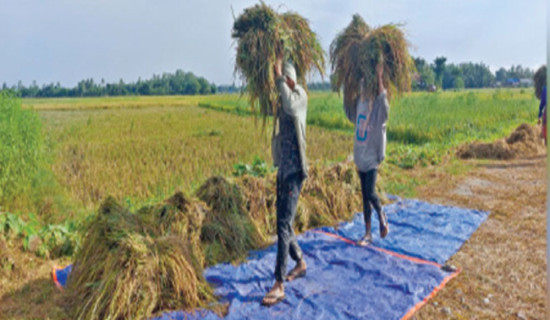
We must realise that as we abandon our villages, we create a vacuum for leadership, mentorship and investment. While we built our private empires, our ancestral homes (paitrik ghar) and the lands we once tilled have become empty and barren. Much of our land has turned into jungle; monkeys have begun ruling where we once thrived.
Our unproductivity in Kathmandu is a betrayal of the village. Returning to the village is not a retreat; it is a redeployment to the strategic frontier. A retired professional can act as a moral beacon who stabilises School Management Committees (SMCs), protecting them from local political infighting and applying the efficiency skills they practised for forty years.
The Vedic call to modern sannyasa: our struggle with the status trap is a spiritual failure to honour our own civilisation’s wisdom. Hindu tradition defines the four stages of life. By age 65, we are meant to transition into Sannyasa Ashram, the stage of renunciation. The Vedic command is clear: leave the home to the sons.
In modern terms, this means the retired elite must vacate seats of power to make way for the younger generation. We must surrender the keys to the state and the titles of the past.
However, sannyasa is not an escape into idle silence; it is a transition from self-interest to selfless service. By taking our wisdom to the primary schools in our villages, we practise modern sannyasa. We renounce the ego of the general to embrace the humility of the mentor. To cling to government posts after sixty is not just a national waste; it is a violation of our ancestral dharma.
Village legacy
In the noble days of our grandfathers, our family's prestige was measured by how much we contributed to the village: kulo, pani, pokhari, and the chautari beneath the cool shade of the pipal tree. Today, we measure it by the height of our compound walls in the city. We have traded community impact for private isolation.
But true success is not how far we have run from our origins; it is how much power we have to return and transform them. The world is watching our villages and recognising their potential—particularly in sustainable development and community resilience—as models for innovative practices that can be adopted globally. It is imperative that we take the lead.
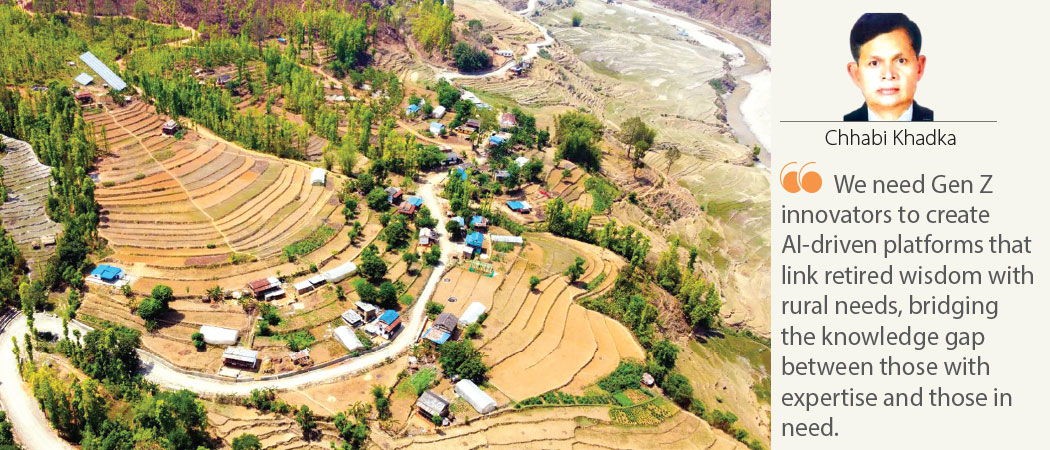
We must reclaim this vast resource of life experience and wisdom that present-day Nepal currently wastes. We need Gen Z innovators to create AI-driven platforms that link retired wisdom with rural needs, bridging the knowledge gap between those with expertise and those in need.
If we visit our village. Let us go as auditors of our future. Check the plate: Is the school meal fresh? Check the kitchen: Is it healthy? Check the home: Can our empty house become a hub for nutrition and health? Let us not allow the story of our families to end with a “For Sale” sign and a rusted lock. Our ancestors are watching. The children are waiting. The soil—the very dust that formed us—is calling us back to our ancestral homes.
(The author is a retired brigadier general of the Nepal Army.)