- Saturday, 2 May 2026

A Pearl On Mumbai’s Shoreline
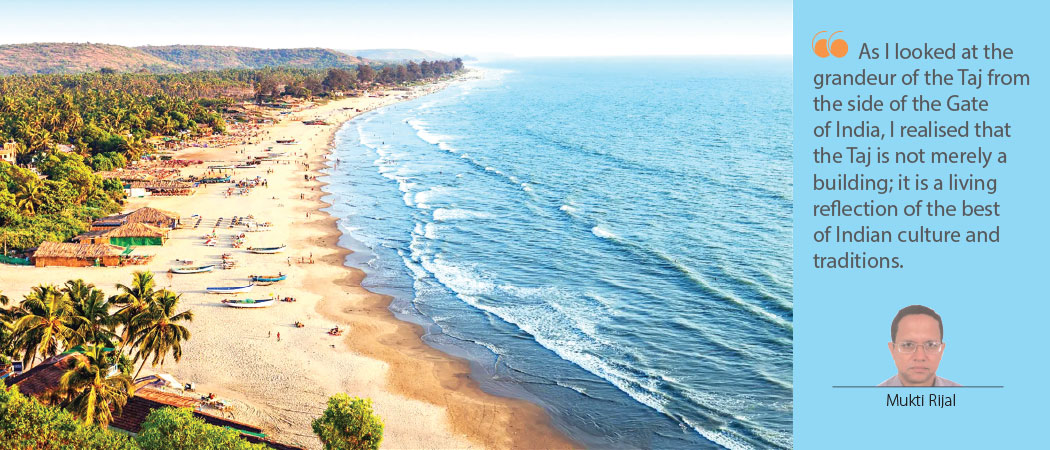

I have been to several prominent cities in India, including Kolkata, Chennai, and New Delhi, and stayed there for months. However, I had not had the opportunity to see Mumbai in Maharashtra – the much-touted commercial and financial hub of India. Thankfully during the previous months my family members joined with me to travel to such destinations as Goa, Mumbai, Ahmadabad and their adjoining areas in India as part of an itinerary package. After visiting Goa and its several scenic beaches, including the famous Calangute, for three days, we took a bus and reached Andheri in Mumbai.
We were picked up by car driver Surya Kumar Yadav at Andheri and taken to the Subha International Hotel, where we were put up for three days. I requested the driver to take us to a nearby bookshop to get reading material that would let us know about the past and present of Mumbai. I found a book titled “Bombay: Meri Jaan: Writings on Mumbai” edited by Jerry Pinto and Naresh Fernandes, and it is extolled as a wonderful collection of writing – poetry, fiction, theatre, social history, memoirs, and journalism – on India’s most cosmopolitan city. As I flipped over the pages of the book, I got stuck at the write-up titled "War comes to Bombay" written by Khwaja Ahmed Abbas, which was an extract of his highly readable book Bombay, My Bombay: The Love Story of the City, published in 1987.
Abbas was a popular columnist in the Bombay-based Blitz weekly, edited by R.K. Karanjia, which was one of the popular magazines across India and overseas during the seventies. While at Mumbai, I made it a point to ensure that the city tour itinerary afforded us the opportunity to catch a view of the famous Taj Mahal Hotel, opened way back in 1903 by India’s well-known patriotic industrialist Jamsetji Tata, the forefather of Ratan Tata, who passed away a few months ago. About this hotel, it is said that Shah Jehan’s dream in marble was born out of his love for his wife. Jamsetji’s handiwork, the Taj Mahal Hotel, was born out of a love for his city, Mumbai.
I have stayed in the impressive Tata's Taj Hotel, New Delhi, twice in the past as a sponsored guest. New Delhi's Taj also epitomises and offers the best a hotel can do for its clients. In New Delhi, when the Taj Mahal Hotel was built, marble cutters from Makrana, painters from Rajasthan, carpet weavers from Panipat, mural artists from Pune and block printers from Kolkata were employed. It is said that till 1970 the Tata Indian Hotels Company Limited had only one historic hotel in Mumbai.
The Tatas then took over the old palaces of the Maharajas in Rajasthan, restoring and refurbishing them to their former glory. One was in the pink city of Jaipur, and the other was further down in Udaipur. The Lake Palace hotel in Udaipur is a small island set like a pearl in the tranquil waters of Lake Pichola. A complex of three hotels was created in Goa, including one having a typical Goan village ambience. RM Lala, in his book Creation of Wealth, focused on Tata’s contribution to the development of modern India and writes, "As India enters the 21st century, the Taj Group, which has grown into a chain of sixty-four hotels, shows no sign of slowing down.
My interest in catching at least a superficial view of the Taj Hotel had been evoked, among others, by the fact that it had been a target of a terrorist attack on 26 November 2008. I had read a comprehensive story about the terrorist attack on this hotel which was published in major newsmagazines both in India and abroad.
According to news reports, the siege at the Taj hotel began on the night of 26 November and ended on 29 November 2008 after Indian security forces regained full control. The attacks occurred at multiple locations in Mumbai simultaneously. Ten armed Islamic militants carried out the attack. The militants, according to reports, chose Taj because it was a symbol of Indian pride and economic progress located near the Gateway of India, an iconic landmark. Indian commandos killed the terrorists barricaded in the hotel to end the three-day battle. At least 31 people had died at the Taj.
Approximately 450 people were staying in the Taj Mahal Palace and Hotel at the time of the siege. The attack was planned, according to the reports, using information compiled by David Headley, a Pakistani-American, who had stayed at the hotel multiple times and had gathered intelligence on its layout and security measures.
Soon after this, Tata chairman late Ratan Tata is reported to have said in an interview with CNN’s Fareed Zakaria that they had received advance warning of the attacks and that some countermeasures had been taken. The less-damaged sections of the Taj Mahal Palace and Tower hotel reopened on 21 December 2008. According to the reports, it had taken several months to rebuild the popular heritage section of the Taj Mahal Palace Hotel.
As we were walking near the Gateway of India, bathed in the golden light of afternoon, the Taj Hotel's domes gleamed against the Arabian Sea. Its red-stone façade exuded a quiet majesty. We had requested the hotel guards enter the lobby. We were allowed to enter the exuberant lobby. We found soaring ceilings and soft lighting, carpets and floral arrangements were very attractive. Framed photographs captured decades of royal visits, international dignitaries, and cultural icons.
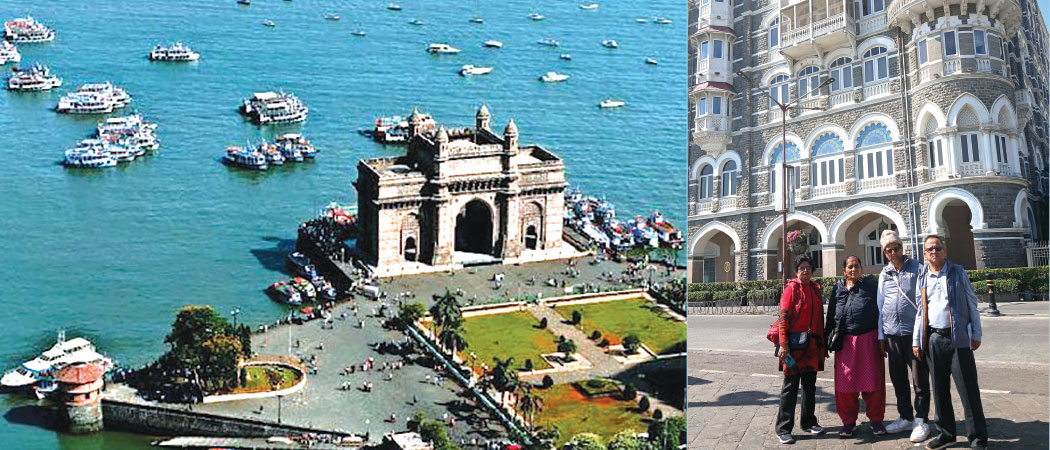
In fact, Taj is not just architecture; it is a living testimony to beauty, courage, and the enduring citadel of human initiative. Standing by the Arabian Sea, watching the sun set behind its domes, I understood why generations of dignitaries, leaders, and travellers had been lured by the grandeur of the hotel.
The hotel has been popular with international tourists, diplomats, and business leaders. Jamsetji Nusserwanji Tata believed that India deserved hotels that could rival the best in the world so that travellers, dignitaries, and artists could experience comfort, luxury, and elegance in equal measure. At a time when luxury hospitality was largely dominated by colonial powers, Tata’s vision was rooted in innovation and Indian identity.
The hotel was designed to offer world-class services while reflecting India’s rich artistic heritage, aiming to provide a welcoming environment for all guests, regardless of their background, in contrast to the exclusivity of colonial-era establishments. In the book 'Creation of Wealth', written by R.M. Lala, there is an interesting story as to why Jamsetji started the Taj Hotel in Bombay.
When he was reportedly refused admission to a hotel in this city which was reserved for Europeans only, he felt offended by this humiliation; he started building this hotel. From the day it opened, the Taj Hotel was recognised as one of the best in the world. In his foreign travels, Jamsetji made most of the purchases for the hotel himself, lavishing the Taj with the finest equipment Europe could offer. Jamesetji had already spent twenty-five lakh rupees on it, at a time when one could build a mansion for a mere one lakh rupees. According to RM Lala, as Taj was one of the first buildings in Bombay to be lit by electricity, it attracted a number of onlookers.
Between Shepherd’s Hotel in Cairo and Raffles Hotel in Singapore, there was nothing like the Taj. The Taj Mahal hotel features in over 90 travelogues, biographies and novels. Louis Bromfield's book titled "One Night in Bombay" revolves around the Taj. The hotel was the subject of a four-part BBC documentary series called Hotel India.
The hotel was a shooting location for Christopher Nolan's film Tenet, released in August 2020, among others. The hotel's corridors, lounges, and sea-facing balconies enchanted royals, artists, writers, and ordinary travellers. Every corner seemed to echo with music, laughter, and the polite clink of teacups. According to reports, it has hosted an illustrious array of dignitaries whose visits have added to the hotel’s legendary status. Among Indian leaders, Prime Minister Jawaharlal Nehru frequented the hotel for diplomatic gatherings, often praising its blend of elegance and warmth. Indira Gandhi visited for state functions, remarking on the hotel’s “majestic interiors and seamless service".
Queen Elizabeth II of the United Kingdom had stayed here during her official visits, reportedly enchanted by the grand domes. A common theme runs through all these accounts: guests are enchanted not only by the Taj’s architectural splendour but also by its human touch, where tradition and luxury coexist in seamless harmony. According to reports, among global leaders, the hotel has hosted several US presidents during their official visits to India. Clinton reportedly admired the seaside view from the Sea Lounge, calling it “a magnificent blend of tradition and modernity".
Other luminaries include Prince Charles and Princess Diana, who stayed at the Taj during official and private tours. International artists, writers, and filmmakers — from Diana Ross to Amitabh Bachchan in Bollywood circles — have also lauded the hotel for its warmth, impeccable service, and historic charm. Many memoirs and travelogues describe the grand staircases, marble floors, and crystal chandeliers as unforgettable experiences. Guests have reviewed that the hotel feels like both a palace and a home, where history, culture, and personal comfort coexist in harmony.
As I looked at the grandeur of the Taj from the side of the Gate of India, I realised that the Taj is not merely a building; it is a living reflection of the best of Indian culture and traditions. Its grandeur lies not just in stone and marble but also in the vision of its founder. In September 1889 Jamsetji had announced an offer that was to astonish the men of the day. He decided to set aside fourteen of his buildings and four landed properties in Bombay for an endowment to establish a university of science. RM Lala, in the chapter titled "Impulse of Learning", writes about the content and quality of philanthropy of the Tatas.
He quotes Jamsetji, who had spelt out his views on philanthropy elaborately, saying, 'There is one kind of charity common among us, and which is certainly a good thing. It is that patchwork philanthropy clothes the ragged, feeds the poor, and heals the sick. I am far from decrying the noble spirit that seeks to help a poor or suffering fellow.
However, charitable hospitals and poor asylums are comparatively more common and fashionable among us Parsis. A nation or community advances more by uplifting the best and most gifted than by propping up its weakest members. I prefer this constructive philanthropy, which seeks to educate and develop the faculties of the best of our young men."
(The author is presently associated with Policy Research Institute (PRI) as a senior research fellow.)
-original-thumb.jpg)