- Thursday, 4 June 2026

Democracy Key To Empowering Women

The democratic movement and women's emancipation are interlinked, as both seek to establish social justice and economic equality. Democracy provides the necessary ground to end all forms of exploitation and oppression. In Nepal, men and women fought shoulder to shoulder against the autocracy, resulting in the restoration of multiparty democracy, human rights and inclusive laws. Following the 1951 revolution, the country pursued a raft of constitutional reforms and institutional efforts that laid the foundation stone for women's empowerment.
Before the advent of democracy, women had very limited access to education, job opportunities and health care. Under a democratic polity, women got a fair crack of the whip, improving their status in society. The constitution, promulgated in the aftermath of the 1990 People's Movement, was instrumental in enhancing gender parity. It guaranteed fundamental rights and equality before the law. It strongly prohibited discrimination based on gender, caste and colour, opening the door for equal opportunities in education and employment. Women, confined within the four walls of the house, started to assert their rights in every sector, which enabled them to leave their mark on the public.
Increased participation
The Local Self-Governance Act of 1999 (2055), which requires at least one seat in each ward to be filled by a woman candidate, significantly increased women’s participation at the grassroots. At a time when the literacy rate among women was very low, this policy provided women with public decision-making and leadership roles. It greatly helped them build capacity and play a role in local and national politics.
Likewise, the Interim Constitution of Nepal (2063 BS), promulgated following the success of Janaandolan II, led to the peace accord between the Government of Nepal and the Communist Party of Nepal (Maoist). It made significant advances in women's rights with provisions for their proportional representation in state organs. It ensured at least 33 per cent representation of women in the Constituent Assembly. The constitutional arrangements guaranteed reproductive health rights as fundamental rights and strengthened women's control over their bodies and healthcare decisions.
The Second Constituent Assembly promulgated the Constitution of Nepal 2072, declaring Nepal as a federal democratic republic with stronger commitments to inclusion and promoting women's rights. Article 18 of the constitution has ensured the right to equality, while Article 38 has spelt out specific rights of women, including lineage rights, reproductive health rights, and protection from violence. It also has a mandatory 33 per cent representation of women in the federal parliament. It also requires that either the Mayor, the Deputy Mayor, the Chair or the Vice Chair in local level must be a woman. Women got the opportunity of broader participation in policy-level and decision-making roles at the local level.
Women have made significant strides in civil service. Last year, women made up over 80 per cent of candidates selected through open competition. The landmark policy of 33 per cent reservation for women in civil service has made it more inclusive. It has been proven that gender-friendly reforms can transform public institutions. According to the 2021 population census, women’s literacy rate increased to 69.4 per cent, while it was 57.4 per cent a decade ago.
Likewise, the enactment of the Human Trafficking and Transportation Control Act (2064), the Domestic Violence (Crime and Punishment) Act (2066 BS) and the Labour Act, 2017 gave a big boost to women's empowerment. The Human Trafficking and Transportation Control Act (2064) BS, which has criminalised the trafficking of women and girls, includes provisions for compensation and rehabilitation of victims. It provided a legal shield to women vulnerable to trafficking and exploitation.
A few years back, the trafficking of women and children was one of the serious problems. Organisations like Maiti Nepal and Shakti Samuha played commendable role in checking trafficking and rehabilitating the trafficked women.
The Domestic Violence (Crime and Punishment) Act (2066 BS) has defined domestic violence as a punishable crime. By recognising physical, mental, sexual and economic violence committed by spouses, family members or relatives of the same household, it protects women from domestic and intimate partner violence. The Gender Equality Act (2063 BS) became instrumental in ensuring equal rights for women.
The establishment of the National Women's Commission (NWC), an independent constitutional body, has proved to be a milestone in the protection and promotion of women's rights. It has been tasked with monitoring laws and policies related to gender equality and recommending suggestions to the government. Besides, the organisation works towards ensuring gender mainstreaming through proportional, social, inclusive and meaningful participation of women from various communities. The NWC obliges the government to fulfil the latter’s commitments expressed in the international conventions and forums.
Social protection
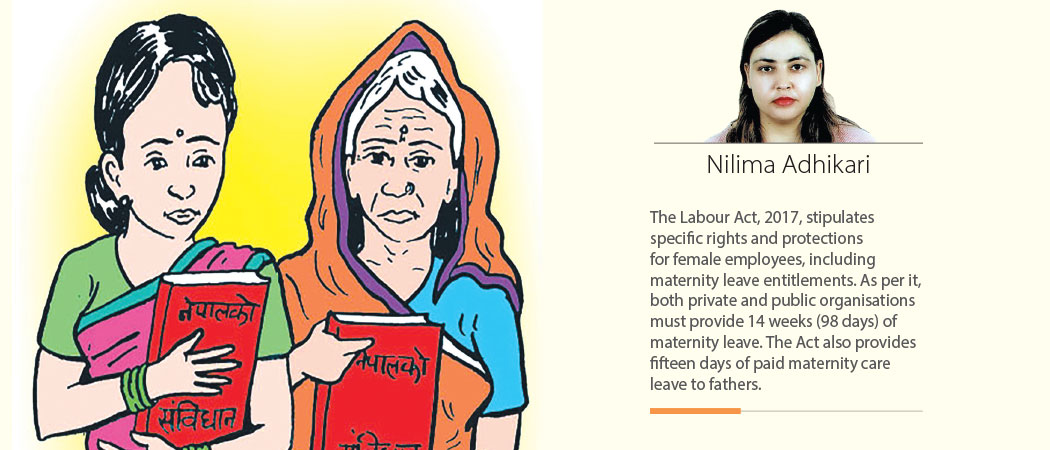
The Labour Act, 2017, stipulates specific rights and protections for female employees, including maternity leave entitlements. As per it, both private and public organisations must provide 14 weeks (98 days) of maternity leave. The Act also provides fifteen days of paid maternity care leave to fathers.
These gender-supportive constitutional and legal frameworks are direct outcomes of democratic movements that took place in different phases of Nepal’s history.
Women themselves were at the forefront of democratic upheavals that catapulted them to the higher leadership rung. Nepal’s democratic tradition is rich because of women’s sacrifices and participation in it. Democracy is both a means and an end, providing legitimate spaces for women to engage in meaningful discourse and deconstruct the patriarchal mindset.
On the occasion of Democracy Day, all stakeholders should commit to implementing all those laws to create an egalitarian society where women secure the due recognition, dignity and opportunity they deserve.
(Adhikari is a journalist at this daily.)