- Monday, 18 May 2026

Budget revised post-Gen Z movement, spending estimates cut to Rs. 1,688 billion
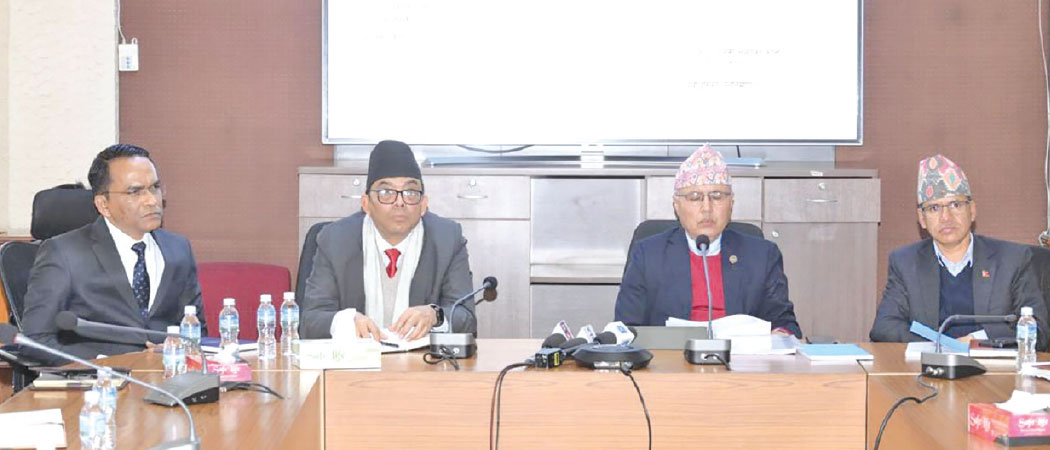

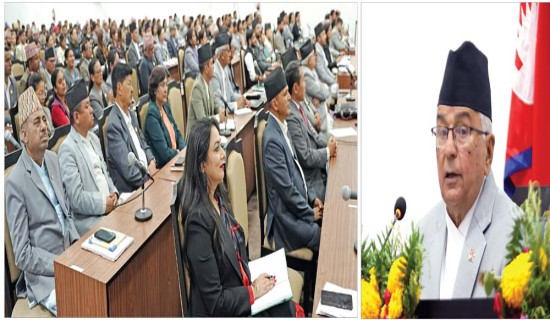
Kathmandu, Feb. 11: The government has revised the budget for the current fiscal year 2025/26 by reducing its expenditure estimates.
With half-yearly review of budget on Tuesday, the Ministry of Finance has estimated that only 85.96 per cent of the initially allocated budget will be spent in the current fiscal year 2025/26.
Finance Minister Rameshore Prasad Khanal has made public the estimate that the government will spend only Rs. 1,688.32 billion in the current fiscal year.
This is around Rs. 275 billion less than the initial budget and represents 85.96 per cent of the original layout.
The government had presented a budget of Rs. 1,964.11 billion for the current fiscal year on May 29, 2025.
The Ministry of Finance has estimated that recurrent expenditure for this fiscal year will amount to Rs. 1,125.97 billion, while capital expenditure is projected at Rs. 243.30 billion.
The budget allocated for financial management is estimated at Rs. 319.04 billion.
Strict policy of cutting unproductive expenditure
Finance Minister Khanal said that the revision was primarily based on the unusual situation created by the Gen Z movement on September 8 and 9, as well as the Council of Ministers’ decision to reprioritise projects and reduce expenditures.
Pressure on current expenditure has increased due to upcoming House of Representatives election expenses, social security payments, dearness allowances for employees, and relief to the families of those injured and killed in the protests.
Expenditure priorities include the reconstruction of physical infrastructure damaged by the Gen Z movement, payments for strategic projects under construction, and mandatory obligations such as salaries, allowances and pensions, he said.
Of the total budget allocation of Rs. 1,964.11 billion for the fiscal year, Rs. 690.21 billion (35.14 per cent) had been spent by mid-January 2026.
Of the amount spent, 41.25 per cent was allocated to current expenditure (including financial transfers), 12.12 per cent to capital expenditure, and 40.95 per cent to financial management.
The Ministry said that a lack of prior project preparation, complications in land acquisition and the utilisation of forest areas, as well as damage to physical infrastructure caused by the Gen Z movement, have led to low capital expenditure.
The budget of Rs. 119.53 billion allocated for unprepared and unproductive small projects has been suspended in accordance with a decision of the Council of Ministers.
Of this amount, Rs. 42.28 billion has been released, as the procurement process has already begun and the concerned ministries requested the release with proper justification, the ministry said.
"Our priority is to enhance 'expenditure efficiency' and 'implementation efficiency' in public financial management. Although the internally created difficult situation and damage to physical infrastructure have brought about some immediate contraction in capital expenditure, we have adopted a strict policy of cutting unproductive expenditure and austerity. Efforts have been made to focus the limited resources available on transformative projects of national pride and strategic importance by suspending small and sick projects that are not prepared in advance and yield low returns," said Minister Khanal.
A policy has been adopted to withhold budgets for unprepared and fragmented projects and unproductive programmes with uncertain returns, and to transfer funds to priority projects.
The goal is to control recurrent expenditure through measures such as suspending meeting allowances, refraining from hiring external consulting services, controlling foreign travel, and not creating new positions.
According to the Ministry, estimation of revenue collection and miscellaneous receipts has been reduced to Rs. 1,298 billion for the current fiscal year.
Earlier, the government had set a total revenue target of Rs. 1,480 billion.
As of mid-January, Rs. 581.40 billion (81.75 per cent) has been collected, including miscellaneous receipts, compared to the target of Rs. 711.20 billion.
Of the estimated annual development assistance mobilisation of Rs. 287.11 billion, only Rs. 61.07 billion (21.27 per cent) has been received during the review period.
Economic growth projected at 3.5%
The Ministry of Finance has revised its estimate, stating that the economic growth rate for the current fiscal year will be limited to 3.5 per cent.
The ministry has made it clear that the economic growth rate will not be achieved as per the budget target due to the decrease in rice production, area and productivity, the slowdown in the construction sector and the decline in real estate transactions in the current fiscal year.
The government had projected an annual gross domestic product (GDP) growth rate of 6 per cent in the budget for the current fiscal year.
According to the ministry, economic growth in the current fiscal year is expected to be lower than in the previous fiscal year, when GDP growth was estimated at 4.6 per cent. According to the National Statistics Office, the gross domestic product (at basic prices) in the first quarter of the current fiscal year is estimated to be grown by 3 per cent.
Amidst the ups and downs in the global economy and the economic expansion of neighbouring countries, Nepal's economy is gradually regaining momentum, said Minister Khanal.
Finance Minister Khanal said that the government has prioritised regulating to control inflation.
A new format, basis, and revised procedures have been implemented to manage various types of grants going to the provincial and local levels.
Interconnections have been established among the Public Asset Management System (PAMS), the CGAS, and the local-level SUTRA system to prepare integrated financial reports.
Rs. 84.5 billion worth of physical damage
According to the ministry, 77 people were killed (including 39 youths) and 2,429 were injured during the protests on September 8 and 9, while physical property worth a total of Rs. 84.45 billion was damaged.
Of the total property damage, 53 per cent (Rs. 44.93 billion) occurred in the public sector, 40 per cent (Rs. 33.54 billion) in the private sector, and 7 per cent in the community sector. Due to the protests, there was a loss of Rs. 13.87 billion in the production of goods and services, and 2,353 people completely lost their jobs.
Similarly, the government has estimated that a total of Rs. 36.3 billion will be spent on the reconstruction and repair of damaged buildings, vehicles and other physical assets in the public sector.
Additional liabilities not included in the budget for relief and reconstruction have been created, while tax exemptions given to industrial establishments and business laxity have led to a contraction in revenue collection, the ministry said.
The government has provided relief of Rs. 1.5 million per family to the 53 families of the deceased and has covered medical expenses for the injured. It has also implemented an “Integrated Business Revitalisation Plan” offering tax exemptions, concessions and loan rescheduling for businesses.




-original-thumb.jpg)