- Sunday, 7 June 2026

Tantra-Mantra Beyond Superstition
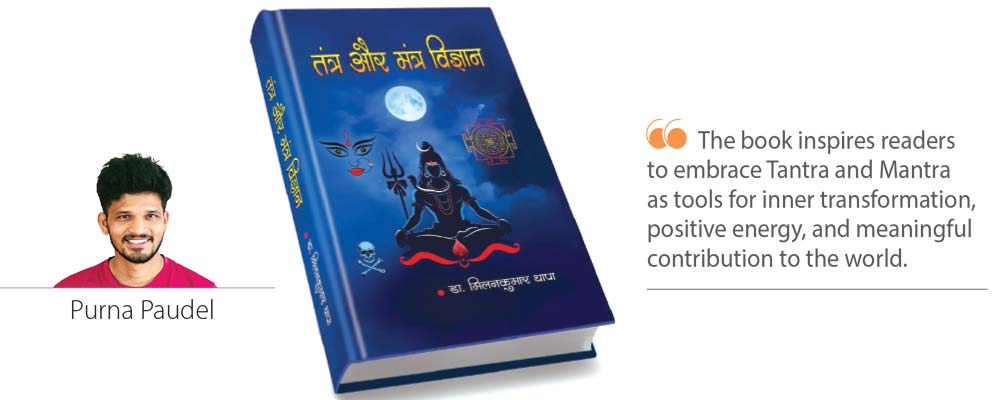

Recent recognition has been accorded to Nepal for its significant spiritual and meditative heritage, which is now starting to be viewed as a deeper form of wealth—a notion that has historically eluded materialism. Dr. Milan Kumar Thapa's scholarly work titled 'The Science of Tantra and Mantra: Nepal as a Nexus of Spiritual Core' frames the conception of Nepal as a timeless centre for seekers, yogis, and practitioners of secret spiritual disciplines.
It persuades the reader that the unique ecosystem for spiritual practices, identified by ancient Nepali artefacts—weaving together thousands of temples, meditation sites within the Himalayan recesses, and living traditions of Shaivism, Shaktism, and Vajrayana Buddhism—deserves careful attention. The thought thus moves beyond superstition, including Tantra and Mantra, into a texture of philosophy, experiential psychology, and the author’s term of “consciousness science”.
Dr. Thapa presents documented history, recorded experience of sages, and the vestiges of famous figures such as Guru Gorakhnath, Padmasambhava, and modern masters like Swami Satyananda Saraswati, who came to Nepal for their Sadhana, as evidence for his argument. The author proposes that, alongside being a major religious site internationally respected for its cult, Pashupatinath symbolises great geomantic and energetic significance that recognises this land as fertile for Sadhana and achieving such goals.
The central theme of the book is the intention of purification. The argument moves that true Tantra and Mantra must be practised with accurate will, a clear mind, and goodwill for others. Analysed in terms devoid of personal gain, these practices are propounded as means of generating positive energy, subsequently transmitted through their effects on human consciousness to wider society. This offers a fresh perspective through which the reader finds these traditions as connecting practices integrating consciousness studies and psychology, in distinct contrast to the cover of mystery.
Yantras, as energy blueprints, can be applied for protection, prosperity, and the welfare of communities, institutions, and places. Simultaneously, the book warns against the darker side of Tantra-Mantra, condemning as misuse anything resting on manipulation, abuse of power, infatuation, exile, and exploitation against Dharma and morality. The core message conveyed is that for any practice to be real, it must stem from pure determination, spiritual purification, and goodwill. The book presents a strategic analysis of Nepal's future, signifying its potential to develop a hub for religious tourism.
It recognises the historical, cultural and spiritual ties that bind Nepal and India. The foundation of faith is shared through the existence of religious sites, including Pashupatinath, Janakpur, and Lumbini in Nepal. The book proposes that Nepal can attract more sincere pilgrims and seekers of knowledge from across the world by reclaiming its spiritual sciences intellectually and presenting them authentically.
A critically important work that rises beyond alert signs against darker applications, the book explicitly condemns manipulative or harmful practices as antithetical to true Dharma and ethics. It draws a clear line between spiritual science and exploitative superstition. The book explains Tantra and Mantra as sacred paths to power, self-fulfilment, and emancipation, clarifying their true meaning and methods of application. Sharing what is arguably one of the most substantiated analyses asserting Nepal as a fertile land for Tantra-Mantra, the book analyses Pashupatinath’s land as a power centre. Using saintly validation as a primary basis, it circles in-depth research around Tantra-Mantra methods, practices, and doctrines. Types of Tantra, Mantra, Yoga, Agama, Yantra, and Tantras are interpreted in clear, easy-to-use language.
Rather than presenting Tantra as a package of tricks wrapped in illusion, the larger purpose of this work is to present it as a nexus governing both material and spiritual well-being. It shows a path to unite matter and spirit through the balance of karma, knowledge, and power. Yantras are noteworthy as energy blueprints applied for protection, prosperity, and the welfare of communities, institutions, or places. Meanwhile, the book cautions against the black side of Tantra-Mantra. It condemns harmful practices such as abuse of power and rituals against Dharma and morality, urging readers to stay clear of fraud, fear, and exploitation. The core message again conveys pure determination, spiritual purification, and goodwill as the road to genuine practice.
The two-volume publication, edited by Professor Som Khatiwada, was set up to connect traditional wisdom with modern consciousness. The 268-page book, published by Shri Hanuman Tantra Shivashakti Sadhana and Research Center, has the potential to enlighten Tantra-Mantra as a subject of deep contemplation, research, and international dialogue, thus adding a new layer to Nepal's cultural and spiritual identity.
Basically, The Science of Tantra and Mantra is the manifestation of a brave attempt to interlink ancient wisdom with modern rationality. It proposes that Nepal's greatest asset might be its spiritual heritage and positions the country as a vital centre in the global discussion on consciousness, well-being, and sustainable cultural development. The book delivers an ultimate message: Nepal is not just the land of beauty; the valley of Nepal is an octagonal celebration centre of transformative spiritual power, waiting for its turn to be understood and engaged with in a newer, enlightened paradigm.
To sum up, Thapa presents Tantra and Mantra as powerful paths for spiritual growth, self-realisation, and liberation within Eastern philosophy and the Shaiva tradition. The book highlights Nepal as a fertile land of tantric knowledge and Pashupatinath as a centre of spiritual power. Drawing on the experiences of sages and ancient traditions, it explains methods, rituals, mantras, yantras, and the role of yoga, showing how these practices can harmonise the material and spiritual aspects of life. Emphasising ethical use, the book teaches that Tantra and Mantra should serve personal growth, societal welfare, and universal harmony rather than selfish or harmful purposes. It also addresses misconceptions and superstitions, presenting a logical and philosophical understanding of these ancient practices. Ultimately, the book inspires readers to embrace Tantra and Mantra as tools for inner transformation, positive energy, and meaningful contribution to the world.
(The author has graduated in political science and English literature from Tribhuvan University.)