- Monday, 25 May 2026

True respect for martyrs lies in meaningful reforms
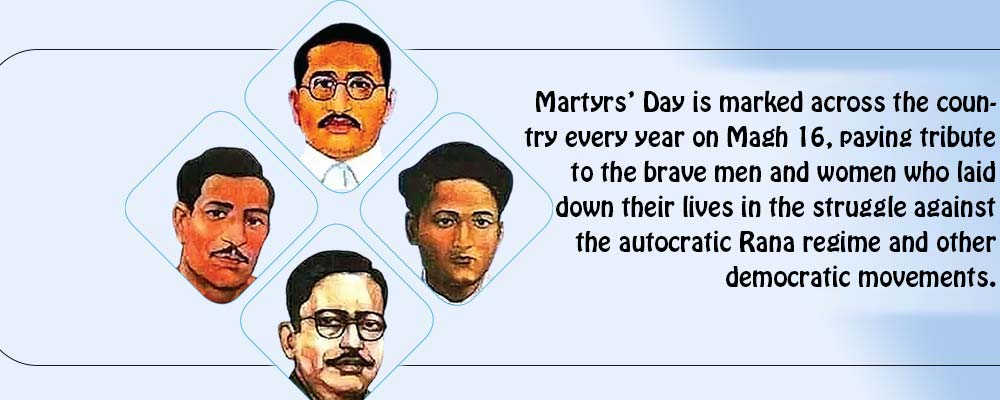

Kathmandu, Jan. 30: Martyrs’ Day is marked across the country every year on Magh 16, paying tribute to the brave men and women who laid down their lives in the struggle against the autocratic Rana regime and other democratic movements.
Among the earliest martyrs, Lakhan Thapa of Gorkha is remembered as a pioneering freedom fighter who boldly challenged Rana rule. He emerged as a courageous leader demanding political reforms, restoration of royal authority, and basic rights for the people.
The Martyrs’ Day is marked commemorating the sacrifice of four prominent martyrs, Shukraraj Shastri, Dharma Bhakta Mathema, Dashrath Chand, and Ganga Lal Shrestha, who were executed in January 1941 for opposing the Rana rulers.
Shukraraj Shastri, a scholar and social reformer, was hanged for spreading political awareness. Dharma Bhakta Mathema was executed for inspiring resistance through his writings. Dashrath Chand and Ganga Lal Shrestha were shot dead for mobilising the masses against the regime. Their sacrifice ultimately paved the way for the restoration of democracy in 1950.
Beyond these well-known figures, many other martyrs from different periods also sacrificed their lives for political change.
Following the end of the Rana regime, further struggles eventually led to the abolition of the monarchy and the establishment of a republic. Even after Gen-Z movement of September last year, 45 martyrs were added in the list.
Meanwhile, The Rising Nepal contacted Vijay Lal Shrestha, brother of martyr Ganga Lal Shrestha. Due to some urgencies, he referred the newspaper to Prashant Lal Shrestha, the grandson of the martyr.
Prashant said the memories and stories of Nepal’s martyrs were gradually fading due to state neglect. Remembering his grandfather as a dynamic, intelligent and decisive freedom fighter, he said that although the dream of freedom had been partially realised, it remained incomplete. “Until the country gets true leadership capable of steering it towards development, the martyrs’ vision cannot be fully achieved,” he said.
He stressed that courage was the force that inspired people to believe in change and said the stories of martyrs must be passed on to younger generations. He urged the state to include the struggles and sacrifices of martyrs in the education curriculum and to formally recognise martyrs and their families. “If the state listens to their voices and takes positive steps, the country can move towards a better future,” he added.
Kalpana Subedi, wife of martyr Durga Subedi, recalled how her husband got martyrdom for raising voice for the people.
Kalpana was 19 years old when her 34-year-old husband Durga was shot on November 3, 1979, in Bhiman, Sindhuli, taking him out from local police post.
Ganga Narayan Shrestha, son-in-law of Subedi, recalled his father-in-law's fight for farmers’ rights. He said Subedi, along with Rishi Devkota ‘Aajad’ and Dal Bahadur Rajan Magar, resisted feudal exploitation and worked to ensure fair distribution of agricultural produce. Their movement extended to districts including Okhaldhunga and Ramechhap. Martyr Subedi was later shot dead in Bhiman. Shrestha said that the sacrifices of past and present martyrs helped establish democracy and the republican system, but their true aspirations remain unfulfilled. “There is no alternative to continued struggle to realise their dreams,” he said.
He further stressed the need to officially recognise all martyrs and ensure state support for their families. “True respect for martyrs lies in meaningful reforms, inclusive development, and ensuring that their families are represented and supported in policymaking,” he added.