- Tuesday, 5 May 2026

Nepal’s exhibition infrastructure insufficient and outdated
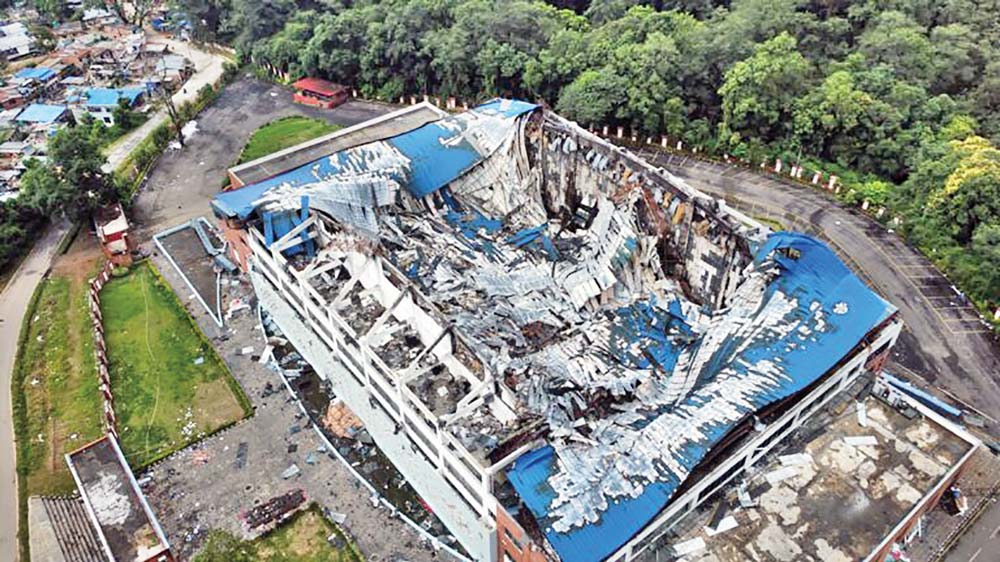
The Godawari Sunrise Convention Centre after being set on fire during the Gen Z movement.File Photo

Kathmandu, Jan. 11: Exhibitions are globally recognised as powerful platforms for trade promotion, innovation, business networking and tourism. However, in Nepal, the absence of well-equipped exhibition and convention centres has emerged as a major structural bottleneck, limiting not only business growth but also the country’s potential in Meetings, Incentives, Conferences and Exhibitions (MICE) tourism.
Despite the growing number of trade fairs, product expos and international forums organised by the private sector, the country still relies almost entirely on a single, government-owned venue, the Bhrikuti Mandap Exhibition Hall, whose deteriorating condition and limited capacity have become a major obstacle to exhibitions, conventions and MICE tourism.
Industry stakeholders said that the absence of multiple, modern exhibition centres had not only constrained business promotion but also weakened Nepal’s ability to attract international conventions, delegations and investors. With Bhrikuti Mandap struggling to meet even basic standards, organisers are increasingly forced to turn to five-star hotels, an option that remains inaccessible for many small and medium enterprises.
Prabhat Rimal, CEO of Vogue Ad and Event Management, stated that the government's neglect of exhibition infrastructure had persisted for years. “The government has been indifferent about exhibition centres,” Rimal said. “In Nepal, there is only one government-run exhibition centre, Bhrikuti Mandap, and it has very limited facilities.”
According to Rimal, the problems are visible and persistent, from parking shortages and outdated technology to limited exhibition space. During the monsoon, water leakage disrupts stalls and damages materials, while exhibitors frequently complain about insufficient toilets, poor waste management and ageing electrical systems.
“These are not small issues. They directly affect the credibility of exhibitions and the experience of both exhibitors and visitors,” he said.
Rimal stressed that exhibitions were not merely commercial events aimed at selling products. They are a crucial component of MICE tourism -- meetings, incentives, conferences and exhibitions, a sector that globally generates high-value tourism revenue. “MICE tourism has huge potential to bring revenue to the country,” he said. “International conventions and exhibitions attract delegates from Asia, Europe and the rest, who stay for days, spend money and promote the destination.” Yet Nepal has largely failed to tap into this opportunity.
Over time, Bhrikuti Mandap, once envisioned as a national exhibition hub, has increasingly taken on the character of a permanent marketplace rather than a professional venue for exhibitions and conferences.
Stakeholders said such shift had further eroded its appeal for high-profile national and international events.
“As a result, serious exhibitors and organisers are compelled to move to five-star hotels for business promotions and events, because they seem to be the only applicable venues,” Rimal said. “But even these hotels struggle to host conventions or exhibitions involving more than 300 participants.”
The reliance on luxury hotels has also created an uneven playing field. While large corporations may absorb the high costs, small-scale producers and emerging businesses are effectively excluded from participation. “This situation has created major challenges for small-scale production businesses,” Rimal said. “They simply cannot afford the expenses of five-star venues.”
A business bottleneck
Industry experts warn that this exclusion undermines one of the core objectives of exhibitions i.e. providing a platform where small, medium and large enterprises can compete, connect and grow side by side. Exhibitions traditionally allow businesses to display goods and services to a targeted audience, showcase products in action, build brand credibility and generate word-of-mouth marketing. They also enable companies to understand customer preferences, receive feedback, observe competitors and strengthen their market presence. Without suitable venues, these benefits remain unevenly distributed.
Kamlesh Kumar Agrawal, President of the Nepal Chamber of Commerce, also pointed out the absence of fully facilitated and technologically advanced exhibition centres as a major constraint for Nepal’s business sector.
“The only existing exhibition centre, Bhrikuti Mandap, is itself in a run-down condition,” Agrawal said. “As a result, the business community has been unable to connect effectively with international markets through exhibitions.”
According to him, the standard of exhibition and event venues directly influences the perceived value of products and businesses, while also shaping the country’s image in the global marketplace.
“The quality of an event venue determines the face value of products and businesses and directly affects the prestige of the country in the international market,” he said.
Agrawal said business stakeholders and private-sector representatives had repeatedly held discussions with the government and urged it to establish advanced exhibition centres. However, he said these concerns had largely been ignored.
“When domestic products fail to gain exposure nationally and internationally, it directly affects sales and limits export potential,” he said, adding that the lack of exhibition venues also constrains marketing opportunities.
He stressed that exhibition centres are essential platforms for businesses of all scales. “They are accessible and convenient not only for large industries but also for small-scale enterprises and new entrepreneurs,” he said. “Without such platforms, emerging businesses do not get the opportunity to connect with international stakeholders, confining their growth to the local market.”
Drawing a regional comparison, Agrawal said neighbouring countries had moved ahead by investing in modern, technology-driven convention and exhibition centres. “While our neighbours are advancing their businesses through such infrastructure, we remain limited to the domestic market,” he said.
Exhibitions are widely recognised as dynamic platforms that connect brands and customers through direct interaction. They support innovation, learning and collaboration across sectors. However, their success depends heavily on infrastructure, planning and execution. In Nepal’s case, organisers complain that infrastructure limitations have become the weakest link.
The loss or repurposing of other major venues has compounded the problem. The Godawari Sunrise Convention Centre was set ablaze and destroyed during the Gen Z movement in September, while the Birendra International Convention Centre (BICC) was used as a parliamentary building and later suffered damage amid political unrest. With these facilities no longer fully operational, pressure on Bhrikuti Mandap has intensified.
From the government side, officials do acknowledge the challenges.
Aaganath Regmi, Head of the Administrative Department of Bhrikuti Mandap Exhibition Hall, said the venue was established nearly four decades ago and had suffered from years of inadequate maintenance. “It has not been regularly maintained, and yes, it is not in well-kept condition,” Regmi said.
According to Regmi, the hall routinely receives complaints related to poor infrastructure, insufficient toilets, parking constraints and outdated technology. “We do acknowledge the complaints from exhibitors about the status of the centre,” he said.
However, Regmi pointed to financial and institutional constraints as the primary reasons behind the deterioration. Bhrikuti Mandap falls under the Social Welfare Council, which, he said, had not been able to allocate sufficient budget for thorough maintenance.
“A few years back, a survey was conducted on the condition of the exhibition centre,” Regmi said. “The report concluded that the life of the building has almost expired.”
Based on the survey findings, authorities reportedly decided against investing heavily in maintenance. Instead, experts recommended constructing a new exhibition centre rather than spending large sums on repairing ageing structures. A detailed project report (DPR) for a new building was even prepared, according to Regmi, but it has yet to be executed.
“We do not have the infrastructure to facilitate international-level exhibitions,” Regmi said. “The structures are dilapidated.”
The prolonged delay in building new facilities reflects broader policy gaps. While exhibitions in Nepal are largely organised by the private sector, the burden of infrastructure development has remained unclear. Private investors argue that purchasing land in prime locations is financially unfeasible without government support.
Public-private collaboration essential
Rimal suggests that the solution lies in public-private collaboration. “What the government can do is provide land on lease, because it is not feasible for the private sector to purchase the land,” he said. “Then the government can invite the private sector to build exhibition centres.”
He also stressed the need for structured dialogue. “The government should hold discussions with experts, stakeholders and the private sector to establish proper, well-facilitated exhibition centres,” he said.
The absence of such coordination has had ripple effects across multiple sectors. Tourism entrepreneurs stress that international exhibitions often serve as gateways for broader travel. Delegates attending conventions typically extend their stay, visit heritage sites and generate income for hotels, restaurants and transport services. Without adequate venues, Nepal misses out on this multiplier effect.
Business associations warn that the country risks falling behind regional competitors. Neighbouring countries such as India, China and Bangladesh have developed multiple international-standard convention and exhibition centres, enabling them to host large-scale trade fairs and global events year-round. These venues not only support domestic industries but also enhance international visibility.
In contrast, Nepal’s dependence on a single, outdated exhibition hall limits scheduling flexibility and discourages international organisers. Conflicting bookings, logistical constraints and infrastructure concerns make it difficult to plan long-term exhibition calendars.
Despite these challenges, interest in exhibitions remains strong. Businesses continue to see them as effective tools for promotion, networking and market research. However, the advantages of participation, brand visibility, customer engagement and industry connections are increasingly offset by high costs, space limitations and operational hurdles.
Organisers suggest that proper planning and adaptability can mitigate some challenges, but infrastructure constraints remain beyond their control. Without investment in modern facilities, they warn, Nepal’s exhibition sector will struggle to grow.
-original-thumb.jpg)