- Thursday, 21 May 2026

Multi-layered election security plan nears completion
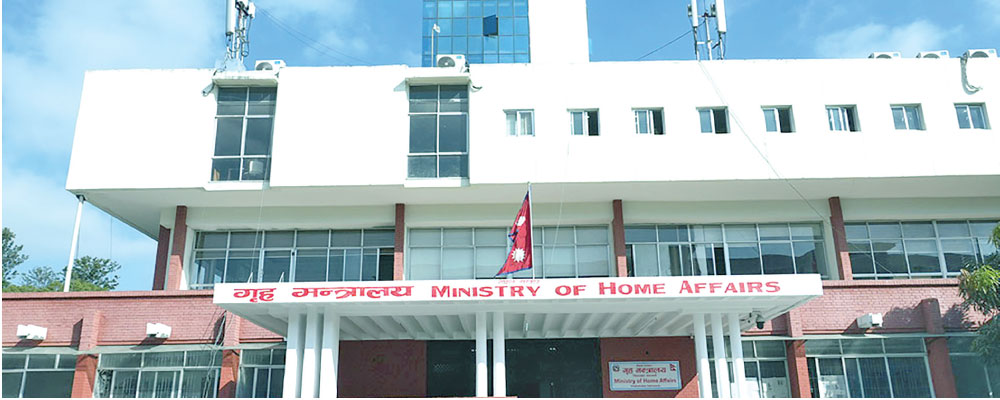

By A Staff Reporter,Kathmandu, Jan. 25: Nearly all preparatory measures essential to ensure security for the upcoming elections scheduled for March 5, 2026 have been completed, according to the Ministry of Home Affairs.
Final-stage preparations include a comprehensive security sensitivity assessment of polling centres, determination of personnel strength, selection and training of election police (temporary police), and joint exercises among all three security agencies.
Under a plan approved by the Central Security Committee chaired by Home Minister Om Prakash Aryal, a three-tier security framework has been put in place, covering the pre-election period, polling day, and the post-election phase.
The Ministry stated that preparations under the first security layer are almost complete. The ‘Integrated Election Security Plan–2082’ was formally endorsed by the Ministry on November 16, 2025.
Home Ministry Spokesperson and Joint Secretary and Chief of Security and Coordination Division, Ananda Kafle confirmed that the first phase of security preparations has mostly been finalised. “In line with the Integrated Election Security Plan–2082, a three-layered security mechanism has been designed for the forthcoming elections. Preparations under the first layer have almost been completed,” he said.
Over 338,000 security personnel to be deployed
In accordance with the approved security plan, a total of 338,890 security personnel will be deployed throughout the election period. The mobilisation includes 79,727 personnel from the Nepali Army, 75,497 from Nepal Police, 34,576 from the Armed Police Force, 149,090 election police (temporary police), and 1,921 intelligence officers from the National Investigation Department.
The Ministry explained that following the approval of the security framework, a nationwide assessment of the security sensitivity of all polling centres was carried out. The assessment concluded that at least 350,000 security personnel would be required. However, as the three primary security agencies could collectively provide a maximum of 190,000 personnel, the number of election police was determined accordingly. The selection of election police is currently underway, and they are scheduled to begin training from January 25.
Meanwhile, joint training programmes, coordinated patrols, drills, and field exercises are being conducted by the Nepali Army, Nepal Police, and the Armed Police Force. These exercises focus on VVIP and VIP protection, identification and neutralisation of groups attempting to disrupt the electoral process, crowd control, candidate security, and safeguarding ballot boxes, informed Kafle. AIG Uma Prasad Chaturvedi, Chief of the Operations Department of Nepal Police and Commander of the Central Election Cell at the Police Headquarters, Naxal, said that election-focused security preparations had reached the final phase.
“A three-tier security plan has been formulated covering the pre-election, polling-day, and post-election periods. Preparations under the first tier have been completed, while joint training, security assessments, determination of election police strength, and training programmes are nearing completion,” said Chaturvedi.
Army deployment from February 4
The Election Commission began printing ballot papers last week. Responsibility for the security and transportation of printed ballots has been entrusted to the Nepali Army, which has already been partially deployed for this purpose. The entire printing and transportation process at Janak Education Material Centre is being conducted under army supervision.
The government has authorised the deployment of the army in the field one month ahead of the elections. Accordingly, visible deployment of army personnel will commence only from February 4, one-month ahead of the election date.
Nepali Army Spokesperson and Brigadier General Rajaram Basnet said, “A decision has been taken to deploy 79,727 army personnel for election security. Some troops have already been mobilised, while the remaining will be deployed in the field from February 4. Necessary training programmes are currently underway, with participation from Nepal Police and Armed Police Force personnel as well.”
Physical and digital challenges in election security
According to Rabi Raj Thapa, former Additional Inspector General of the Armed Police Force, ensuring a peaceful election is the responsibility not only of the state but also of the political parties participating in the polls. Even with high-level security arrangements, challenges cannot be completely ruled out. The upcoming election, too, will inevitably face security challenges.
This time, more polling stations have been assessed as security-sensitive compared to previous elections. In the past, elections were often challenged by tensions arising among the very political parties competing in the polls, and that situation still persists.
However, the election being held after the Gen Z uprising is expected to bring a different kind of challenge. For instance, political polarisation is particularly intense in this election. There is a possibility that competition between parties and internal dissatisfaction could turn into violent incidents. This aspect, Thapa said, requires special attention.
According to Thapa, these are not the only concerns. Topographical complexity, cyber and information security threats, financial constraints, and climate-related risks in high mountain and Himalyan region could also pose challenges.
Moreover, the spread of misinformation and rumours through social media could undermine trust in the electoral process.
Similarly, another Deputy Inspector General of Nepal Police, Keshav Adhikari, said that while in past election misinformation was spread through wall writings, posters and pamphlets, the medium has now changed with advances in technology. At a time when social media has become the dominant platform, false information disseminated through these networks could affect the election. Preventing this has emerged as a major challenge.
Adhikari also noted that in recent times, activities aimed at disturbing religious harmony have been increasing in various districts of the country. Controlling such activities conducted through social media is extremely important. If content that undermines religious tolerance is promoted and circulated on social media during the election period, it could lead to conflict and adversely affect the polls. Therefore, security agencies must urgently focus on monitoring individuals or groups involved in such activities and bringing them within the legal ambit.
Sensitivity of constituencies
The Election Commission has already designated 11,901 polling stations for the upcoming House of Representatives elections. From a security point of view, the Central Security Committee meeting has classified those polling stations into three categories: highly sensitive, sensitive and general, and arranged security management accordingly.
According to the security report submitted to the Election Commission by the Central Security Committee, out of the 11,901 polling stations designated for the elections, about one-third have been included in the highly sensitive list.
Similarly, 4,442 polling stations have been designated as sensitive and 2,845 polling stations have been designated as general in view of security challenges.
According to the sources, 278 polling stations have been placed on the general list in the Kathmandu Valley, while 237 have been classified as sensitive and 12 have been classified as highly sensitive.
In Koshi Province, 647 polling stations have been included in the general, 237 sensitive and 12 in the highly sensitive list. In Madhes, 159 polling stations have been placed on the general, 755 sensitive and 1,246 in highly sensitive list. In Bagmati (excluding the valley), 437 polling stations have been placed under general, 497 sensitive and 1,288 highly sensitive.
In Gandaki, 392 polling stations have been placed under general, 577 sensitive and 328 highly sensitive, in Lumbini, 471 general, 738 sensitive and 358 highly sensitive, in Karnali, 161 general, 422 sensitive and 358 highly sensitive, and in Sudurpaschim, 300 general, 394 sensitive and 481 highly sensitive list.
Vehicles procurement and grant from India
Owing to acute shortage of vehicles following widespread destruction in the Gen Z movement, the government of India has announced grant assistance of a total of 538 vehicles for the forthcoming election. In addition, it has also provided non-lethal riot-control equipment for the security agencies as part of the grant. In the first phase of the assistance, the Indian government has already handed over 61 Bolero jeeps to Minister for Home Affairs Om Prakash Aryal on January 20.
Ananda Kafle, Spokesperson for the Ministry of Home Affairs, said that nearly 100 of the vehicles provided by India have arrived in Kathmandu in the first phase, with more expected to arrive in soon.
Apart from this, the government has stated that it has secured funding from the Ministry of Finance to purchase 327 vehicles for the security agencies (Police, APF and NID), with some of them already in the procurement process.
Of them, 262 will be for the Nepal Police, 59 for APF and six for NID. For this, the Finance Ministry has ensured budget of over Rs. 830 million. During the Gen Z protest, a total of 61 four-wheelers of security bodies were completely torched while 571 other vehicles were damaged.


-original-thumb.jpg)