- Sunday, 3 May 2026

The Myth Of Progress
 Maggie Rowe
Maggie Rowe
Maggie Rowe
I am a longtime devotee of the God of Progress. Forward is good. More is better. Faster means I’m winning. If something hurts, it’s probably growth. If something feels empty, well, that is just the price of forward motion. Up until recently, I did not think of my devotion to progress as an allegiance to a particular mythology. I took it to be reality. Like gravity. Like time. I bought into it early and enthusiastically.
Progress meant saying yes to opportunities even when they made me feel slightly sick. It meant treating rest as a reward I earned later and contentment as a suspicious emotion that might slow me down. Progress and purpose promised a payoff. That was the deal. Endure now, arrive later. The problem is that “later” is a mirage that keeps walking backward. At some point, I began to notice that many of the things I had labeled as progress had quietly made my life smaller. More efficient, yes. More impressive on paper, maybe. But thinner. Narrower. Tighter in the body.
On my podcast 50 Words for Snow, where my cohost Emily Garcés and I hunt for words without English equivalents, I found the perfect word for my relationship with progress: the German danaergeschenk. A poisoned gift. A gift that looks generous but carries harm. A promotion that ruins your health. An opportunity that costs you your friendships. A milestone that requires you to amputate a part of yourself to reach it.
Progress, I started to suspect, might be a danaergeschenk. The myth of progress depends on a few unexamined assumptions. That life moves in a straight line. That accumulation equals meaning. That motion is inherently virtuous. That if you stop moving forward, you must be moving backward. It does not leave much room for seasons, cycles, or plateaus. It has no language for ripening, composting, or wandering.
It also does not like bodies. Bodies are inconvenient to the myth of progress. They get tired. They get sick. They develop mysterious aches that do not respond to productivity hacks. They insist on grief. They insist on pleasure. They insist on limits. For years, I treated my body like a faulty employee: something to be managed, overridden, and motivated by the promise of future satisfaction. And when it rebelled, I framed it as a personal failure rather than a data point.
The myth of progress tells us that if we just push through, we will eventually arrive at a place where pushing is no longer necessary. This is the most seductive lie of all. What if there is no arrival? What if progress is not a staircase but a treadmill cleverly disguised as a ladder? I began to see how often I had mistaken escalation for evolution, how often I had confused intensity with depth, how often I had said yes not because something felt alive, but because it felt like it would look irresponsible to say no.
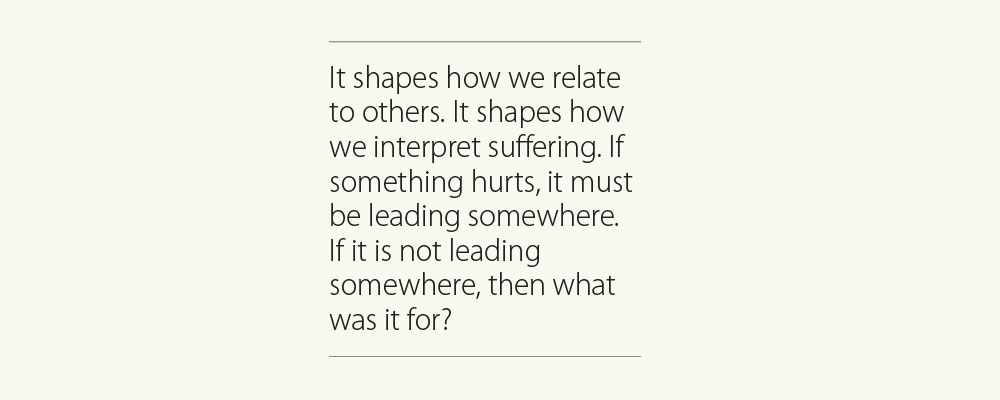
There is another problem with the myth of progress. It trains us to live in a permanent state of anticipation. The good life is always one promotion away, one project away, one healed version of yourself away. This creates a subtle contempt for the present moment, for the imperfect now, and for the unoptimized life you are already living. This is not a neutral worldview. It shapes how we measure our worth. It shapes how we relate to others. It shapes how we interpret suffering. If something hurts, it must be leading somewhere. If it is not leading somewhere, then what was it for?
But not all pain is instructional. Not all sacrifice is noble. Not all difficulty is a sign that you are on the right path. Sometimes, a poisoned gift is just that. The alternative to the myth of progress is not stagnation, laziness, or giving up. It is something more unsettling. It is learning to ask different questions. Not “Is this moving me forward?” but “Is this making my life larger or smaller?” Not “Will this pay off later?” but “What is it costing me now?”
Progress is not inherently bad. The problem is treating it as a moral imperative rather than a tool. Tools are meant to be used selectively, not worshipped. I am still unlearning this. I still feel the tug toward more, faster, better. But I am beginning to trust the moments that feel like pauses rather than failures. I am learning to recognize when something shiny is actually heavy and when an opportunity is actually a request for self-abandonment. The myth of progress taught me how to strive. It did not teach me how to stop.
And stopping, I am discovering, is not the opposite of growth. It is often the only way to tell whether what you have been calling progress was ever truly yours to begin with.
-Psychology Today