- Tuesday, 26 May 2026

Election: A Crucial Test For Voters

Nepal is all set for the parliamentary election scheduled for March 5, 2026. This is an early election, held three years after the last parliamentary elections in 2022. The early election was deemed necessary after the Gen Z movement that toppled the NC-UML coalition government headed by KP Sharma Oli and also led to the dissolution of the House of Representatives or the lower chamber of parliament. The Gen Z movement was primarily against corruption, demanding good, transparent and accountable governance in Nepal. Corruption was definitely rampant, which had corroded the morale of society and eroded public trust in politicians, political parties, and the system itself. Politics without principle, honesty and integrity is nothing other than political thuggery, against which the Gen Z movement mainly focused.
We have been practicing multi-party democracy since 1990. Nepal entered into a new era of democracy for the first time in 1951 but it did not last long as the then-king dismantled the democratic system and imposed a monarchical absolute regime. The brief experience of democracy from 1951 to 1960 was also mixed. Back in the 18th century, French philosopher Jean-Jacques Rousseau said the government is the product of a social contract between the rulers or political party and the people. Based on this contract, parties or rulers agree on working for the larger benefit of citizens, while people consent to abide by the rules, agreeing to handover their sovereignty to the rulers.
Greater transparency
Once elected, politicians, however, forgot their own words and promises made to the people and started behaving like masters and lords while reducing people to the state of mere subjects. Democracy demands greater transparency, honesty and accountability from political parties, leaders and workers. But this was glaringly lacking in our context. Politics is an art of governance but it has, instead, turned into a profit-making venture. Our parties and leaders tended to become like tribal lords whose job is to extract and extort personal and partisan benefits by the use and abuse of power and authority. This led to various anomalies, which defamed the political system and earned it a bad reputation among the general people.
The history of our parties and leaders is glorious as they fought relentless struggles to establish democracy in the country, for which they succeeded. However, fighting for democracy is one thing and the art of nurturing democracy is different. The real objective of politics is service to the nation and the people but politics has been a profiteering business. It now seems that the entire purpose of the politicians has been to capture power, get a position, make money and other benefits by the use and misuse of power and finally promote family members and relatives. For this, they generally protect and promote corruption, criminalisation, collusion and capitulation.
It is said, ‘when money speaks, truth remains silent’. Our elections are getting expensive and politicians tend to earn more money to finance the election expenditures. This compels politicians to get involved in manipulation and abuse of authority, for which they do everything possible to come to power. As a result, politics and power are criminalised and crimes politicised. The other modus operandi is collusion and unholy partnership with unethical businesspeople, scoundrels and criminals. Sometimes, they even tend to compromise our national interest with external forces for power and personal gains. If we have to get rid of these anomalies like corruption and bad governance, it should begin with reforms in our electoral system.
The Gen Z movement rose against this background, which earned support from a wider section of society. As the election is being held, it is high time that voters choose and vote for the right, clean, honest and competent candidates. This alone would help cleanse our political system and governance. The upcoming parliamentary election is the opportune moment to select the right person to govern the country.
It is said that democracy begins with the ballot box. There can be no democracy without elections. Free and fair elections are the soul of a democratic polity and at the same time impartial elections are possible only in a genuine democracy. Democracy and elections are, therefore, inseparable. As French philosopher and historian Alexis de Tocqueville says, ‘people get the government they deserve’, people need to make a wise decision in voting. The March 5 election is therefore an acid test for the Nepali voters as to what type of government they seek to have for another five years.
We must understand the fact that voting power is the key that tames and directs the political parties and leaders. It is this reason why former American President Abraham Lincoln once said, “The ballot is more powerful than the bullet". It is through the ballot papers that individual citizens make the social contract and hand over their sovereign power to a particular party or a candidate to use on their behalf. In the wise and conscious decision of citizens on polling day lies the fate of our democracy and country for the next five years. The people must follow the dictates of their conscience.
Democratic duty
In a democracy, an election is a festival in which every vote counts and has its value. Voting is not only our right but also a duty. If we do not vote, we will fail in discharging our political and democratic duty. Similarly, if we do not vote, wrong people may get the chance to be elected, which is tantamount to our consent, letting the crooks and scoundrels run the country. In such a case, democracy becomes what Soviet era’s communist ruler Nikita Khrushchev said as ‘a political mockery’.
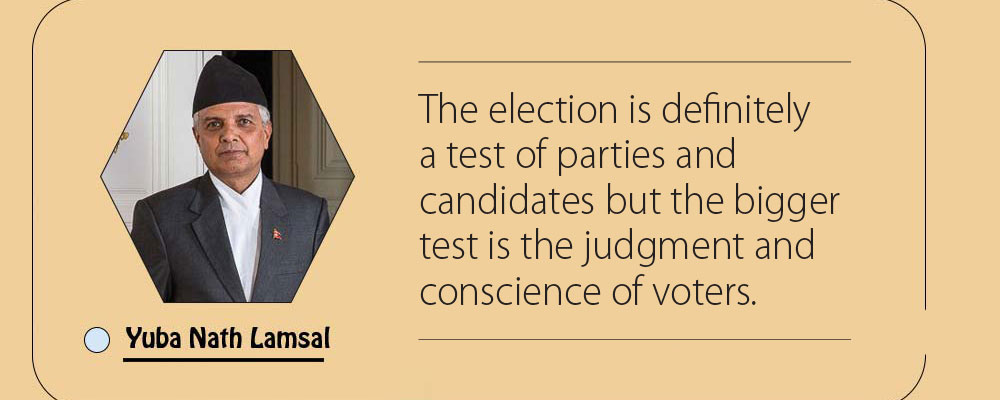
Democracy is a people’s polity in which the government is chosen by the people from among themselves through free election. The fate of democracy, therefore, lies in the sanctity of the election. Political parties and candidates must respect the fundamental principles and qualities of the election. However, the Election Commission and government alone cannot fully ensure the purity of the election unless all other stakeholders, including political parties, leaders, individual candidates and election monitoring groups, work together. The election is definitely a test of parties and candidates but the bigger test is the judgment and conscience of voters. It is, thus, high time that all people who believe in democracy need to be vigilant to ensure the sanctity of the election.
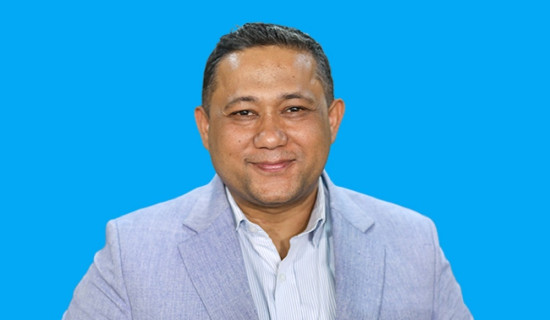
(The author is a former chief editor of this daily and a former ambassador.lamsalyubanath@gmail.com)