- Sunday, 3 May 2026

Experts, Gen Z discuss ways to make public education reform political agenda
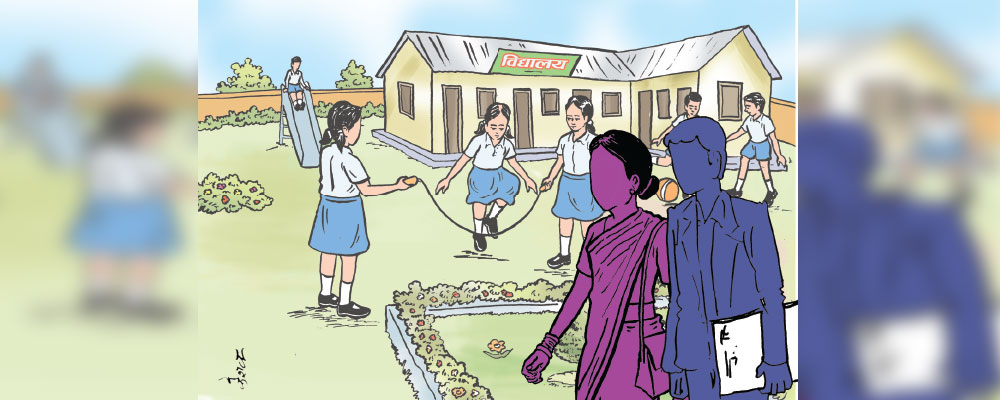

By A Staff Reporter,Kathmandu, Jan. 7: Public educationists, experts, and Gen Z representatives are concerned that public education should be a major agenda in the upcoming election scheduled for March 5.
Educationists have urged Gen Z youth, who are focused on political change, to also carry the agenda of public education reform. Experts said a political change is not possible unless there is a change in the education sector.
They also urged Gen Z youth to pay attention to this issue, saying that public education is the main foundation for social transformation. Educationists have warned Gen Z activists about the danger that the development of two types of education systems, private and public, will accelerate in society if public education is not improved.
A dialogue held in the capital, organized by the Campaign for Public Education Promotion, emphasized that every political party and Gen Z leader should consider public education as part of their political agenda. The dialogue was organized ahead of the election of the House of Representatives.
Speaking to The Rising Nepal, Teeka Bhattarai, senior public educationist and organizer, said that new political parties and Gen Z activists should focus their agenda on education reform.
“Gen Z youths are concerned about education reform. However, they are not sure whether they can make the education agenda a major political issue ahead of the upcoming election,” said Bhattarai.
During the programme, Gen Z participants and experts also pointed out that structural reform in education is essential, rather than merely making new decisions.
Parash Rahadi Magar, Rijan Ranamagar, Bikash Kami, Monika, and other Gen Z youth representatives, as well as Kedar Bhakta Mathema, Dr. Krishna Prasad Paudel, Prof. Dr. Sushan Acharya, Prof. Dr. Prem Phyak, Teeka Bhattarai, and Prof. Dr. Peshal Dahal attended the programme.
Mathema said that sustainable change is essential for education reform, stating that social coherence is missing from public education. “Previously, children from all backgrounds used to enroll in public schools.
It was a common forum and learning centre for everyone. However, in recent times, education has lost its social coherence, as the state promotes two types of education systems,” said Mathema.
He also argued that long-term political change is not possible without educational reform. If this situation continues, social harmony and coherence in education and society will be weakened. Experts also worried that the new generation is becoming detached from their communities, despite huge financial investment in the education sector.
Most Gen Z activists are also concerned that total structural reform is essential in education.
Parash Rahadi Magar, one of the Gen Z activists, argued that there is a structural barrier rather than a problem with a particular government. He said that the education reform agenda is being complicated because the entire structure remains traditional.
“We have to be serious about reforming the entire structure by creating pressure for policy changes,” said Parash.
Similarly, Bikash Kami, another Gen Z activist, said that the entire conceptual framework should be changed. For this, a comprehensive dialogue is essential, he said.
“The education we received never taught us anything other than going to the embassy carrying a university certificate,” said Bikash.
Gen Z youths also expressed their commitment to creating pressure to improve public education policies. They also complained to senior experts for not transferring their skills and knowledge to the new generation.
Rijan Rana Magar, a Gen Z leader, argued that discrimination in society should be eliminated through educational reform. Recalling that the constitution provides education as a right, Rijan said that growing discrimination in society can be ended through education.

-square-thumb.jpg)