- Sunday, 3 May 2026

To What Extent Can Teachers Use AI ?

Those of us born in the 1960s and 70s and fortunate enough to go to school (going to school was a hard-to-afford affair for many Nepalis, and the school-going cohort mostly included youth and children from well-off Brahmin-Chhetri community and the rich from Nepal’s hills, Kathmandu Valley and plains) have one thing in common. We had a similar type of teachers, more or less.
Often having to learn by squatting on the open ground and writing the alphabet on wooden slats, our instructors, mostly Brahmins, taught us by drilling. In Nepal’s hills, there were also teachers from Madhesh, who would basically teach math and science and were also considered geniuses in these subjects.
As we reached higher grades, we would talk about them on their backs: Which teachers are kind, which fierce and stern and hardworking. ‘Kind,’ a rare type, would be everybody’s favorite. That a student-teacher relationship can also be built on compassion, love and respect for each other was still an unconventional notion. Ruthless caning for not rote-learning formula and word meanings was an established norm.
Types of teachers
Students liked two types of teachers—talented and kind. The former, much more admired, were ascribed these qualities: The one who knows everything (at least about the subject he taught), he, who could go on at great length describing things without reading from or consulting the textbook pages. A teacher was thought to know even more than the textbook. There was a reason why a teacher was expected to be resourceful and knowledgeable: If a teacher did not know, you would not know it either; if a teacher did, there was a great chance you would learn it too.
As argued in my previous column (“AI in Education: A Double-edged Sword,” Nov 19, 2025), the AI tool such as ChatGPT is taking over this role of a teacher, bit by bit. A language and literature teacher can get teaching materials made by an AI tool, a math teacher probably does not have to wrack his brain, for hours, how to solve certain problems, a physics teacher probably does not have to spend hours searching the materials related to the history of thermodynamics and its implications, a teacher of social studies and history would probably get everything he would need, and I would not have to take hours to write this column if I resorted to AI.
A teacher resorting to AI may be a new idea in the Nepali context but surveys elsewhere show, caveats notwithstanding, it’s becoming an accepted practice. A 2023 survey by Forbes revealed that 60 per cent of teachers use AI in their classrooms, believing that AI has had a positive effect on the teaching and learning process. Countries like China are using AI for practical teaching, learning, assessment and research. Another 2023 survey by the Walton Family Foundation of the US showed ChatGPT was used by teachers more than students.
Yet another survey research entitled ‘K-12 Teacher Perceptions of Artificial Intelligence Tool Use in the Classroom’ by researchers at the University of Michigan showed 78 per cent of teachers agreeing that AI tools can support them in key tasks such as creating lesson materials, supporting students with different learning needs, grading, detecting cheating, while a large majority of them (85 per cent) also expressing ethical concerns. A 2023 Pew Research Centre survey, on the other hand, showed the majority of high school teachers (35 per cent) saying that AI tools do more harm than good in K-12 (kindergarten through grade 12).
Teachers’ dilemma
But what should we (teachers) do about it? Should we also start turning to AI to generate teaching materials? Can a teacher of English language and literature, for example, teach students Fitzgerald’s The Great Gatsby or Dostoevsky’s Crime and Punishment with equal confidence by solely depending on AI-generated notes?
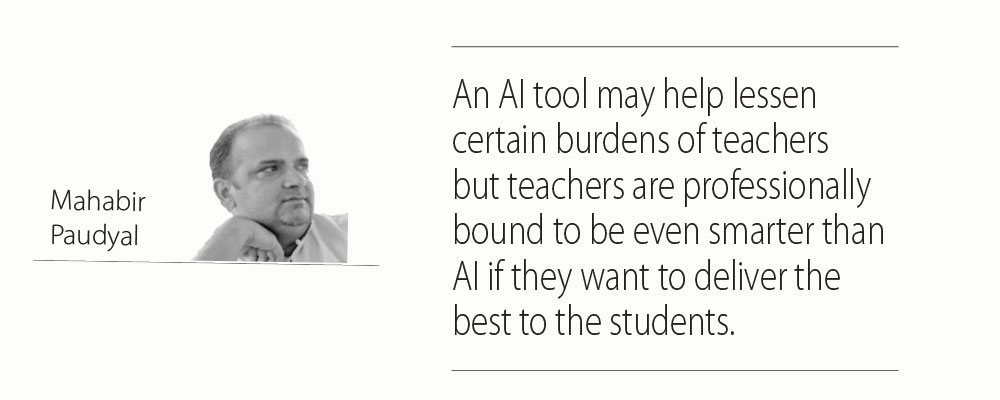
An AI tool may help lessen certain burdens of teachers but teachers are professionally bound to be even smarter than AI if they want to deliver the best to the students. To detect that the AI is giving him the right material, a teacher should know what the right material is to detect that the AI has given him the right summary notes; he should first have read the novels or essays between the lines. Seen this way, teachers will likely have to work even harder and smarter in the age of AI.
Meanwhile, Nepali academia and research institutions need to discuss whether teachers should use AI, how much and in what way. We need experts who can train teachers, who can teach them how they can benefit and what they will lose if they turn to AI. The world is talking about it. There is no reason why Nepal should not.
(The author is a journalist and educator based in Kathmandu.)