- Wednesday, 22 April 2026

Sales at stores are suddenly surging in the US economy’s latest show of strength
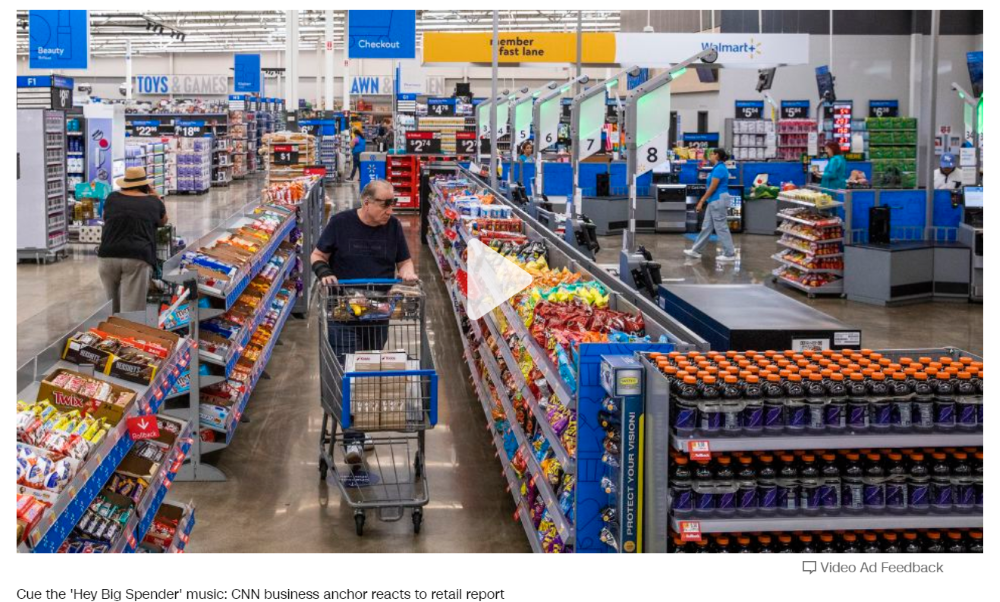

By Bryan Mena, Washington. CNN, Aug 15: The backbone of America’s economy remains solid, despite a slowing job market, elevated interest rates and still-high inflation.
Sales at US retailers unexpectedly surged in July, the
Commerce Department said Thursday, rising by a solid 1% from the prior month,
up from June’s downwardly revised 0.2% decline. That trounced economists’
expectations of a 0.3% gain.
Retail sales, which are adjusted for seasonal swings but not
inflation, make up a sizable chunk of overall spending. July’s reading is a
boon for the US economy because the country’s economic growth hinges on
Americans spending their dollars.
It is the economy’s latest show of strength in the face of
several economic hurdles squeezing the US consumer.
The Dow closed 555 points, or 1.4% higher, as investors
cheered the retail sales report. The S&P 500 gained 1.6%, and the Nasdaq
Composite added 2.3%.
Sales jumped across most categories last month, rising the
most at car dealerships, which likely reflects a rebound from the cyberattack
on software systems that dealerships use earlier this summer. Those sales
spiked by 3.6% in July. Excluding that category, retail sales were up by a
still-strong 0.4% in July from June.
Retail spending on electronics and at grocery stores also
rose robustly last month, up by 1.6% and 1%, respectively. Americans also
continued to spend at bars and restaurants at a healthy pace. Meanwhile, sales
were down at specialty stores and clothing retailers in July.
“The economy is maintaining an encouraging glide path down
to a more normal state and a soft landing,” Oren Klachkin, financial market
economist at Nationwide, told CNN.
The Federal Reserve has kept interest rates at 23-year high
for a year now to stamp out price pressures in the economy. The central bank
has seen some substantial progress since kicking off a historic rate-hiking
campaign in early 2022: The Consumer Price Index fell below 3% in July for
the first time in more than three years, according to data released
Wednesday, down considerably from the four-decade peak of 9.1% seen in June
2022.
But the Fed’s bitter medicine to remedy inflation has also
pulled on the economy’s reins. That’s precisely how the Fed wrangles inflation
– by cooling demand, which subsequently slows down the broader economy. That
comes with the risk of a recession, and those odds increase if the Fed keeps
rates too high for too long.
So far, the US economy has proven remarkably resilient
throughout the Fed’s inflation battle, but some cracks have emerged. The
biggest, worrisome question mark right now is the future of the job market, a
key driver of the economy. Unemployment recently jumped to its highest level
since October 2021, after more than two years of the jobless rate hovering
under an ultralow 4% rate. Economists tell CNN that once unemployment starts
rising, it tends to catch momentum and continues to rise.
Some retailers are in a rut. Others are not
Many major retailers continue to say that American shoppers,
including some with high incomes, are spending their dollars more carefully
nowadays. That’s been a big theme this earnings season and it’s
keeping Wall Street attentive for any additional signs that the US
consumer is tapping out. Consumer discretionary stocks in the S&P 500 are
down 1.7% this year, the only sector currently trading in the red.
Home Depot this week reported that sales in stores open for
at least a year dropped
3.6% in its latest full quarter, and it expects sales to continue to
dwindle this year, falling between 3% and 4% compared to last year.
“During the quarter, higher interest rates and greater
macro-economic uncertainty pressured consumer demand more broadly, resulting in
weaker spend across home improvement projects,” Ted Decker, Home Depot’s CEO,
said in a statement.
High-end shoppers are also tightening their (expensive)
belts. The parent company of luxury brands Louis Vuitton, Dior and Fendi
reported late last month that sales in its latest quarter rose by just 1%
compared to the same time last year, as both revenues and profits declined in
the first half of its budget year.
But it hasn’t all been doom and gloom for Corporate America.
Walmart, America’s largest retailer, reported on Thursday that sales at its US
stores jumped
4.2% last quarter and its operating income surged 8.5% during the
quarter. Online sales spiked 22%. That sent the company’s shares surging 7%
during pre-market trading Thursday.
“The only place anyone is shopping right now is Amazon,
Walmart and Costco,” Michael Baker, an analyst at DA Davidson, told CNN
previously. “Walmart does a great job focusing on value. Value has become more
important. Structurally, they’ll well positioned.”
The Fed is still on track to cut interest rates
Thursday’s report on retail spending doesn’t change the
likelihood that the Fed will cut rates next month. Inflation has continued to
make some steady progress toward the central bank’s 2% target, and the job
market has notably softened, which are the two main reasons why the Fed is on
track to lower borrowing costs.
But it may have dented the chances of the Fed rolling out a
bigger-than-expected rate cut in September. Fed officials have said that the
economy’s enduring strength has allowed them to sit tight and gather additional
evidence that inflation is truly under control. If the economy seems to be
facing dire straits, then that would force the Fed to consider more aggressive
action. That doesn’t seem to be the case, with American shoppers still fueling
the economy with their spending.
The latest remarks from central bankers don’t suggest that
the Fed is planning for a jumbo rate cut. Some officials are still wary of
inflation possibly not being tamed just yet.
“We want to be absolutely sure,” Atlanta Fed President
Raphael Bostic, who votes on policy moves this year, said Tuesday during a
conference in Atlanta. “It would be really bad if we started cutting rates and
then had to turn around and raise them again.”
The chances of a quarter-point cut next month rose to 75%
after the government’s latest retail sales report was released, up from 60%
earlier Thursday morning, according to the CME FedWatch Tool. That also means
that the odds of a half-point cut fell markedly as traders re-calibrated their
expectations.












-original-thumb.jpg)