- Friday, 8 May 2026

New foot-trail ends reliance on Indian roads to reach Balmiki Ashram in Madi

By Bomlal Giri,Nawalpur, Aug. 14: The long-standing reliance on Indian roads to reach Valmiki Ashram in Madi Municipality, Chitwan, has come to an end with the recent construction and opening of a new foot-trail.
This development marks a significant improvement in accessibility to the revered site, which holds great religious importance as the place where Lord Ram is believed to have left Sita in exile, where their sons Lava and Kush were born, and where Sita is said to have descended into the earth.
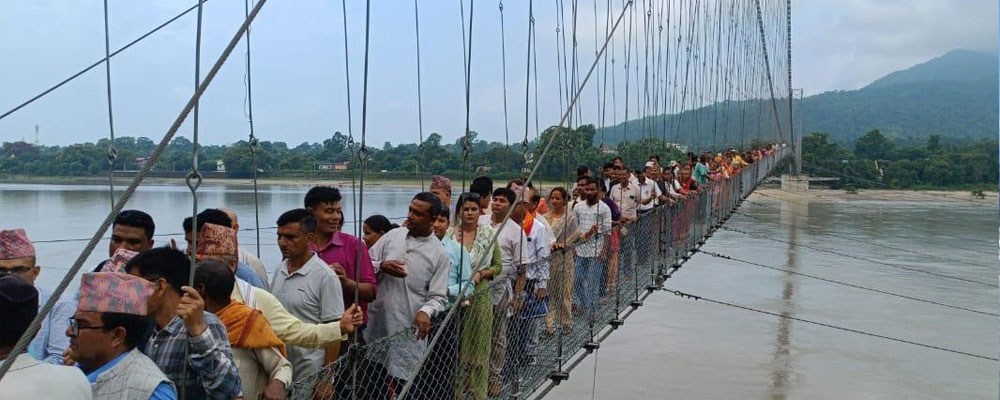
Two years after the completion of a suspension bridge over the Narayani River, connecting Trivenidham and Balmiki Ashram, local residents took initiative to construct a footpath from the Lava Kush suspension bridge to the ashram.
When India denied permission to use the road for transporting machinery needed to construct the access road from the suspension bridge to Balmiki Ashram in Vinayi Triveni Rural Municipality-6 of Nawalpur, the locals took initiative to build the road themselves through voluntary labour.
This had previously forced visitors to use a route through Indian territory.
To overcome this challenge, the Bagmati provincial government allocated Rs. 2 million in the last fiscal year for the construction of an access road from the eastern side of the suspension bridge to Balmiki Ashram and an army check post.
Using the allocated budget, Om Construction Company was contracted to build an access road, with approval from Chitwan National Park.
However, the plan faced setbacks when India did not grant permission to use the forest area of Balmiki Tiger Reserve to transport the machinery, causing the tender process to be canceled and the allocated budget to be frozen.
As a result, the locals of Triveni took it upon themselves to construct the footpath by donating their labour, labour to build a 3-km footpath, which now provides direct access to Balmiki Ashram from Nepal.
The Lava Kush suspension bridge, for which an agreement was reached in 2070 B.S., was completed in 2079 B.S. remained non-operational due to the lack of an access road leading to Balmiki Ashram.
The completion of this footpath has not only made it easier for pilgrims to reach the ashram, but also for religious tourists who previously faced difficulties due to the lack of an accessible route.
The inauguration of the new pathway was celebrated with a pilgrimage organised by the Triveni Gajendramoksha Divyadham Area Development Committee.
The event saw the participation of provincial assembly members, former parliamentarians, local representatives, government officials, security personnel, religious activists, and journalists.
Swami Krishna Prapannacharya, chairman of the Gajendramoksha Divyadham Area Development Committee, expressed his satisfaction with the new route, stressing that it has significantly eased access to Balmiki Ashram via Nepali territory.
Jhapendraswar Bhusal, executive director of the Triveni Gajendramoksha Divyadham Area Development Committee, also highlighted the importance of the new road for facilitating religious tourism to the ashram.
Previously, reaching Balmiki Ashram required crossing the Gandak Dam on the Narayani River at Triveni, 28 km south of Bardaghat Bazar on the East-West Highway, passing through Balmiki Nagar in India’s Bihar state, and traversing the Balmiki Tiger Reserve Forest.
With the new footpath, pilgrims and tourists can now directly reach the ashram without having to rely on Indian roads, marking a significant improvement in access to this sacred site.