- Friday, 8 May 2026

Legal Regime For Party Democratisation

Several democratic changes and transformations have occurred globally during the recent decades particularly in the domain of constitutional strengthening of the political parties. In many of the European countries, political transformations especially related with recognition to political parties in the constitution was brought about after Second World War. Studies on European political parties state the fact that Iceland was the first country to recognise political parties within its constitutional framework in 1944 followed by Austria, Italy and Germany in 1945, 1947 and 1949 respectively. Several other European countries have also recognised political parties within the constitutional framework, with Luxembourg being the latest country during the previous decade to join the league.
The European Parliament under the European Union (EU) has also endorsed a resolution calling upon the member states on assigning constitutional status to the political parties. However, political parties are extra-legal entity in many countries. In both the US and UK, political parties are not yet constitutionally recognised, stipulated and entrenched. In fact, it is almost agreed that the legal lacunae for regulating the functioning of political parties must be remedied by conferring constitutional recognition on them, which would in turn, institutionalise these parties and increase their transparency and accountability.
Needless to say, political parties are the key link between the citizens and the government. In democracies, parties function as representatives of the people, either as members of the ruling party that forms the government or in the opposition. In his valedictory observation in the meeting of the Constituent Assembly of India, Dr. B.R. Ambedkar had asserted the importance of political parties stating that the constitution can provide only the organs of state such as the legislature, the executive and the judiciary. The factors on which the working of those organs of the state depends are the people and the political parties they set up as their instruments to carry out their wishes and their politics.
Constitutional framework
Although the Constituent Assembly that wrote the constitution of India was silent on the regulation of political parties, the constitution itself was engendered as a result of party politics. India’s constitution was authored by leaders of the Indian National Congress which was led by such leaders as Mahatma Gandhi and Jawahar Lal Nehru, among others. The current day Indian political dynamics are significantly different from the conditions prevalent in the early 1950s when the constitution was promulgated. Hence, it is the need of the hour to bring political parties within the ambit of the constitutional framework. As political parties are representatives of citizens in the government, there is a need for regulation to make them more accountable and transparent. Most importantly, expenditure incurred by the political parties during elections should also be made available to the public.
It is worth noting the fact that the federal constitution of Nepal 2015 recognises political parties and enshrines the provision that they needed to be incorporated as a legal entity and registered with the Election Commission (EC) of Nepal. The commission is designated legally as the regulating authority for the political groups and organisations. The constitution requires the political parties to imbibe into the democratic values and norms. Party office bearers for different tiers and levels need to renew their mandates every five years through democratic elections subject to the provisions in their respective statutes. Pursuant to the constitutional provision, a separate law relating to political parties has been formulated in 2017 that spells out registration process, standards, functions, scope and party functionary recruitment, and several other aspects of the political party regulatory governance.
Though the EC has been often criticised for its less than satisfactory performance especially in enforcing rules and regulation, it has of late, become apparently active to assert its role as the enforcer of the political party regulatory regime. Nepali Congress had convened its 14th general convention because of the mandatory legal provision and also the constant reminder served by the EC to it in regard to its statutory compliance requirement. Similarly, CPN - Maoist Centre had felt the urgency to hold its party congress because of the mandatory provision of the party regulatory regime.
Impartiality
Furthermore, the Election Commission has sprung into action to enforce the provision in the law relating to political parties that prohibits recruitment of the school and university teachers, civil servants, among others, as the members of the political parties. Not very long back, the commission served the notice to the political parties to refrain from recruiting the government-remunerated employees into the formal party structure to uphold the provisions envisaged in the law relating to political party. Needless to say, a large numbers of government remunerated employees including the school and university teachers are reportedly recruited into the ranks and files of political parties that has politicised the orientation of public institutions in the country. This has to be stopped to ensure impartiality and rationality of the academic and bureaucratic institutions that feed on the public exchequer.
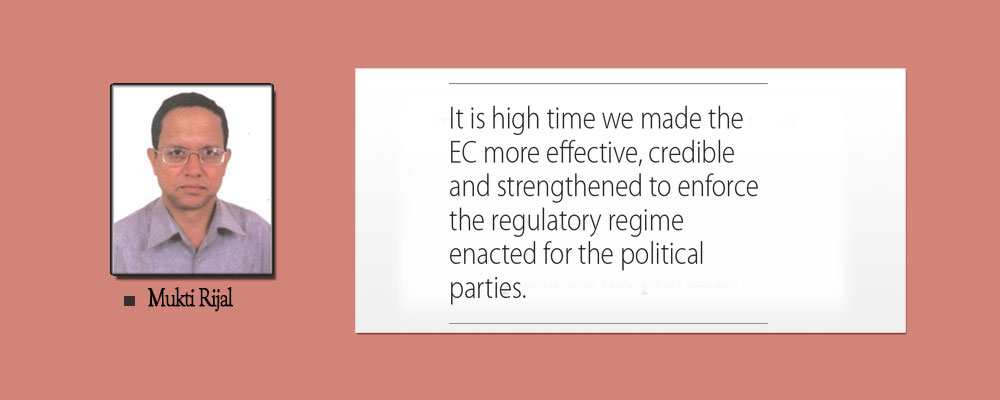
Political party laws have their significance in promoting and regulating the political parties especially requiring and sanctioning them to organise and act democratically. The law fulfills such critical functions as defining the criteria for recognition of a political party, regulating party activities, prescribing norms for party organisation, setting sanctions against parties if they fail in upholding the norms and so on. In Nepal, we have rightly formulated political party law according to the democratic intents of the constitution. However, it is high time we made the EC more effective, credible and strengthened to enforce the regulatory regime enacted for the political parties.
(The author is presently associated with Policy Research Institute (PRI) as a senior research fellow. rijalmukti@gmail.com)