- Saturday, 9 May 2026

Human encroachment leads to decline in grass species in forests
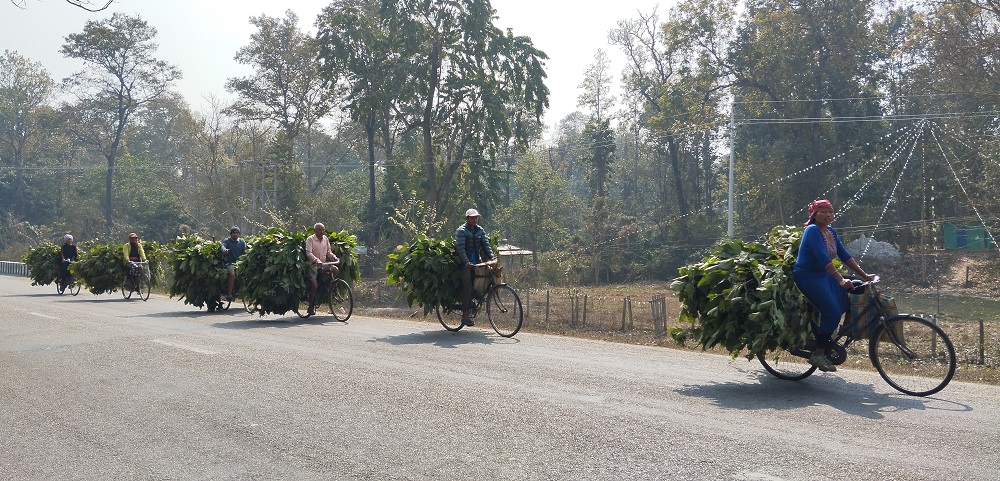

By Hari Prasad Koirala,Urlabari, Mar. 21: Grass species are declining in the national and community forests of eastern Morang as goat herders, reliant on the forest, have begun cutting down small shrubs before they mature. As a result, grass species are not maturing in the forest, and the growth of new plants has also been slow.
When human encroachment increases in the habitats of wild animals, especially in dense forest areas, the natural growth of plants has been affected. Over a decade, a decline has been noticed in the sighting of new saplings such as Saaj (terminalia elliptica), Tatari (dillenia pentagyna), Kusum (schleichera oleosa), Kumbi (wild guava), Bankera (capparis formosa) and other forest species.
Other small plant species like erythrina indica coral plant, aulia plant and runbambous are also in critical condition. Locals said that the monkeys entered the village after the fruit-bearing plants like Fadir, Jamun, Harro, Barro, Kumbhi, Saaj, Tatari, Kusum, Angeri, Damaiphal and Bankera were cut down from the forest for the goats. The grass of fruit-bearing plants, which monkeys prefer, is considered the best for goats.
Until 20 years ago, Ranikusum and Saaj were abundant throughout the forests, now they are found nowhere in the forests of the Kanepokhari-Letang area.
Padam Prasad Koirala, 50, from Kanepokhari-7, said that Tatari and Kumbi species are also vanishing. Koirala recalled, “When we were in school, we used to have Kusum and Fadir for our tiffin.”
Currently, Kusum, Tatari, Kumbi, and Saaj cannot be seen on the southern side of the East-West Highway. Experts attribute this disappearance to the indiscriminate cutting of plants following the initiation of commercial goat-rearing campaigns.
Tulsi Prasad Dahal from Kanepokhari-4 said that fruits such as Tatari, Kumbi, Saaj, and Ranikusum have ceased to appear in the forest.
Every day, more than 600 bicycles and motorcycles from the southern villages of Kanepokhari transport grass from the forests in the north while the villagers in northern Letang transport grass from the forests in the south. The management of grass for goat rearing primarily depends on resources from the forest.
According to Assistant Forest Officer Allauddin Ansari of the Sub Division Forest Office in Kanepokhari, when small saplings are cut instead of harvesting grass from the large trees in the jungle, it leads to a decrease in grass species in the forest. He said, “Even if grass collection is restricted from the forest, it does not necessarily improve the situation.”
Therefore, awareness programmes and the plantation of drought-tolerant species are essential. Community forests, scientific forestry, and governmental bodies should focus on producing nurseries for drought-tolerant species and then proceed with tree plantation.
He said that the Kanepokhari Sub Division Forest Office has already prepared seedlings for 1,200 Kusum (Cceylon oak) trees.
Devendra Thapa, the chairman of the Rural Improvement Community Forest User Group in Kanepokhari-7, emphasised the necessity of controlling the practice of indiscriminate grass collection to maintain sustainable harvesting.
Grass cutting is not the only concern. It has been observed that those who trim Sal leaves also peel off Sal bark and sell it by the roadside. “We have been raising awareness about this issue as well,” he added.

-square-thumb.jpg)
-original-thumb.jpg)