- Sunday, 10 May 2026

NAM For Resilient Global Order

The 19th summit conference of Non-Aligned Movement (NAM) ended at Kampala, capital of Uganda on 20 January with consensus on reinventing the relevance of the movement but clueless about how to restructure its operational framework to enable it to address multi-polar geo-political realities. NAM had come into existence in September 1961, just one year before the Cuban missile crisis of 1962, as a response to the challenges emanating from the bipolar world order. This movement, which remained a powerful alternative framework for handling global affairs more than five decade, is now at its lowest ebb.
During its heydays, the NAM worked as an effective alternative foreign policy tool to navigate a safe passage through the labyrinth of tricks and truculence resorted to by superpowers and their allies to sustain their global dominance and monopolise resources. During the Cold War period, the NAM stood as a bulwark of peace and neutrality consistently refusing to be part of power alignment and avoiding complicity in inter-state conflict.
Under the leadership of leaders like Gamal Abdul Nasser of Egypt, Jawaharlal Nehru of India, Joseph Broz Tito of Yugoslavia, Sukarno of Indonesia and late King Mahendra of Nepal, the NAM had effectively navigated the harsh terrain of Cold War as a defender of sovereignty of poor developing countries of the world. However, with the departure of its charismatic founding leaders from the global stage, the ship of Non-Aligned Movement became rudderless in the stormy sea of global geo-politics of the ensuing post-Cold War decades.
Multilateralism
During two decades of post-Cold War transition, the NAM suffered a serious decline together with whole range of international institutions that had consistently promoted multilateralism fostering the values of equality, inclusivity and collaboration. During this period, a global surge of democratisation took place under what is often referred to as the Third Wave Democracy. The Rose Revolution in Georgia (2003), Jasmine Revolution in Tunisia (2010) and Arab Spring in West Asia (2011) were much-hyped by western democracies which hardly brought any positive social change except destabilising these countries. Syria, Libya and Yemen are still burning in the racial fire ignited and stoked by these revolutions.
Despite the immense obstacles, NAM was still the most credible institutional movement which rallied hundreds of small and developing countries to pursue a foreign policy based on neutrality, non-alignment, and respect to sovereignty, mutual equality and cooperation. It continued, against all odds, to play an instrumental role in protecting humanity from the horrors of war till early 21st century. The fall of USSR and the rise of unipolarity sounded death knell for multilateral institutions. Institutions like WTO, United Nations, World Bank and IMF all aligned their policies to suit the interest of power countries which funded them or were able to use their economic resources and military might to manipulate their operations against the interest of poor developing countries.
Multilateralism is incompatible with unipolar structure of power. During that period NAM faced various obstacles in the way of institutionalising its vision of equitable, inclusive and peaceful world order due to duress from power blocks and divergent interests of member states making it difficult for framing consensus. Now the euphoria over the fall of bipolar world has come to an end with the rise of China and the resurgence of Russia as global strategic and economic powers setting stage for multi-polar conflict, and by extension, revival of multilateralism. Multi-polar world order paves the way for the evolution and consolidation of institutions. Diffusion of power and resources help sustain multilateral dynamics.
In the changed context, international institutions, including NAM, must try to reinvent themselves to be able to play their role for fostering collaboration, cooperation, coexistence and consensus. For that purpose there is a need to introduce reform in their structures and build preparedness to cope with the upcoming challenges imposed by the geopolitics pivoting towards multi-polarity. In recent years, we find several countries locked into armed conflict in a number of battle fronts. The Russian-Ukraine war and Israel-Hamas war run the risk of escalating into wider conflict because of superpowers taking sides and supplying lethal weapon systems to their proxies. In such situation, the Non-Aligned Movement has the potential to emerge as a powerful agency to deescalate conflict and find peaceful settlement through dialogue and diplomacy.
Non-Alignment Movement is rooted in the principle of Panchsheel which is also known as five principles of peaceful coexistence. These principles can also be rephrased as the policy of mutual respect to sovereignty and territorial integrity, mutual non-aggression, non-interference in domestic affairs, mutual non-aggression and peaceful coexistence. These are the core values of diplomacy which, if implemented honestly, may help the world to avert violent confrontation and seek settlement of global issues through peaceful dialogue.
As one of the founding members of NAM, Nepal has always played its role responsibly to institutionalise its principles in the directive principles of its foreign policy. The commitment which Nepal has expressed to fulfill its obligation for its continued operation need not be reiterated. As a country navigating a path for survival and growth through treacherous landscape of geopolitics, Non-Aligned Movement is a magical foreign policy tool for safeguarding its vital interest.
Bulwark of peace
During the past six decades of its existence, Non-Aligned Movement stood fast as a bulwark of peace effectively pushing back the forces of aggression addressing regional and global issues through peaceful negotiation and dialogue. During the post-Cold War decades NAM suffered serious decline both in its profile and performances.
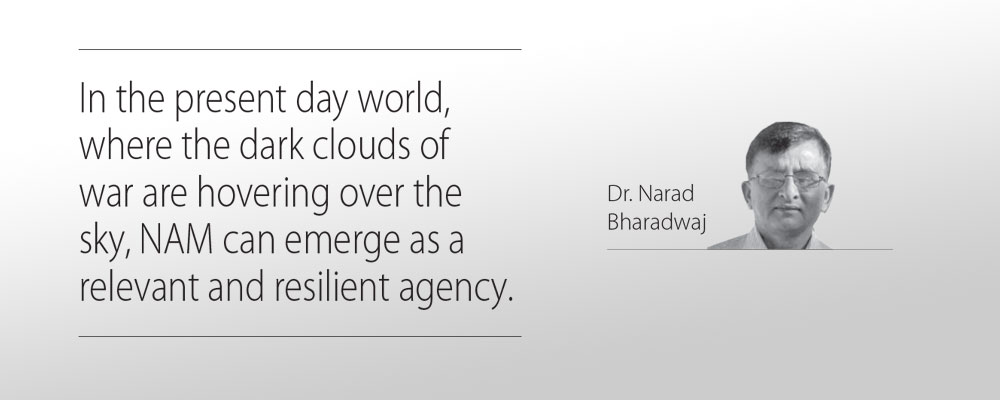
The situation is now undergoing change making it difficult for unilateralism to gain currency. Shifting geo-political fault lines are again yielding operational space for multilateralism and peace agencies like NAM. In the present day world, where the dark clouds of war are hovering over the sky, NAM can emerge as a relevant and resilient agency capable of containing violence and preventing war by promoting peace, equality, inclusivity, collaboration and co-existence which are the fundamental prerequisites for just world order.
(The author is former chairperson of Gorkhapatra Corporation and former ambassador of Nepal to Qatar.)