- Sunday, 10 May 2026

Multipronged Approach Reduces Malnutrition

Malnutrition affects millions of people around the world. It is a condition that arises when the body does not get the required nutrients to function properly. Malnutrition can trigger many health problems including stunted growth, weakened immune systems, and even death. Malnutrition is a global health issue that afflicts millions of people worldwide. According to the World Health Organisation (WHO), malnutrition is defined as "deficiencies, excesses, or imbalances in a person's intake of energy and/or nutrients." Malnutrition can occur due to various factors that include but are not limited to poverty, lack of access to nutritious food, and underlying health conditions.
Epidemiological studies have revealed that it is a significant public health problem in many parts of the world. In low-income countries, malnutrition is a leading cause of morbidity and mortality, particularly among children under the age of five. The prevalence of malnutrition varies across different regions and populations. In sub-Saharan Africa, for example, an estimated 22 per cent of children under the age of five are underweight, while in South Asia, the prevalence is around 30 per cent.
Risk factors
In developed countries, malnutrition is more prevalent among certain groups, such as the elderly, hospitalised patients, and those with chronic diseases. Much research has also identified various risk factors for malnutrition. Poverty is a significant risk factor, as it limits access to nutritious food and healthcare. Other risk factors include poor sanitation, lack of education, and inadequate maternal and child healthcare. Malnutrition can have significant health consequences, including stunted growth, weakened immune systems, and increased susceptibility to infections.
Moreover, in children, malnutrition can lead to developmental delays and cognitive impairment. In adults, malnutrition can increase the risk of chronic diseases such as diabetes, cardiovascular disease, and cancer. Preventing and treating malnutrition requires a multi-faceted approach that addresses the underlying causes and risk factors. Therefore, improving access to nutritious food, promoting education and healthcare, and addressing poverty and inequality are essential to address it.
There are several ways by the help of which the problem of malnutrition can be addressed. First of all, increasing access to nutritious food is the most effective one. This can be done by promoting the production and distribution of nutrient-rich foods, such as fruits, vegetables, and whole grains. Governments can also provide subsidies to farmers to encourage them to grow these foods. Additionally, food banks and other charitable organizations can distribute food to those in need.
Another way to tackle malnutrition is to improve education on nutrition. Many people do not know what foods are nutritious and how to prepare them. By providing education on nutrition, people can learn how to make healthy food choices and prepare nutritious meals. This can be done through community programmes, schools, and healthcare facilities. In this regard, school health education is one of the most important ways of tackling it. It is important to note that the revision of the curriculum if need be, can be an important beginning.
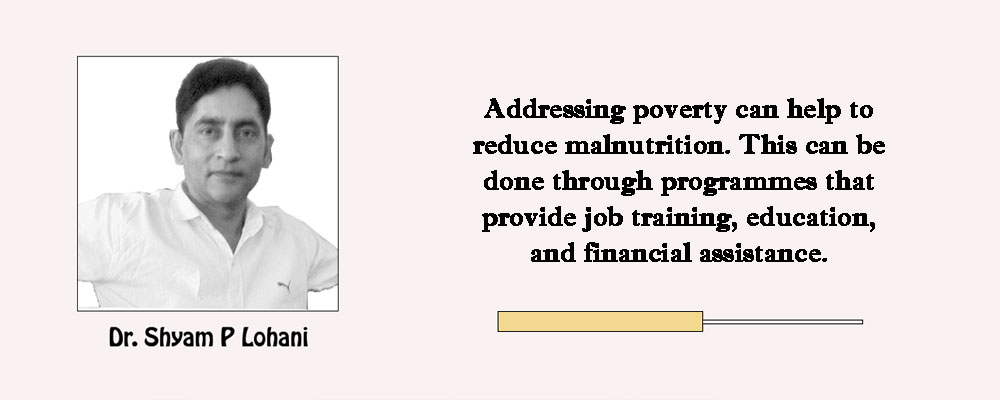
In some cases, people may not be able to get all the nutrients they need from food alone. In these cases, nutritional supplements can be provided. This can include vitamins, minerals, and other nutrients that are essential for good health. Nutritional supplements can be provided through healthcare facilities or community programs. The role of the Female Community Health Volunteer (FCHV) cannot be undermined in the Nepalese context. Poverty is a major contributor to malnutrition. People who live in poverty may not have access to nutritious food or the resources to purchase it. Addressing poverty can help to reduce malnutrition. This can be done through programmes that provide job training, education, and financial assistance.
Healthcare facilities can provide screening and treatment for malnutrition. They can also provide education on nutrition and refer patients to community programmes that provide nutritious food and supplements. Identifying severe acute malnutrition (SAM) and moderately acute malnutrition (MAM) at the household levels by FCHV becomes important. Healthcare providers also play a crucial role in identifying and treating malnutrition, particularly in high-risk populations.
Nepal government has initiated the Multi-Sectoral Nutritional Policy (MSNP) that aims at addressing the issue of malnutrition in Nepal. It recognises that malnutrition is a complex problem that requires a multi-sectoral approach involving various government ministries, civil society organizations, and other stakeholders. The policy focuses on improving nutrition outcomes through a range of interventions, including improving access to nutritious food, promoting breastfeeding and complementary feeding practices, enhancing nutrition education and awareness, and strengthening the capacity of health systems to deliver nutrition services.
Collaboration
The MSNP also emphasises the importance of collaboration and coordination among different sectors, such as health, agriculture, education, and social welfare, to address the underlying causes of malnutrition and ensure a comprehensive approach. Overall, the Multi-Sectoral Nutritional Policy is seen as a positive step towards addressing the issue of malnutrition in the country. By adopting a multi-sectoral approach, it aims to tackle the problem from various angles and improve the nutritional status of the population.
In conclusion, malnutrition is a serious problem that requires a multi-faceted approach. By increasing access to nutritious food, improving education on nutrition, providing nutritional supplements, addressing poverty, and improving healthcare, we can work towards reducing malnutrition and improving the health of millions of people around the world. Thus, by working together, we can improve the health and well-being of millions of people affected by malnutrition worldwide.
(Dr. Lohani is the executive director at the Health Concern. lohanis@gmail.com)