- Sunday, 10 May 2026

In B’desh, Beyond Poll Victory

Far too predictably, Awami League leader Hasina Wajed has led her Awami League to the fourth consecutive win in the violence-marred January 7 parliamentary elections that were boycotted by Bangladesh Nationalist Party (BNP), the key opposition. The boycott call contributed to the low voter turnout of a disputed 41 per cent as against 80 per cent turnout in 2018. The Awami League obtained three-fourths of the total parliament seats and most of the remaining winners were “independent” candidates known to be from the ruling party. Hasina fielded scores of her party members as independent candidates to avoid an embarrassment of an opposition-free parliament.
After the political change in December 1990, voters in Bangladesh have not been deprived of casting their ballot papers. Nor have they experienced any military takeover since then. Bangladesh presents a story of periodic elections and steady economic growth rates. However, elections can churn out autocratic rule if discrepancies in the governance of a state go unaccounted for. Interrelated as they are, both the components are essential in a functioning democracy.
Hence, Bangladesh’s engagement in democratic practices should compare with the experiences and expectations of other multiparty systems. It does compare well with not only its South Asian neighbours but many others among developing economies. If it used to be cited as a nation of teeming multi-millions most of whom were in a state of semi-starvation and malnutrition five decades ago, the table now has turned for a dramatic better and is looked at with envy by many other nations struggling for meeting their basic needs.
Remarkable stride
In the world’s most-populous region of South Asia that accounts for every fifth person on Earth, Bangladesh’s story is remarkable. Frequent lockdowns and boycott of parliament marked the first decade and a half since the 1990 changes. A running fierce feud between the Awami League and the BNP adversely impacted the growth rate. By the 2010s, the economy began to register an upward swing. New policies have placed the world’s “basket case”—as Henry Kissinger once in the 1970s disparagingly tagged the nation—to conditions that have drawn appreciation from both the neighbourhood and beyond.
At 7.2 per cent GDP growth a year ago, the country achieved one of the fastest records in the world, which was higher than those of India, Indonesia and the Philippines, among Asian nations. It now paces toward emerging as an upper-middle income country.
China had been assessing Bangladesh’s economic pace to visitors from the neighbourhood, including Nepal. It is to this scribe’s knowledge that at least three professors from different universities in China had told foreign guests that Bangladesh was an emerging economy whose transformation would be acknowledged well within the 2020s. Under Hasina’s stewardship, Dhaka has begun looking beyond the immediate region for new opportunities with long-term prospects. Its hopes of becoming a fast-developing economy by the next decade is not an improbable target, with also the potential of emerging as a credible regional power.
Bangladesh’s garment industry ranks as the world’s second largest, which makes for 11 per cent of GDP and contributes to 80 per cent of the country’s export revenue. Governments in the past three decades appreciably responded to demands for changes in law and regulations and with free-market approach. One of the poorest regions of British India, its conditions remained unchanged for decades even after it broke away from Pakistan to become an independent Bangladesh in 1971. Political assassinations and military-backed rule marked much of the next 15 years. Mass uprising in 1990 brought down the HM Ershad regime and paved way for democratic reforms.
In 1994, during Prime Minister Khaleda Zia’s fourth year in office, the League resorted to frequent boycott of parliament to press for an independent caretaker government for conducting elections. Although the demand was eventually met after a series of incidents, the League backtracked on its stand when it came to power and changed the rule in a reverse of its earlier stand.
Disturbing
Undoubtedly, Bangladesh has come a long way since the early 1990s. But democratic aspirations of the general people, particularly those of the youth, should be addressed through timely responses and reforms. Several thousand activists of BNP were reported to have been arrested on the eve of the 2018 elections. Charges that critics, including journalists, are regularly put behind bars are of serious nature and implications. At the same time, BNP’s boycott of last week’s election cannot be taken lightly. It dismisses the exercise as a “disgrace” while Hasina Wajed considers BNP a “terrorist” organisation.
Fear of Islamic radicalism emanates primarily since the religious extremist violence in 2016, when 24 people were killed in a blast in Dhaka. The Awami League government cracked down on some extremist groups but is seen to have cultivated rapport with other anti-secularist groups in a country where Muslims constitute 90 per cent of the 173 million people. Economic success alone cannot guarantee democratic governance, as numerous instances in various parts of the world have shown time and again. Commitment to democracy in practice would serve the Awami League government well.
Flushed with her fourth consecutive electoral victory, Hasina Wajed cannot afford complacency over the principal opposition’s non-participation in the latest general election. BNP and former Prime Minister Khaleda Zia, now under house arrest after court conviction in corruption cases, will not lie low. They await a chance to strike in a manner their strength can best muster. The ruling side’s best defence would be in greater democratic practices and higher living standards for an average Bangladeshi.
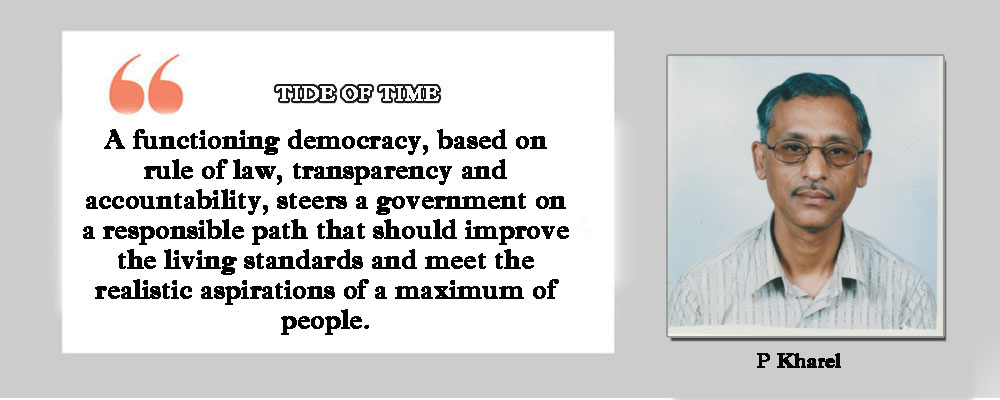
A functioning democracy, based on rule of law, transparency and accountability, steers a government on a responsible path that should improve the living standards and meet the realistic aspirations of a maximum of people. Already the longest ruling prime minister in South Asia, Hasina Wajed’s fourth consecutive term following a previous one term needs to engage in actions that enhance her democratic credentials and accelerate the economic pace.
(Professor Kharel specialises in political communication.)