- Sunday, 10 May 2026

Save The Mountains

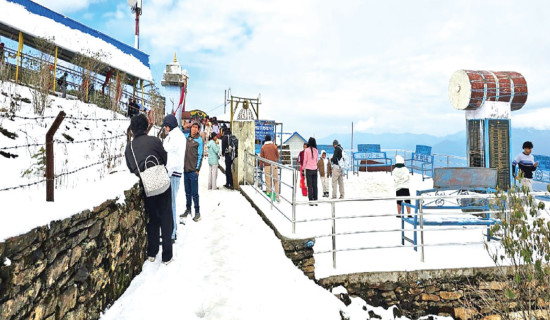
The International Mountain Day 2023 was celebrated on Sunday with the theme 'Revitalising Mountain Ecosystem'. This year's event urges the promotion of nature-based solutions, adoption of best practices, and strategic investments to strengthen resilience, reduce vulnerability and enhance mountain adaptability to daily challenges and extreme climatic events. Home to most of the Himalayas, the highest mountain range in the world, Nepal also houses eight of the 14 highest peaks above 800 metres. For a civilisation born in and nurtured by the mountains, the significance of mountains is too vast to put into words. Nepal's identity is so inextricably tied with mountains that it is synonymous with mountains. Mountains breathe life into about half of the world's biodiversity. Billions of people quench their thirst from melt water coming from mountain glaciers.
Hundreds of millions of farmers living downstream depend on the snow-fed water to irrigate their fields. The rivers fed by this water are also a source of hydropower and the economy it sustains. But rising temperatures and climate change is changing our mountains beyond recognition, threatening the ecosystem underpinned by them. The biodiversity, fishing communities whose life and livelihood are inseparably linked with the glacier-fed rivers, highland communities, among many others, are all in jeopardy. Climate change has also increased drought in frequency and duration. As rainfalls become scarce, pasture land is shrinking. No longer to find enough grazing land for their animals, yak herders are migrating to places in lower altitudes.
Another significant threat is the continuous formation of a large number of glacial lakes. The lakes consist of vast quantities of glacier melt water. The accelerated rate at which the glaciers are melting means that the water accumulating in such lakes is increasing rapidly and they might burst at any time. Once that happens, it will have devastating consequences for the downstream communities, marketplaces, roads, bridges, crops, fertile land and livestock. UN Secretary-General Antonio Guterres highlighted this peril during his recent visit to Nepal and even during the COP 28 summit in Dubai.
The high mountains are feeling the intense impact of warming climate. For farmers growing apples or grain on steep mountain slopes, climate change means they have to shift their orchards higher in pursuit of cooler temperature their crops need. For others, shifting pattern of snow and rainfall is leaving streams and springs dry on the one hand and increasing the likelihood of flash flood on the other. Most of the high-elevation ecosystems like forests, peat lands, rangelands, wetlands and their inhabitant species are fragile and vulnerable to the changing climate. Endemic species, in particular, are at increased risk as a slight change in the combination of temperature and precipitation leads to sharp decline in their survival rate, ultimately leading to their extinction.
Given such a dire situation, what urgent step do we need to take? Of course, adaptation. But the warming is outpacing our ability to adapt. To keep up, most climate vulnerable countries are in desperate need of the climate loss and damage fund. Climate change is not of our making, but we are having its direct, disproportionate and damaging impacts. It is incumbent upon the developed countries that became rich burning the fossil fuel must now help the poor and vulnerable ones to tackle the climate crisis. Most importantly, when it comes to significantly lowering the burning of fossil fuel, if not discarding it altogether, there mustn't be no ifs and buts.