- Thursday, 23 April 2026

Policy Reforms Essential For Growth
Nepal has been facing significant challenges in recent years, with low economic growth and political instability, posing major obstacles to the country's development. Despite its rich cultural heritage and natural resources, Nepal has struggled to achieve sustained economic growth and improve the living standards of its people. According to the macroeconomic update published by Asian Development Bank, Nepal's gross domestic product (GDP) growth is predicted to slow to 1.9 per cent in fiscal year (FY) 2023 from 5.6 per cent in the year prior due to tight monetary policy, the unwinding of stimulus from the COVID-19, ongoing global challenges, and broader fiscal reduction.
Due to a favourable monsoon and the utilisation of enhanced seed varieties, cereal output —namely, paddy, wheat, and maize — increased by 3.9 per cent in FY2023 compared to 2.2 per cent the previous year. Following a 10.8 per cent growth in FY2022 due to contractions in manufacturing and construction, increased interest rates, import restrictions and slackened domestic and overseas demand, the industry only rose by 0.6 per cent in FY 2023. Growth in services virtually halved from 5.3 per cent in FY 2022 as retail and wholesale trade shrank.
Political instability
One of the key factors contributing to low economic growth is the country's political instability. Nepal has experienced frequent changes in government, with a history of political unrest. This has created a challenging environment for businesses and investors, leading to a lack of confidence in economic prospects. This has led to a lack of policy continuity, making it difficult for the government to implement long-term development plans. The chronic instability has hindered the implementation of much-needed economic reforms. The economy is heavily reliant on agriculture, with limited diversification into other sectors such as manufacturing and services. The contribution of agriculture to the GDP is gradually decreasing.
The lack of economic diversification has made the country vulnerable to external shocks, such as fluctuations in global commodity prices. The government's inability to implement structural reforms to promote economic diversification has hampered the country's ability to achieve sustained economic growth. The production that can depend on food grains and fruits has not been obtained from the agricultural sector. Even now food, fruits and vegetables have to be imported from abroad. Such a problem has arisen due to the inability of the state to implement a policy to promote the agricultural sector. The underdeveloped infrastructure is another bottleneck. Our infrastructure is inadequate to support economic growth, with poor road networks, limited access to electricity, and a lack of modern transportation facilities.
The poor infrastructure has stunted the country's ability to attract investment and promote trade, as businesses struggle to transport goods and access markets. This has also made it difficult for the government to provide essential services such as healthcare and education to remote areas, further exacerbating the country's development challenges. The country also grapples with significant social and environmental challenges. There is a high poverty rate, with a large proportion of the population living in rural areas and relying on subsistence agriculture for their livelihoods. This has led to widespread poverty and limited access to basic services such as healthcare and education. Furthermore, it is vulnerable to natural disasters such as earthquakes, floods and landslides, hitting the growth.
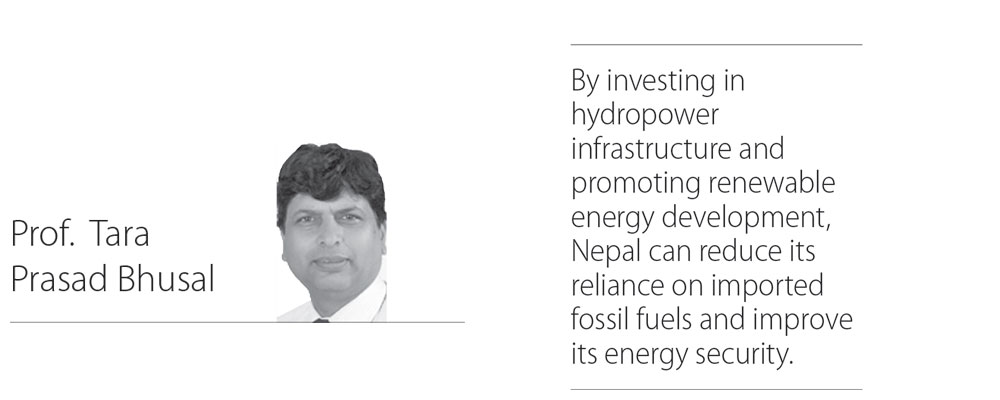
Despite these challenges, there are opportunities to achieve sustainable economic growth and improve the living standards of the people. It holds huge potential for tourism development. A home to some of the world's highest mountains, including Sagarmatha (Mt Everest) and rich cultural heritage, many foreigners are lured by its wonders. By investing in infrastructure and promoting sustainable tourism, Nepal could create new economic opportunities for its people and reduce its reliance on agriculture. The country has also enormous potential for hydropower development, with untapped hydropower potential, which could provide a reliable source of electricity and support economic growth. By investing in hydropower infrastructure and promoting renewable energy development, Nepal can reduce its reliance on imported fossil fuels and improve its energy security.
The country has a young and growing population, which could provide a valuable labour force for manufacturing and service industries. Investment in education and skill development, Nepal could create new economic opportunities for its people. To navigate these challenges and capitalise on these opportunities, Nepal needs to implement a comprehensive set of policy reforms. Firstly, it needs to prioritise political stability and create an environment conducive to investment and business growth. This includes implementing policies that promote the rule of law, protect property rights and curb corruption. A stable and transparent business environment enables the government to attract investment for economic growth.
Road networks
Secondly, Nepal should focus on building road networks, expanding access to electricity, and developing modern transportation facilities, thereby improving access to essential services. Finally, Nepal needs to prioritise social and environmental sustainability in its development efforts. This includes investing in healthcare and education to improve the living standards of its people, as well as promoting environmental conservation to protect the natural resources.
In conclusion, Nepal has both and opportunities for economic growth. It needs to move forward by utilising its natural and cultural resources, as well as its potential for tourism, hydropower, and economic diversification. By implementing comprehensive policy reforms that prioritise political stability, infrastructure development and social and environmental sustainability, Nepal can come out of its low economic growth and achieve sustainable development for its people.
(Professor Bhusal is Assistant Dean of Humanities and Social Sciences at Tribhuvan University.)


-original-thumb.jpg)