- Tuesday, 2 June 2026

Time To Reorganise Political Parties

In recent times, the issue of party restructuring in Nepal has arisen among the lower strata of members of the conventional parties. While many of them demand that the apex leadership hand over power to younger generations, a few others grumble about the party's lost credibility due to the leadership's failure to meet people's aspirations during its multiple spells in government. The leading political party, the Nepali Congress (NC), underwent a marked upheaval in the wake of the new year 2026, which the members of the CPN-UML and Nepali Communist Party (NCP) did not dare to do, remaining indolent, simply expressing their disgruntled views in the media, while accepting the party verdict in their official conventions, meetings, and forums. Neither of the two actions of conventional forces could make a big difference in the March 5 election.
Until now, dissatisfaction has not subsided among the cadres, well-wishers, and voters. But the dissatisfaction with only political leadership is not justifiable. Political instability on the surface level is only the result of cultural degeneration. It is thus mainly due to the degradation of value-based political principles, which independent thinkers have recognised. However, their voices are unheard amid the loud shouts of less knowledgeable political actors with superficial ideas and flippant outlooks. This is perhaps the most unfortunate phenomenon in contemporary Nepali politics.
Ideal political principles.
It will not be misleading to say that hitherto practiced Nepali politics has not been based on political ideologies. Nor has it been grounded on ideal political principles. Conversely, they have been practiced through teamwork, and when misunderstandings have arisen among the active members of the team, mostly prominent leaders, the teamwork has crumbled. Everybody says it is a wrong practice, but nobody dares to rectify the situation. The moment teamwork ceases, political turmoil infects the entire nation. This has happened numerous times in the country's political annals. We have witnessed such political events from autocracy to democracy to republicanism. It is thus essential for major political forces to restructure themselves ideologically, recognising that changing party leadership without a solid foundation in the broader political context is a mistake.
During the Panchayat system, different teams were formed or disbanded as the government was constituted and portfolios were distributed among cabinet members. The same practice occurred during democracy and republicanism as well. If politics is to go in the right direction, it must be guided by a substantial ideology. That ideology at this juncture is nothing but the ideology of socialism. Despite the immense popularity that socialism gained worldwide in the previous century, it has nonetheless failed to yield its true fruits to the fullest extent. Even the countries that have been practicing unfettered capitalism love to talk about socialism without their real intent to implement it in practice.
It has been everybody’s cup of tea, much referred to but never realised in any nation. Nepali political parties, too, have been constantly discussing the introduction of socialism since their inception, but to no avail thus far. It is thus essential that political actors in conventional political parties recognise that party structuring, with leadership substitution alone, cannot solve the chronic problem. Instead, it can be done through overall political restructuring. Until recently, the two major political forces were in opposition – one advocating democratic socialism, led by the NC and the other campaigning for scientific socialism, led by two seemingly alternative political giants, the UML and the NCP. Despite controversies, their lines were somehow clearer and more direct, with less confusion.
However, they were contradictory in principle and practice. It may not be presumptuous to argue that they have been practicing capitalism in the name of socialism, often masquerading the first as the second. The NC, too, has apparently been practicing capitalism in the name of socialism. It is most likely that both NC and the communist parties have shamefully lost the election this time for this very reason. The ruling party has garnered votes not simply based on ideology and principle, but also because of people’s anger at the conventional parties. Therefore, they need to organise on political ideologies and principles, not simply on the spirit of teamwork, which is inherently fragile and may crumble at any time in unfavourable weather.
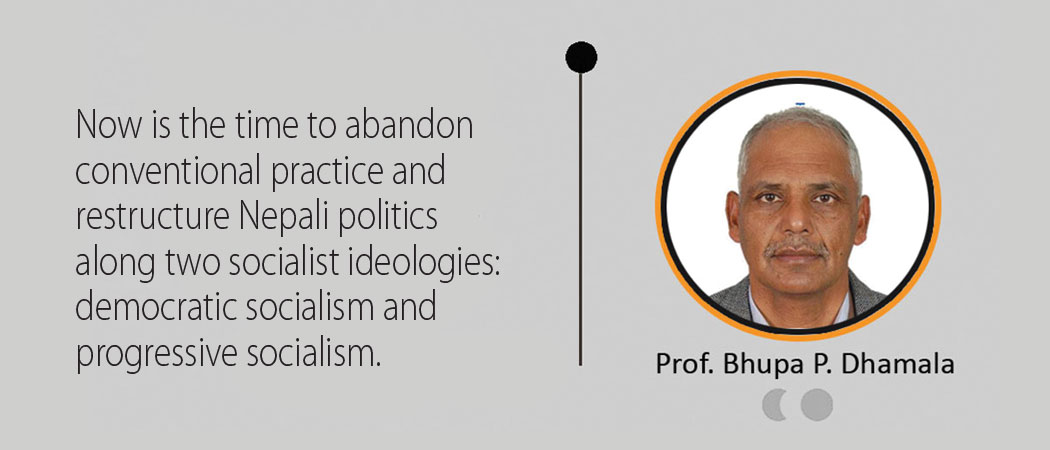
Six political parties have been recognised as national parties, albeit they were chosen by the people on non-political grounds as well. Now is the time to abandon conventional practice and restructure Nepali politics along two socialist ideologies: democratic socialism and progressive socialism. To put it more precisely, the contemporary Nepali politics has to be organised into two camps of socialism. It may be reasonable to assume that the ruling party, namely the Rastriya Swatantra Party (RSP), and the main opposition, the NC, are close to the ideology of democratic socialism. On the contrary, the two communist parties, namely UML and NCP, which have been participating in the country's multiparty system and have adhered to the principles of periodic elections and the rule of a majority government, can be restructured in line with progressive socialism.
New coinage
The remaining two smaller parties in parliament have yet to clarify their stable political positions, leaving aside even a tint of conservative outlooks, as demonstrated now and then. The terms democratic socialism and progressive socialism should not be regarded as mere political jargon, despite their repeated use even in recent times. Whereas democratic socialism should be explained further to suit the changed Nepali context, progressive socialism should be defined in a new light, regarding it almost as a new coinage.
Whereas democratic socialism was first introduced in Nepal by the NC leader, late BP Koirala, the pioneering communist leader Pushpalal introduced the concept of progressive socialism under the name New Democracy, which was modified by late Madan Bhandari, naming it as People’s Multiparty Democracy. All communist parties that accept the fundamentals of Nepal’s constitution and participate in periodic elections are no longer revolutionary in the strict sense; instead, they are reformists in essence. Therefore, they should accept the concept of progressive socialism without delay. It is only in this sense that party restructuring can be done through political restructuring.
(The auther is the chairman of Molung Foundation bhupadhamala@gmail.com)