- Monday, 11 May 2026

A Clarion Call To Save Lives From Stroke

According to the available data, a stroke is likely to affect one out of every four individuals during their lifetime. Yes, you understood it correct: 1 in 4! That’s a huge number. Stroke is a prominent cause of death and disability globally, and we can make a substantial difference in minimising its effect with the correct understanding and collaborative effort.
As the world is celebrating World Stroke Day on October 29, 2023, we are reminded of the importance of raising awareness about this worldwide health issue that claims millions of lives each year. This day is an important chance to educate the public about stroke prevention and to assist survivors on their road to recovery.
A Silent Threat
Strokes, often referred to as a "brain attack", occur when the blood supply to the brain is interrupted or reduced (ischemic stroke) or there is bleeding in brain (haemorrhagic stroke), resulting in a variety of symptoms that can result in severe disability or death. They are sometimes referred to as "silent threat" because they can strike without warning, affecting people of all ages and backgrounds. Many strokes, however, can be prevented, and prompt intervention can substantially improve the chances of survival and recovery.
Global toll
The worldwide toll of strokes is enormous. According to Word stroke organisation, around the world, there are 12.2 million new strokes per year which means one in every three second. Interestingly, 63 per cent of stroke in people younger than 70 years means stroke is no longer a disease of the elderly only. In 2017, $861 billion was spent in management of stroke, the majority data of which comes from the developed world. Globally, stroke is the second leading cause of death accounting for nearly 6 million deaths annually, according to the WHO. 11.6 per cent of all deaths occurred due to stroke in 2019. Furthermore, millions of survivors have long-term disabilities that impair their quality of life. Stroke has no geographical or demographic boundaries. It affects people in both high and low income countries, making it a worldwide concern. Unfortunately, 89 per cent of the global stroke deaths and disability reside in low and middle income countries (LMICs) where access to healthcare and education on stroke prevention may be limited.
Stroke care in Nepal
In Nepal, the inaugural celebration of World Stroke Day took place in 2008 at BP Koirala Institute of Health Sciences in Dharan, spearheaded by the author of this article within the Department of Internal Medicine, led by Professor Dr. Prahalad Karki. The momentum continued to build, leading to the establishment of the Nepal Stroke Association (NSA) in 2016. The NSA, together with its members and the community, embarked on a dedicated mission to raise awareness and advocate for stroke-related issues, igniting a rapid movement throughout Nepal.
Despite these efforts, there remains a shortage of comprehensive stroke data from Nepal. A glimpse into the situation emerged from the southwest community of Bhairahawa, revealing that 2.4 per cent of the population is living with the aftermath of stroke. Recent data underscores that approximately 70 per cent of stroke cases are of the ischemic type, with the average age of affected individuals at 63 years. The risk factors for stroke in Nepal mirror those seen in the rest of the world, including the factors listed below. Sadly, 16.9 per cent of stroke patients do not survive, while the crucial treatment known as thrombolysis (clot-busters) is administered to only 2.39 per cent of patients.
Nepal Stroke Association's ambitious plans to advance stroke care in Nepal enjoy the support of the Government of Nepal, Nepal Stroke Project (NSP) under the leadership of Dr. Christine Tünkl from Germany, the World Health Organisation (WHO), and the World Stroke Organisation (WSO). Through the NSP, hundreds of medical professionals throughout the country have already received education and training in the field of stroke care, with many more poised to follow suit.
Prevention is Key
On this World Stroke Day, the theme “Be #GreaterThan > Stroke” signifying “Preventing Strokes Together" underscores the importance of prevention as a fundamental strategy in the battle against strokes. Key prevention aspects include:
Lifestyle Modifications: Encouragement of healthy lifestyle modifications such as regular physical activity, a balanced diet, and abstinence from tobacco and excessive alcohol consumption can dramatically lower the incidence of strokes.
Hypertension Management: High blood pressure is the major cause of strokes. Regular blood pressure monitoring and medical intervention are essential.
Diabetes Control: Diabetes control, including medication, food, and exercise, is critical in stroke prevention.
Quit Smoking: Staying away from smoking lowers the risk of a stroke and improves overall health.
Early Detection and Treatment of Atrial Fibrillation: Atrial fibrillation (irregular heartbeat) is a disease of the heart that raises the risk of stroke. It is critical to detect and manage it.
Community Education: Raising community knowledge about the signs and symptoms of strokes, as well as the urgency of obtaining quick medical assistance can save lives. While prevention is critical, it is also critical to focus on assisting stroke survivors on their road to recovery. Rehabilitation, healthcare access, and psychological support are critical in assisting stroke survivors to reclaim their freedom and reconstruct their lives.
Global call for action
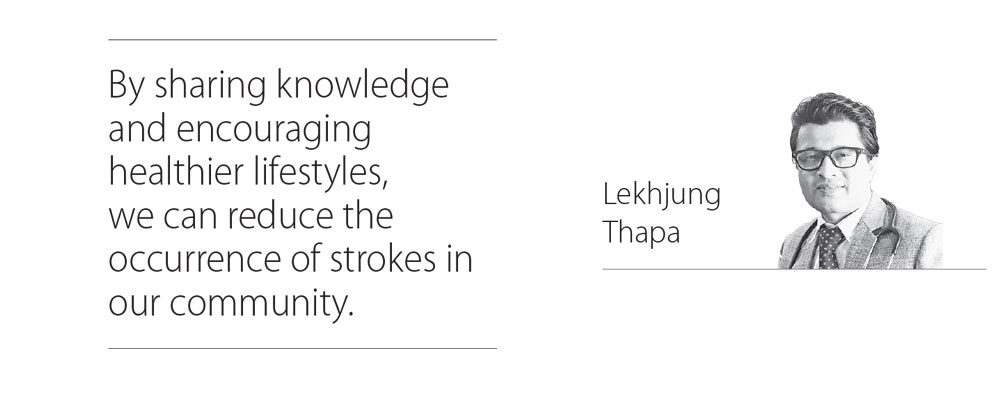
On World Stroke Day, let us join our efforts to raise awareness, educate our communities, and lobby for legislation that support stroke prevention, cure, and rehabilitation. By sharing knowledge and encouraging healthier lifestyles, we can reduce the occurrence of strokes in our community. When strokes do occur, prompt medical intervention and support for survivors can make a significant impact.
The key stakeholders like governments, Nepal Stroke Association, medical experts, non-profit groups, and the media all play important roles in this global endeavour. We can tackle the quiet menace of strokes and save lives if we work together.
Let us not just observe but also act on World Stroke Day. Every one of us can help make a stroke-free world a reality. We can empower individuals to take control of their health and lessen the impact of strokes on individuals, families, and communities by working together. Avoiding strokes is a worldwide need that requires our immediate response.
(The author, a senior consultant neurologist, is the Director of National Neuro Centre, Kathmandu.)